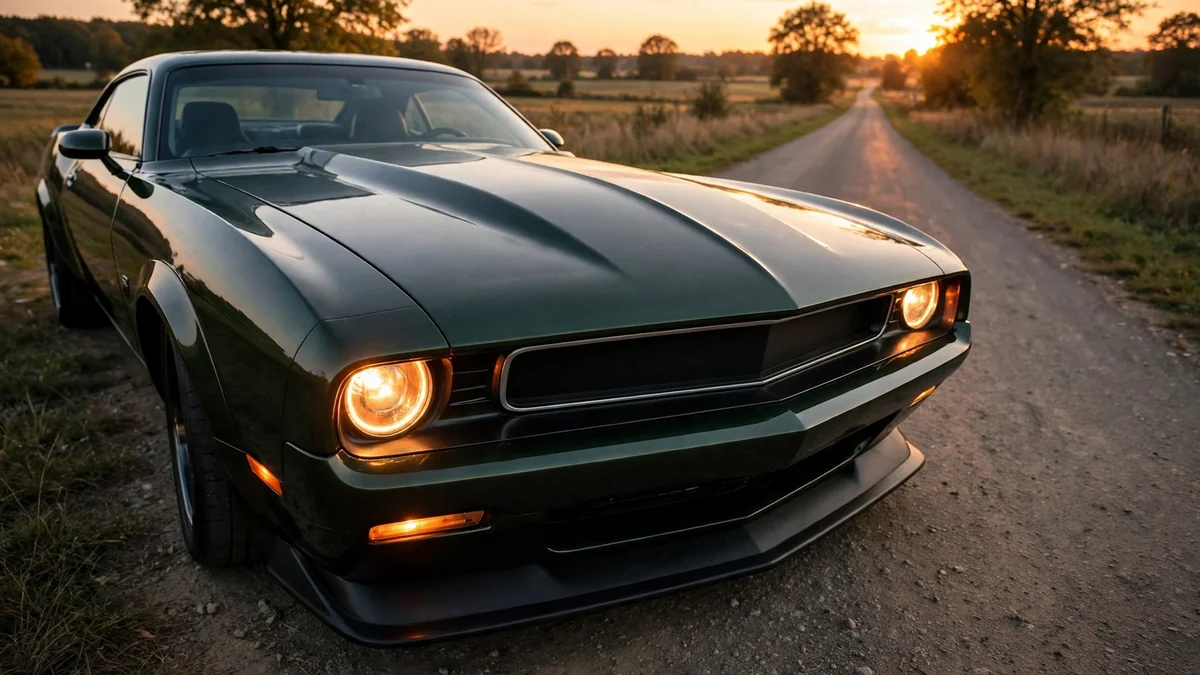
The light is going down over a country road when the engine catches, and the whole car seems to clear its throat. It is not a polite sound. It is a deep, uneven rumble that you feel in your chest before you hear it properly, and it is the first thing anyone remembers about a muscle car.
A luxury muscle car takes that old idea, a huge engine in a simple body, and finishes it to the standard of a grand tourer, with leather, silence at speed and brakes that match the power. This is how a luxury muscle car works, from the first turn of the key to a hundred miles an hour.
Step 1: The V8 breathes in air and fuel
It starts with air. When you press the accelerator, the throttle opens and air rushes through the intake, past the filter and into the intake manifold, a set of passages that divides the air evenly between the eight cylinders. Fuel injectors spray a fine mist of petrol into that air just before it enters each cylinder, and the mixture has to be exactly right, because too much fuel wastes power and too little makes the engine stumble.
The size of the engine is the point. A luxury muscle car typically carries a V8 of five to six litres, which means each cylinder swallows a large gulp of air and fuel on every cycle. A smaller engine can be made to rev higher, but it cannot fake the low-down shove of a big V8.
Step 2: The cylinders fire in sequence
Inside each cylinder, a piston slides up and squeezes the air and fuel mixture into a small space, and then the spark plug fires. The mixture explodes, not with a bang but with a fast, controlled burn, and the pressure pushes the piston down with enormous force. Eight cylinders fire in a carefully chosen order, one after another, so the crankshaft below them is always being pushed and never has to wait for the next shove.
The crankshaft turns that up-and-down motion into rotation, and a heavy flywheel smooths out the pulses between firings. The uneven rumble a muscle car makes is no accident: it comes from the firing order and the way the exhaust pulses from the two banks of the V8 arrive at the tailpipes slightly out of step.
Step 3: The gearbox turns revs into speed
The engine spins fast, but the wheels turn slowly, so a gearbox sits between them. In a luxury muscle car it is usually a six-speed manual or an eight-speed automatic, and its job is to keep the engine in the rev range where it makes the most power. In first gear, the engine can spin many times for each turn of the wheels, which gives the huge shove off the line; in top gear, the engine turns slowly while the car cruises quietly at speed.
The automatic in a modern luxury muscle car is smarter than the driver about shifting. It watches the throttle, the road speed and the engine load, and it changes gear in a fraction of a second, faster than any human hand. The way the gearbox and the engine are matched is laid out in the guide to the best V12 engines ever built, where the same matching of engine character to gearbox decides how a car feels.
Step 4: Power reaches the rear wheels
From the gearbox, power travels down a driveshaft to the rear axle, and the differential there splits it between the two rear wheels while letting them turn at different speeds around a corner. A luxury muscle car uses a limited-slip differential, which is the clever part: if one wheel starts to spin on a slippery patch, the differential sends more power to the wheel that still has grip, instead of letting the spinning wheel take it all.
The rear tyres are wide for a reason, because all of that torque has to reach the road through two patches of rubber no bigger than a hand each. Traction control watches the wheels many times a second and gently cuts power or brakes a spinning wheel before the driver even notices, and it can be switched off by drivers who want the car to slide.

Step 5: Suspension, steering and brakes keep it civilised
Power is only half the story. A luxury muscle car weighs close to two tonnes, and it has to ride like a grand tourer, so the suspension uses adaptive dampers that stiffen in a corner and soften on a rough road, changing their behaviour many times a second.
The brakes have the hardest job of all, because stopping two tonnes from high speed takes enormous energy. Big ventilated discs and multi-piston callipers do the work, and the same thinking that ranks the finest stopping hardware is described in the guide to the best hypercar brakes ranked, where the brakes are sized to the power of the car rather than its price.
Step 6: The cabin turns noise into theatre
Inside, the luxury muscle car does something clever: it lets the driver hear the engine and keeps everyone else comfortable. Sound insulation in the floor and doors damps the tyre roar, while a tuned exhaust note is piped into the cabin through valves that open when the driver asks for more.
On the road, all of it comes together in a particular rhythm: the rumble at idle, the shove as the throttle opens, the gearbox shifting, and the long, easy cruise that follows. The build that makes that possible is described in the guide to how a luxury muscle car is made, where the body, the engine and the cabin are put together as one piece of engineering rather than three separate jobs.
The spec sheet at a glance
| Specification | Typical luxury figure |
|---|---|
| Engine | 5.0 to 6.2 litre V8, naturally aspirated or supercharged |
| Power | 450 to 700 horsepower |
| Torque | 550 to 850 newton-metres |
| Gearbox | Six-speed manual or eight-speed automatic |
| Drive | Rear-wheel drive, limited-slip differential |
| 0 to 100 km/h | 3.8 to 4.5 seconds |
| Top speed | 250 to 290 km/h, often limited |
| Weight | 1,750 to 1,950 kilograms |
| Brakes | Ventilated discs, six-piston front callipers |
| Suspension | Adaptive dampers, independent front and rear |
| Fuel economy | 12 to 15 litres per 100 kilometres combined |
| Exhaust | Active valves, switchable quiet and loud modes |

What it costs, and a rare fact
A luxury muscle car costs an estimated $70,000 to $130,000, depending on the engine, the gearbox and how far the interior is taken towards grand tourer comfort, with supercharged flagship versions costing more.
Here is the rare fact the brochure never mentions. The famous muscle car rumble is partly an accident of plumbing: the exhaust pipes from the two banks of the V8 are different lengths, so the sound pulses arrive at the tailpipe out of step and interfere with each other, and engineers discovered that owners loved the result so much that later cars were tuned to keep it. The sound of a muscle car is, in other words, a design flaw that became a trademark.