It is smaller than a phone, lighter than a wallet, and it holds a lifetime of photographs. You drop it in a bag, carry it through an airport, plug it into a laptop in a hotel room, and in a few seconds a whole film project moves across the cable. Nobody thinks about what is inside that small metal case, until it is the only copy of something that cannot be shot again.
A luxury portable SSD is a hard drive with no moving parts, built for speed, toughness and quiet reliability. Inside a sealed metal shell sits a circuit board covered in memory chips, a controller that manages every file, and a fast port that talks to your computer. Making one means packing all of that into a case that can survive a fall onto concrete, a splash of rain and a hot summer day in a bag.

How It’s Made
Step 1: Making the memory chips
Every SSD starts in a chip factory, where silicon wafers are turned into NAND flash memory. The wafers are printed in layers, etched with circuits far smaller than a human hair, and cut into individual chips, each one able to store billions of bits. The chips are tested one by one, and only the fastest and most reliable are chosen for a luxury drive.
The memory in a luxury SSD is usually a fast, durable type that can be written to many thousands of times without wearing out. That sorting is one of the reasons a luxury SSD costs more, and why it keeps working after years of daily use.
Step 2: Building the controller and circuit board
The memory chips are useless without a controller, a small chip that acts as the brain of the drive. It decides where each file is stored, spreads the work evenly across the chips so none of them wears out early, and corrects errors before they can corrupt a photograph or a document. The controller is fitted to a tiny circuit board along with the memory chips, a cache chip and the port connector.
The board is built by machines that place components with pinpoint accuracy, then soldered in a hot oven that melts the solder on every joint at once. Each board is inspected under a camera and tested electrically, because a single bad joint can mean a drive that fails without warning. The same care with a small, precise board appears in other luxury gadgets, and the way a luxury mesh router is made shows how a tiny circuit board can carry a whole network.
Step 3: Fitting the fast connection
A luxury SSD is only as fast as its connection to the computer. The builders fit a modern USB-C port, usually with a fast standard that can move several gigabytes per second, and a cable that matches it. The port is soldered firmly to the board and reinforced, because it will be plugged and unplugged thousands of times, often by someone in a hurry.
The firmware, the software inside the drive, is loaded at this stage. It tells the controller how to talk to the computer, how to encrypt the data if the owner turns that on, and how to report the health of the drive. The drive is then plugged into a test computer and filled with data, read back and checked, to prove that every chip and every connection works at full speed.

Step 4: Sealing the metal case
The case of a luxury portable SSD is usually milled from a single block of aluminium, a slow and expensive process that leaves no seams for dust or water to enter. The metal is anodised, giving it a hard, coloured surface that resists scratches, and the inside is lined with a thin layer that cushions the board against shocks. The case is both a shield and a heat sink, pulling warmth away from the chips during a long transfer.
Some luxury models add a rubber bumper around the edge, or a case that is sealed against dust and water. The board is fitted into the case, the lid is closed with screws or a strong adhesive, and the whole drive is checked for rattles. The way a luxury portable SSD is specified shows how those details are listed, from the size and weight to the speed and the protection rating.
Step 5: Testing for drops, water and heat
Before a luxury SSD is sold, it is tested the way a traveller will treat it. Sample drives are dropped onto concrete from shoulder height, left in a freezer, baked in a hot room, and splashed with water, then plugged in to see if they still work. The makers also run them for days at full speed, copying huge files again and again, to check that they do not slow down or overheat.
The goal is a drive that survives the accidents of real life, because the data inside is often worth far more than the drive itself. The same idea of testing a small machine until it breaks, then making it stronger, turns up across luxury technology, and the way a luxury robot pool cleaner is made shows a machine built to keep working in water, day after day.
Step 6: Packing, encrypting and shipping
The finished drives are formatted, given a final speed test, and packed with a cable and a short guide. Many luxury models offer hardware encryption, so the data is locked with a password and cannot be read if the drive is lost or stolen. The owner sets the password on first use, and the drive warns clearly that there is no way back in if the password is forgotten.
A luxury portable SSD looks simple from the outside, a smooth metal rectangle with a single port, but inside it is a stack of carefully sorted memory, a smart controller and a case engineered to protect them both, built to carry your work safely wherever you go.
| Specification | Typical luxury portable SSD |
|---|---|
| Capacity | 1 TB to 4 TB, with larger models available |
| Read speed | Up to about 1,000 to 2,000 MB per second |
| Write speed | Up to about 1,000 to 2,000 MB per second |
| Connection | USB-C, with a fast cable included |
| Case | Milled aluminium, often with a rubber bumper |
| Protection | Drop resistant, often dust and water resistant |
| Security | Hardware encryption with a user password |
| Weight | About 50 to 100 grams |
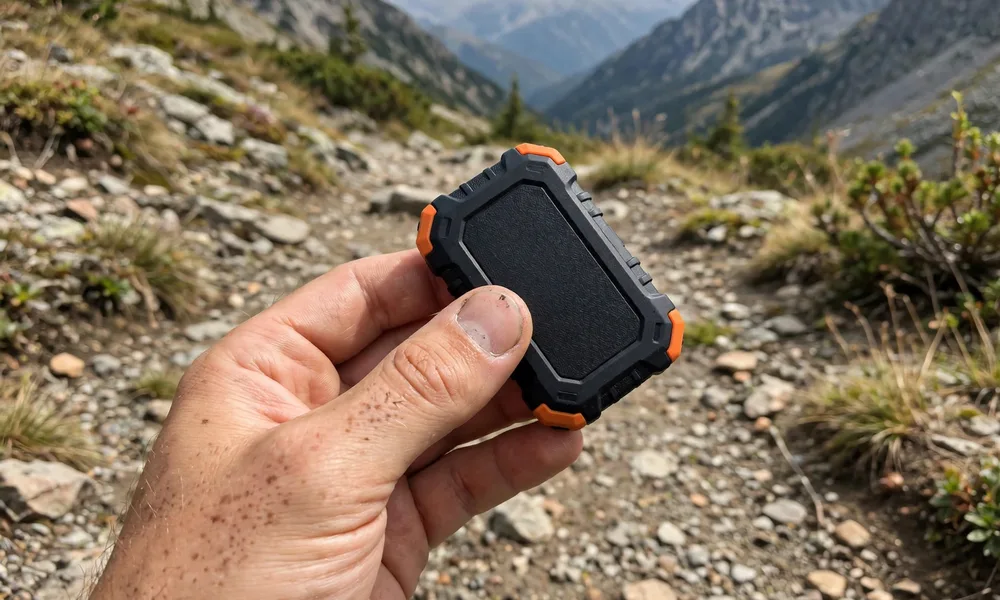
A luxury portable SSD is an estimate of $150 to $500, depending on the capacity, the speed and the toughness of the case. A 1 TB model sits at the lower end, while a 4 TB model with the fastest connection and the strongest protection sits at the top. It is far more than a cheap flash drive, but it is also far faster and far harder to break.
Here is a rare fact worth knowing. An SSD has no moving parts at all, which means it makes no sound and it does not care if you move it while it is working. An old spinning hard drive could be damaged by a small bump while it was reading, because the head floated a hair above a spinning disc. The first portable SSDs were sold to photographers and film crews working in rough places, and the silence of a drive with nothing spinning inside was the sound of a new kind of storage.


