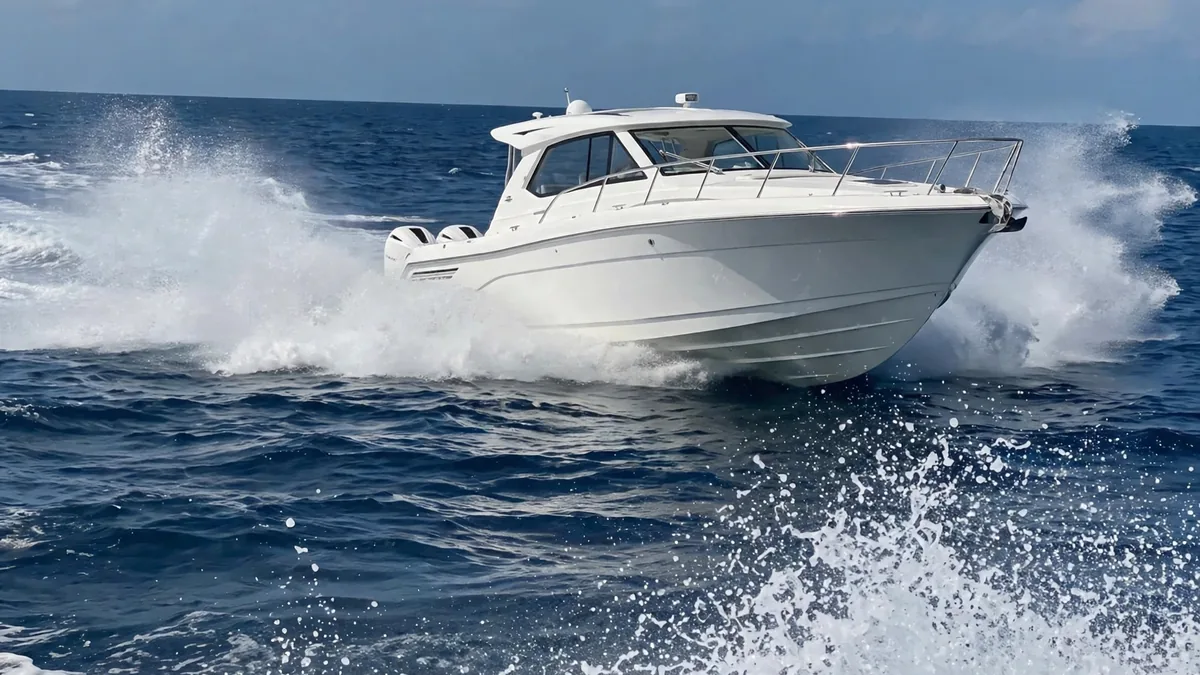
Out on the open water, a powerboat is doing something that still feels slightly impossible. The hull is barely touching the sea, the bow is up, and a white sheet of spray is peeling away on both sides. Inside, the driver is standing at the wheel in the wind, one hand steady, watching the horizon. Behind him, the passengers are laughing rather than holding on. The boat is going fast, but it feels calm, almost gentle.
A powerboat is not a speedboat with a different badge, and it is not a yacht with the sails left off. This is how a luxury powerboat works, from the waterline to the throttle, and from the fuel tank to the propeller.
Step 1: The hull lifts the boat out of the water
Everything starts with the shape of the hull. Less hull in the water means less drag, and less drag means more speed for the same power. Steps are cut into the bottom of the hull, small ledges that break the suction of the water and let air under the boat. The closest cousin to this hull shape is the speedboat, and the guide to how a luxury speedboat works explains the same planing trick in its purest form. The stepped hull is inspected for stress cracks around the steps every season, because a crack there will let water into the foam core.
Step 2: Engines turn fuel into thrust
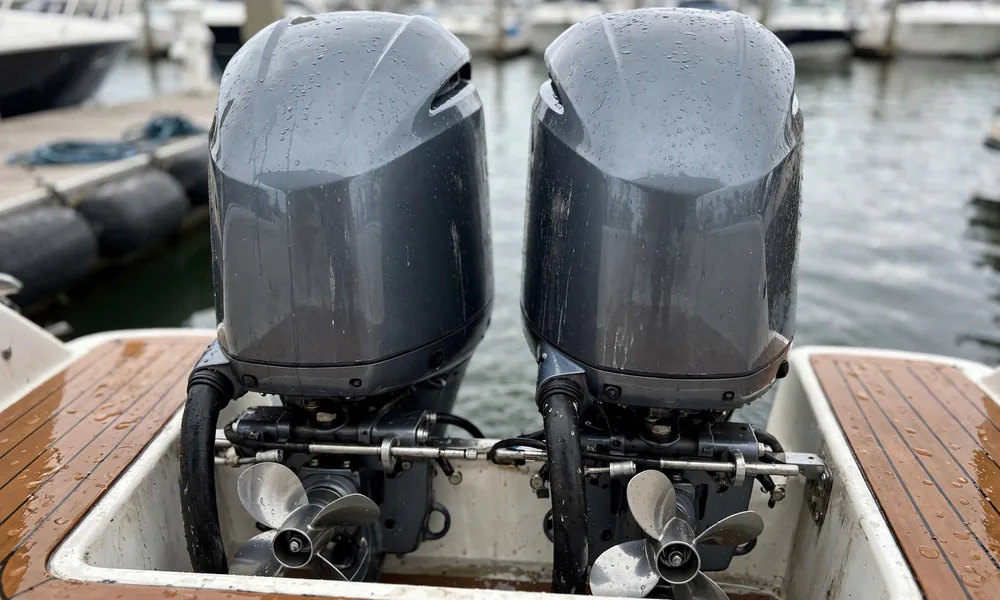
The power usually comes from two or three outboard engines on the transom, or from inboard engines driving stern drives, with a combined output of 600 to 1,500 horsepower. Outboards are popular because they can be tilted out of the water, serviced easily and replaced without opening the hull, and because three smaller engines give the boat a spare if one fails. The engines burn petrol or diesel, breathe through intakes above the deck, and cool themselves with seawater pumped through the block. The fuel filters are drained of water before every trip, because a slug of water in the fuel will stop an engine dead at full throttle.
Step 3: Propellers and stern drives push the boat
The engines’ power reaches the water through propellers, and the choice of propeller decides how the boat behaves. A propeller with a steep pitch gives top speed on flat water, while a flatter pitch gives acceleration and pulling power in a chop. Others use surface-piercing propellers, which run half in and half out of the water at speed, cutting drag and adding knots. The propellers are removed and greased at every service, so they never seize onto the shafts and have to be cut off.
Step 4: The helm, throttles and trim
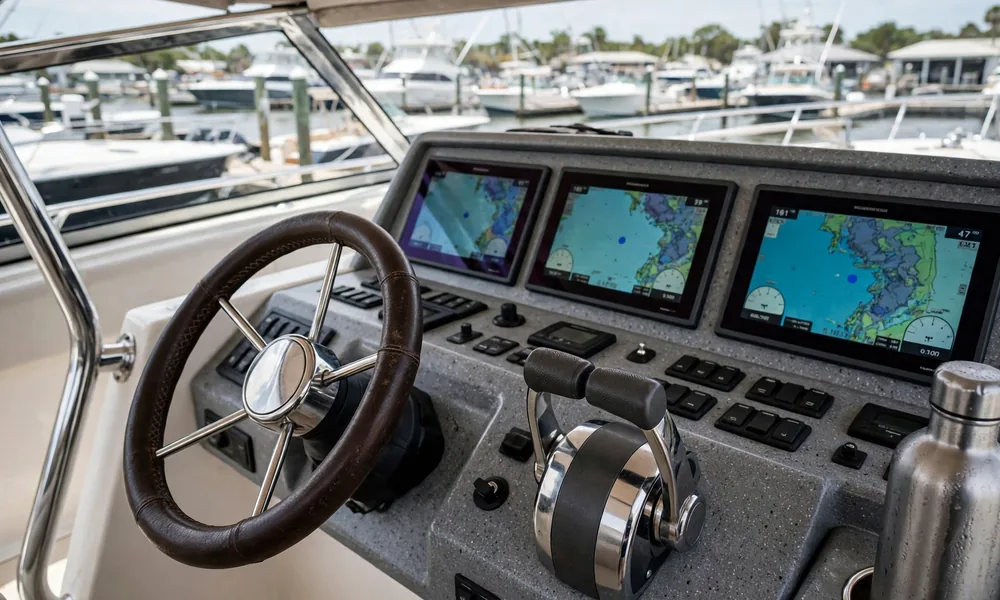
The helm of a luxury powerboat is built for a standing driver. A joystick option lets the driver move the boat sideways in a marina, the computer mixing the engines and the bow thruster together. The open layout of the helm owes something to the centre console boats, and the guide to how a luxury center console boat works shows the same driving position in a fishing boat. The kill cord is tested before every trip, because a cord that does not stop the engines is worse than no cord at all.
Step 5: Trim tabs and the ride in a chop
A powerboat at speed is a balancing act, and trim tabs do much of the balancing. When they are wrong, the boat porpoises, bouncing bow-up and bow-down, and the driver has to back off the throttle and start again. The numbers behind the ride are worth knowing before you buy, and the luxury speedboat specs explained guide sets out what the power, weight and hull figures really mean. The bilge pump is tested by pouring a bucket of water into the bilge, because a pump that has never been tested is a pump that cannot be trusted.
Step 6: Fuel, cooling and safety below deck
Below the deck, a luxury powerboat carries the systems that keep it running and keep its crew safe. Fuel tanks sit low in the hull with filters and water separators, and the fuel lines run through fireproof sleeves. Bilge pumps sit at the lowest point of the hull and switch on automatically if water gets in. The fire system in the engine bay is weighed every year, because a bottle that has lost pressure will not put out a fire when it matters.
The spec sheet at a glance
| Specification | Typical luxury figure | What it tells you |
|---|---|---|
| Length overall | 8–13 m (26–42 ft) | How big the boat is |
| Engines | 2–3 × 300–500 hp outboards | How much power it carries |
| Top speed | 45–65 knots | How fast it can go |
| Cruising speed | 30–40 knots | Its comfortable passage speed |
| Fuel capacity | 600–1,500 litres | How far it can travel |
| Passengers | 8–12 | How many it carries |
| Hull | Deep-V fibreglass, stepped | How it cuts through waves |
| Weight | 4,000–8,000 kg | How heavy it is to tow and launch |
| Draft | 0.6–0.9 m | How shallow it can run |
Keeping it in good shape
A luxury powerboat lasts longest when it is flushed, dried and covered after every run. Flush the engines with fresh water so salt does not eat the cooling passages, and wash the salt off the hull, the deck and the upholstery before it dries into a crust. Check the propellers for nicks after every trip through shallow water, and have the engines serviced on their hours, with the oil, the filters and the impellers changed on schedule. Keep the fuel tanks full when the boat is laid up, so condensation cannot form, and store the boat under cover, out of the sun, with the batteries on charge. A powerboat that is flushed, washed and serviced on time will still lift onto the plane cleanly after years of hard use, while a neglected one will start to porpoise, overheat and drink fuel.
What it costs
A luxury powerboat typically costs an estimated $300,000 to $1.2 million, depending on length, engines and finish. The estimate covers the boat alone, not the trailer, the berth, the fuel or the insurance. Running costs are steep as well, with fuel at full throttle measured in hundreds of litres an hour, and the engines needing service after every season of hard use.
A rare fact
One detail few passengers ever learn is that a powerboat’s propellers can be worth more than a small car. Racing teams carry spare sets in padded cases, and a propeller is never repaired by an amateur: it goes back to a specialist who measures every blade and restores the exact shape. Some owners keep a spare set on board, because a damaged propeller in a remote anchorage can end a holiday.
A luxury powerboat works by refusing to push water out of the way. The deep-V hull cuts through it, the steps lift the boat clear of it, and the engines turn it into speed. The helm, the trim tabs and the propellers are what keep that speed under control, and the systems below deck are what keep it safe. The boat is not trying to be a yacht, and it is not trying to be a ship.