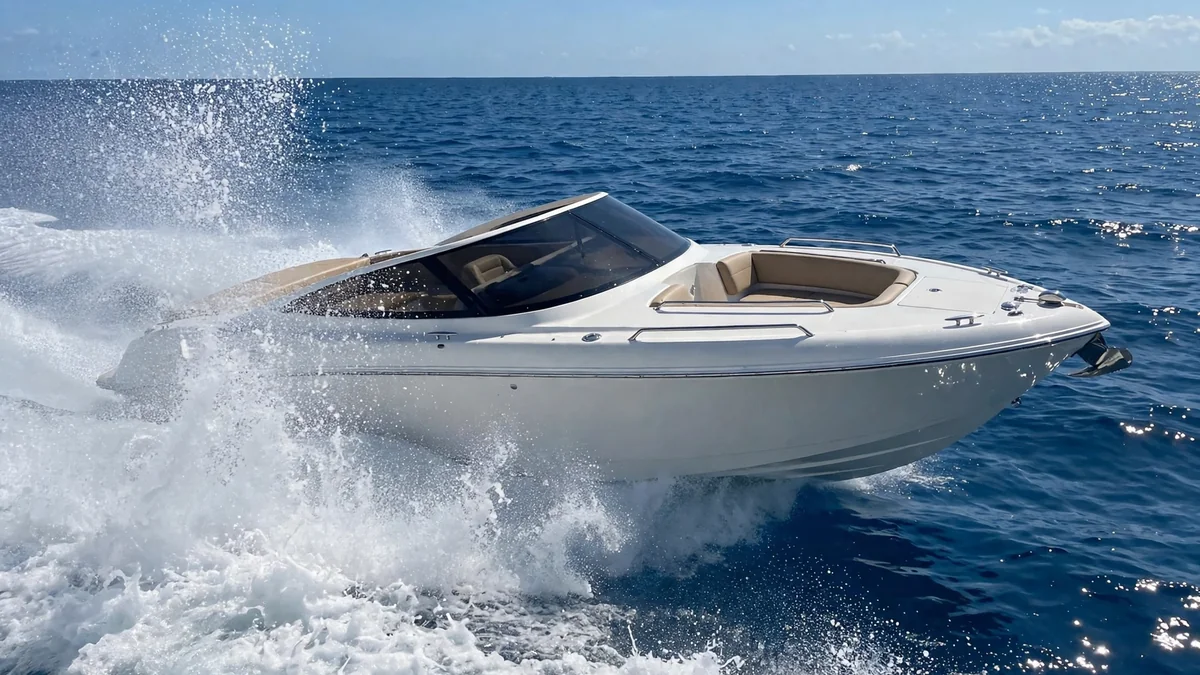
Out on the open water, a speedboat is doing something that still feels slightly impossible. The hull is barely touching the sea, the bow is up, and a white sheet of spray is peeling away on both sides. Inside, the driver is standing at the wheel in the wind, one hand steady, watching the horizon. Behind him, the passengers are laughing rather than holding on. The boat is going fast, but it feels calm, almost gentle.
That is the luxury speedboat, a machine that turns a thousand horsepower into a smooth ride across water that would beat a smaller boat to pieces. It is a careful balance of hull shape, engine power and control. This is how a luxury speedboat works, from the waterline to the throttle.
Step 1: The hull lifts the boat out of the water
Everything starts with the shape of the hull. A luxury speedboat uses a deep-V hull, a sharp wedge that cuts through waves instead of slamming into them, and as the speed rises the hull begins to plane, lifting most of its weight out of the water so that only a small part of the hull is still touching the sea. Less hull in the water means less drag, and less drag means more speed for the same power.
The hull is built from fibreglass laid up by hand in a mould, layer after layer of cloth and resin, with a foam or balsa core in the middle to make it stiff without making it heavy. Steps are cut into the bottom of the hull, small ledges that let air slip underneath and reduce the grip of the water still further. A well-shaped hull can feel soft over waves that would rattle the teeth out of a flat-bottomed boat.
Step 2: The engines make the power
Behind the hull, the power usually comes from two or three large outboard engines hung on the transom, or from inboard engines buried in the hull. A luxury speedboat can carry more than a thousand horsepower in total, and each engine is a marine V8, built to run at high revs for hours in salt air, cooled by seawater pumped through its block.
The engines are mounted high and tight, and their exhausts run through the water to keep the noise down. The driver controls them all from a single set of throttles, and the engines answer together, which is why a speedboat can go from a gentle cruise to full speed in a few seconds. The layout is the same thinking found in a superyacht engine room, where big engines, careful cooling and clean installation matter more than raw power alone.
Step 3: The propellers turn power into thrust
From the engines, power reaches the propellers, and the propeller is where the speed is really made. A luxury speedboat uses large stainless steel propellers with three or four blades, shaped to grip the water without slipping and to stay efficient as the boat climbs onto the plane. The blades are polished to a mirror finish, because a rough blade wastes power in turbulence.
Trim is the secret the passengers never notice. By tilting the engines up or down, the driver changes the angle of the propellers and the attitude of the hull, lifting the bow in calm water for speed or dropping it in a chop for comfort. The yacht propeller spec sheet explains how blade shape, diameter and pitch decide how much of the engine’s power actually becomes forward motion.
Step 4: The helm and the electronics keep control
At the helm, the driver stands or sits behind a wheel that feels more like a car’s than a boat’s, because modern steering is hydraulic or electronic rather than a simple cable. A turn of the wheel moves the engines together, and the boat leans into the turn the way a motorcycle leans into a bend.
The screens at the helm show speed, engine revs, fuel, water depth and a chart of the coast, and a joystick can take over at low speed, moving the boat sideways into a berth with a nudge. GPS and autopilot can hold a course across open water, leaving the driver to watch for other boats rather than steering every second.

Step 5: The hull, the seating and the systems work together
While the engines do the shouting, the rest of the boat does the quiet work. The deck is laid with teak or synthetic planking that grips wet feet, the seats are bolstered so passengers can stand or sit as the sea demands, and the windscreen is shaped to throw the spray aside rather than into the cockpit.
Below deck there is a small cabin with a berth, a head and storage, and the fuel tanks sit low in the hull to keep the centre of gravity down. The bilge pumps, the batteries and the fire extinguishers are all within reach, because a boat that goes this fast must be able to look after itself far from shore.
Step 6: Anchoring, docking and coming home
A speedboat spends much of its life going slowly, and the slow work matters as much as the fast work. Coming into a marina, the driver drops the revs, trims the engines down and uses the joystick or the throttles to walk the boat sideways into its berth. Fenders go over the side, lines are made fast, and the boat settles against the pontoon.
At anchor, the windlass drops the anchor and chain, and the boat swings gently on the tide. The yacht anchor system does the same job on a bigger scale, holding a vessel steady while its crew swims, eats and sleeps. When the day is done, the engines are flushed with fresh water, the covers go on, and the boat waits for the next clear morning.
The spec sheet at a glance
| Specification | Typical luxury figure |
|---|---|
| Length | 10 to 13 metres |
| Engines | Two or three outboards, up to 1,200 hp total |
| Top speed | 90 to 110 kilometres an hour |
| Cruising speed | 55 to 70 kilometres an hour |
| Hull | Deep-V fibreglass, stepped bottom |
| Propellers | Stainless steel, three or four blades |
| Fuel tank | 800 to 1,200 litres |
| Range | 300 to 450 kilometres |
| Seating | 8 to 12 people, bolstered seats |
| Steering | Hydraulic or electronic, joystick docking |
| Electronics | GPS, chart plotter, depth sounder, autopilot |
| Weight | 5 to 8 tonnes |

What she costs, and a rare fact
A luxury speedboat costs an estimated $400,000 to $1,200,000, depending on the length, the engines and the finish, with the largest triple-engine models costing more. The running costs matter too: fuel, berthing and servicing can add tens of thousands of dollars a year.
Here is the rare fact the spec sheet never mentions. A stepped hull can go faster with the same engines because the steps let air slip under the hull and break the suction of the water, and the idea came from racing seaplanes more than a century ago, when designers noticed that a hull with steps lifted clear of the water far sooner than a smooth one. The fastest boats on the water still ride on an idea first drawn for aircraft.