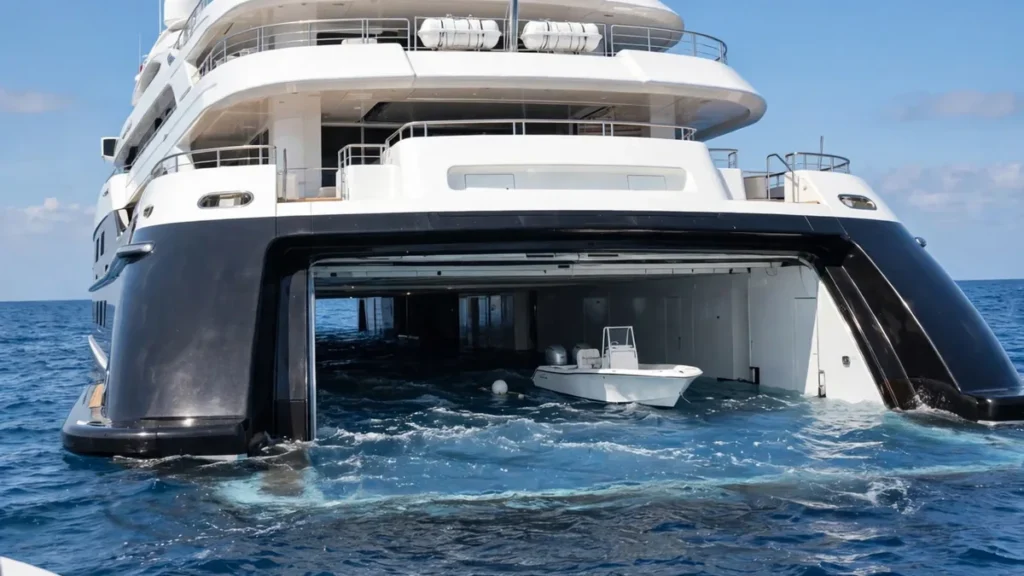
The strangest sight in a superyacht marina is a yacht that can sink on purpose. A semi-submersible yacht arrives looking like any other large white vessel, all clean lines and tinted glass. Then the crew opens valves, seawater floods into ballast tanks deep in the hull, and the whole boat settles lower in the water until its main deck is awash. A smaller boat, a submarine or a fleet of tenders simply floats on, and the big yacht carries them away like a ferry.
Building a vessel that floods itself safely, on command, is one of the hardest jobs in yacht construction. The hull must be strong enough to carry hundreds of tonnes on its deck, the ballast system must never fail in the wrong direction, and the luxury accommodation above must stay dry, quiet and comfortable while the machinery below does something no ordinary yacht would ever dare to do.
This is how a luxury semi-submersible yacht is made, from the first steel plate to the day the deck dips beneath the waves for the first time.

How It’s Made
Step 1: Designing a yacht that floods itself
Before any steel is cut, the yacht lives inside a computer. Naval architects model the hull, the ballast tanks and the deck load, then run thousands of simulated floods through the design. The key question is stability at every stage of the submersion: the boat must stay level as it sinks, rise level as it floats again, and never pass the point where it cannot come back up.
The team settles the tank layout early because everything else hangs off it. Tanks must be spread so the yacht sinks evenly, and the pumps must be able to empty them faster than the sea can refill them. Scale models in a test tank confirm the numbers, and only then does the yard order the steel. The semi-submersible yacht in operation shows what this design has to do at sea, and the contrast explains why the build is closer to a small cargo ship than to a normal yacht.
Step 2: Building the steel hull
The hull is built from marine-grade steel plate, cut by computer-controlled machines and welded in sections inside a dry dock. Unlike a fibreglass yacht hull, which is lifted from a mould, a steel hull is assembled piece by piece: frames first, then plates, then the double bottom that forms the ballast tanks.
The work is heavy and slow. Every weld is inspected, many with ultrasound, because a failed weld in a ballast tank is not a leak to be mopped up but a threat to the whole operation. Once the hull sections are joined, the steel is blasted clean and coated with a multi-layer paint system that must survive years of salt water, including long periods fully submerged.
Step 3: Installing the ballast system
The ballast system is the heart of the boat. Huge tanks run along the bottom and sides of the hull, connected by pipes the width of a man’s torso, with valves, pumps and sensors at every junction. Flooding is done by gravity, opening valves and letting the sea in, while de-ballasting uses powerful pumps to push the water back out.
Step 4: Fitting the deck and cargo systems
With the hull watertight, the crew builds the main deck, a flat steel expanse strong enough to carry a smaller yacht, a submarine or several tenders. The deck is fitted with rails, lashing points and adjustable cradles, and its surface is coated with a non-slip finish that must grip even when wet.
Above the deck, the superstructure rises: the bridge, the crew quarters and the guest accommodation. Cranes are mounted to lift tenders and toys aboard, and the deck is tested by loading it with water bags and concrete blocks until it carries the full design weight. The luxury submarine build shows what one of the most demanding deck cargoes looks like from the inside, and why the cradles must fit it to the centimetre.
Step 5: Engines, power and control
A semi-submersible yacht needs serious power. Diesel-electric propulsion is common, with generators feeding electric motors that drive the propellers, and bow thrusters that let the huge hull hold station while a tender floats aboard. The electrical load is enormous, because the ballast pumps alone can draw as much power as a small town.
The control system ties it all together. Sensors report the level in every tank, the trim of the hull and the load on the deck, and the software presents it as a single picture on the bridge. The crew trains on a simulator before the boat is finished, because a real submersion is not the moment to learn where a valve is.

Step 6: The luxury accommodation
Above the working deck, the yacht is pure luxury. The guest suites sit high in the superstructure, with panoramic windows, pale wood, cream upholstery and bathrooms finished in stone. A saloon, a dining room and an open sun deck give guests somewhere to watch the strange spectacle of their own tender floating aboard.
Soundproofing matters more here than on a normal yacht, because the ballast pumps and generators sit directly below the cabins. Floating floors, acoustic insulation and careful routing of pipes keep the suites quiet, and every fitting is weighed, because a heavy superstructure raises the centre of gravity and makes the submersion harder to control.
Step 7: Flooding trials and handover
The first flood is done in calm water, with the yard’s engineers aboard and a rescue boat standing by. Valves open, the deck settles, and the team watches the trim gauges for any sign of a list. Then the pumps start, the deck rises, and the yacht floats free again. The cycle is repeated dozens of times, with different loads on deck, until the crew can run it in their sleep.
Only then does the yacht take on its first real cargo. The submarine specifications explain the sizes and weights the deck cradles must handle, from a small submersible to a full tender fleet, and why the trial numbers matter more on this yacht than on any other.
| Specification | Typical figure |
|---|---|
| Length overall | 60 to 120 metres |
| Beam | 18 to 28 metres |
| Hull material | Marine-grade steel, coated |
| Deck cargo capacity | 500 to 2,000 tonnes |
| Submersion depth | Deck 2 to 5 metres below the surface |
| Guests and crew | 10 to 16 guests, 20 to 30 crew |
| Build time | 24 to 36 months |
How much does one cost?
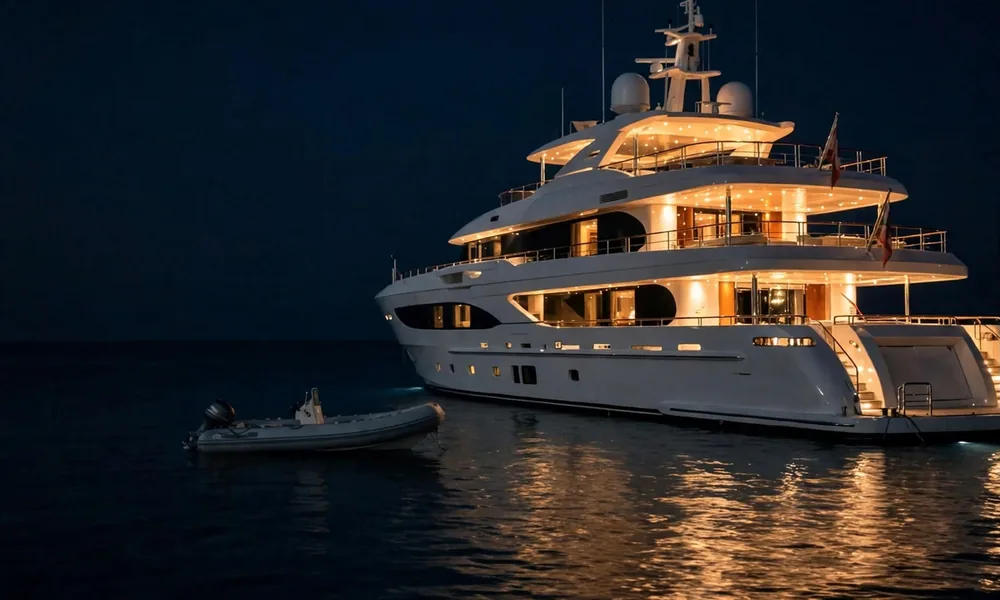
A luxury semi-submersible yacht is priced like a small ship, because that is what it is. As an estimate, a new 80-metre example costs roughly 80 to 150 million dollars, with the steel hull, ballast system and deck machinery accounting for much of that figure. Larger or more luxurious versions can be estimated well past 200 million dollars.
Owners accept that because no other yacht can carry a submarine, a fleet of tenders and a seaplane, and then set them all afloat again in the middle of nowhere.
A rare fact
Here is something few people know: the semi-submersible idea began with oil rigs and heavy cargo ships, not yachts, and the first vessels to sink their own decks were built to move drilling platforms across oceans. Yacht designers borrowed the trick almost unchanged, and the ballast calculations for a luxury semi-submersible yacht still use the same naval architecture as a ship carrying a 10,000-tonne oil rig.
The result is a yacht that can do something no other luxury vessel can: disappear halfway under the sea, swallow another boat whole, and rise again as if nothing happened.