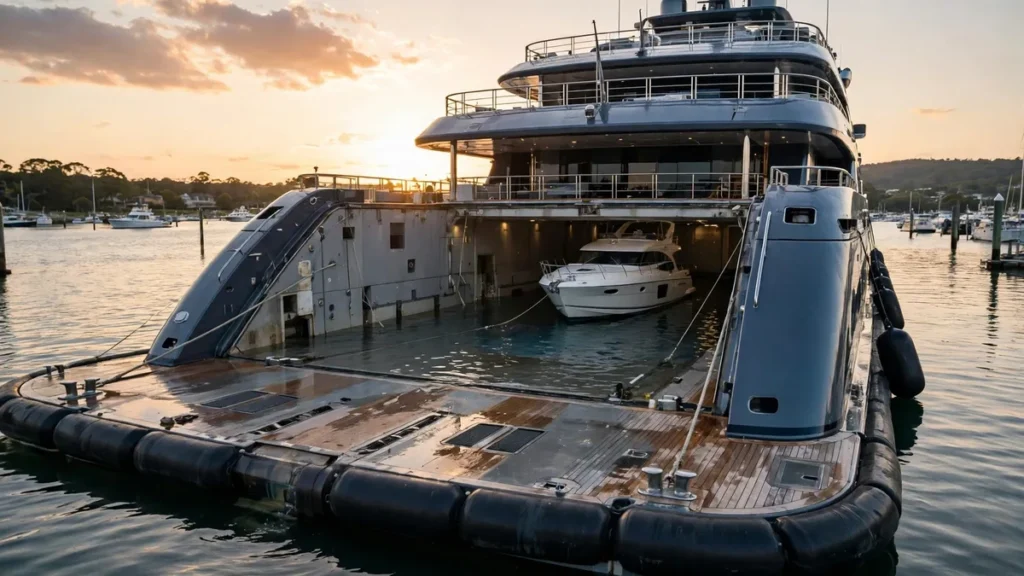
The yacht in the harbour looked broken. Its wide deck sat low in the water, almost level with the waves, and the crew were standing in water up to their ankles, calm as anything, while a smaller boat floated slowly over the deck and settled into place.
A luxury semi-submersible yacht is not really a yacht at all, at least not in the usual sense. It is a heavy-lift ship dressed in luxury, a vessel that can sink its own deck on purpose, float another boat on board, and then rise again and carry it like a parcel. The spec sheet is where that strange trick is explained, in numbers about ballast, deck load, depth and speed.
This guide translates every number on a luxury semi-submersible yacht spec sheet into plain English, from the ballast system and the deck to the engines, the range and the crew who run it all.

How to Read a Luxury Semi-Submersible Yacht Spec Sheet
Ballast system: how the deck sinks on purpose
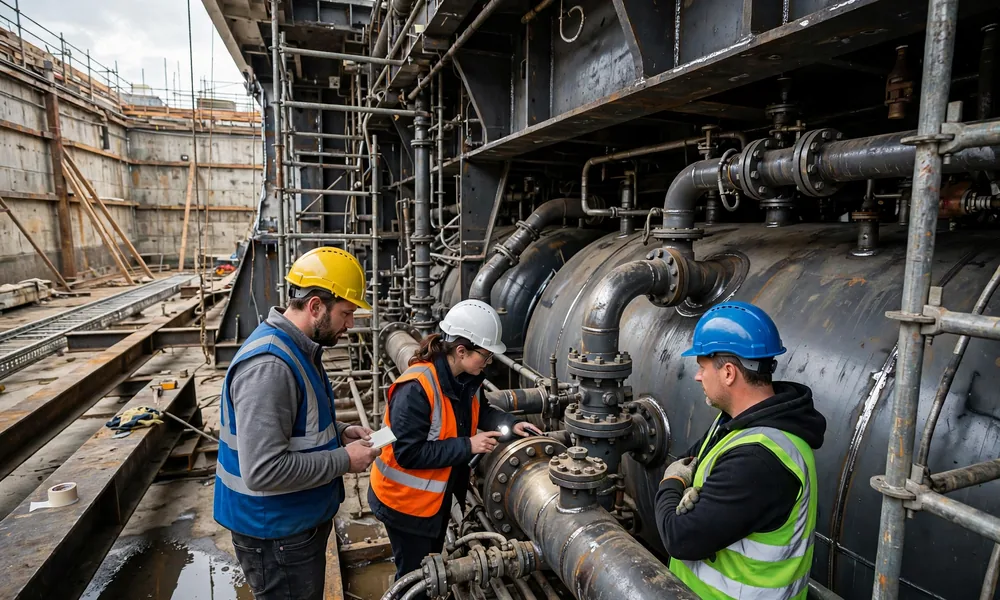
The ballast system is the first number on the sheet, and the most important, because it is what makes the whole vessel work. A luxury semi-submersible yacht usually carries ballast tanks holding about 5,000 to 15,000 tonnes of seawater, and by flooding those tanks the ship can lower its main deck by about 10 to 16 metres, until the deck is several metres under the water. How the tanks, the pumps and the steel are built is a craft of its own, as our guide to how a luxury semi-submersible yacht is made explains.
Deck load: how much it can carry
Deck load is the weight the deck can carry, and a luxury semi-submersible yacht usually offers a deck load of about 5,000 to 20,000 tonnes, which is enough for a large sailing yacht, several smaller boats, or a whole collection of tenders, cars and equipment. The deck itself is usually about 100 to 180 metres long and about 40 to 60 metres wide, which is a space bigger than a football pitch, and it is strengthened with heavy steel beams so the load can sit anywhere without bending the ship.
Length, beam and draft: the size of the ship
Length, beam and draft are the three dimensions that describe the ship, and a luxury semi-submersible yacht is usually about 150 to 220 metres long, with a beam of about 40 to 60 metres. Draft is the depth of the hull below the water, and it changes dramatically with the ballast: in normal sailing the draft is about 8 to 10 metres, but when the deck is submerged the draft can reach about 20 to 26 metres, which is why these ships only flood their decks in deep, sheltered water. How the hull, the tanks and the controls work together is a story of its own, as our guide to how a luxury semi-submersible yacht works explains.
Engines and speed: slow, steady and very strong
Engines and speed are the numbers that surprise people most, because a semi-submersible yacht is not fast. It usually has two or four diesel engines making a combined output of about 15,000 to 30,000 kW, and it cruises at about 12 to 15 knots, which is a gentle walking pace for a ship of its size.
Range and fuel: how far it can carry its cargo
Range is the distance the ship can travel without refuelling, and a luxury semi-submersible yacht usually offers a range of about 10,000 to 15,000 nautical miles, which is enough to cross an ocean twice without stopping. The fuel tanks hold about 3,000 to 6,000 tonnes of fuel, and the ship burns about 40 to 80 tonnes a day at cruising speed, which sounds enormous until you remember that it is carrying the weight of a small fleet. The numbers behind the whole machine are worth a look, as our guide to luxury submarine specs, explained shows for another vessel that sinks on purpose.
Crew and guests: who lives aboard
Crew and guests are the last numbers on the sheet, and they show that this is a working ship first and a luxury vessel second. A luxury semi-submersible yacht usually carries a crew of about 20 to 40 people, including the captain, the engineers, the deck crew and the cooks, and it can carry about 10 to 30 guests in comfortable cabins, though the guests are usually the owners and crew of the boats being carried rather than holidaymakers. The accommodation is comfortable but practical, with cabins, a mess room, a small gym and a bridge that looks more like a control room than a lounge.
Luxury Semi-Submersible Yacht Specs
| Specification | Typical range |
|---|---|
| Ballast capacity | About 5,000 to 15,000 tonnes of seawater |
| Deck submersion | About 10 to 16 metres below the surface |
| Deck load | About 5,000 to 20,000 tonnes |
| Deck size | About 100 to 180 metres long, 40 to 60 metres wide |
| Length | About 150 to 220 metres |
| Draft, submerged | About 20 to 26 metres |
| Engine power | About 15,000 to 30,000 kW combined |
| Cruising speed | About 12 to 15 knots |
| Range | About 10,000 to 15,000 nautical miles |
| Crew and guests | About 20 to 40 crew, 10 to 30 guests |
What Does a Luxury Semi-Submersible Yacht Cost?
A luxury semi-submersible yacht typically costs an estimated 100 million to 300 million dollars to build, depending on size, deck load and the quality of the accommodation, with the largest vessels passing an estimated 400 million dollars. Chartering one to move a yacht across an ocean usually costs an estimated 500,000 to 2 million dollars per voyage, depending on distance, the size of the cargo and the season, which is still cheaper than sailing a delicate racing yacht across a rough ocean on its own hull.

A Rare Fact
A semi-submersible yacht can sink its deck so precisely that the water over it is measured in centimetres, and the crew watch the load-out like a landing on an aircraft carrier. The other boat is floated in by tugboats, nudged sideways by lines from the deck crew, and settled onto wooden cradles that were built to match its hull exactly, and the whole operation is done in a swell of less than a metre, because any bigger wave would slam the two hulls together. Once the deck is dry, divers go down to check that every cradle is touching the hull, and only then does the ship get under way, carrying a boat that has never left the water, on a ship that has just come back out of it.
A luxury semi-submersible yacht is a ballast system, a giant deck, a set of strong engines and a crew that can sink a ship on purpose, and the spec sheet is really a description of that balance. The ballast tells you how deep the deck goes, the deck load tells you what it can carry, the speed tells you how patient you need to be, and the range tells you how far it can take you. Read those four numbers first, and the rest of the sheet falls into place.