When a luxury ship arrives at a bay too beautiful for a pier, it does not tie up. It stops, in open water, and drops a piece of steel the size of a small car into the sea. The anchor falls, the chain runs out with a rumble you can feel through the deck, and then the ship swings gently on its chain, held in place by nothing more than a hook in the mud.
A luxury ship anchor is a heavy steel hook, usually weighing between ten and twenty tonnes, lowered and raised by a windlass, a powerful winch that pays out and hauls in hundreds of metres of chain, and it works by digging its flukes into the seabed so that the weight of the chain and the grip of the anchor hold the ship against wind and current.
How It Works
Step 1: The anchor, the flukes, and the bite
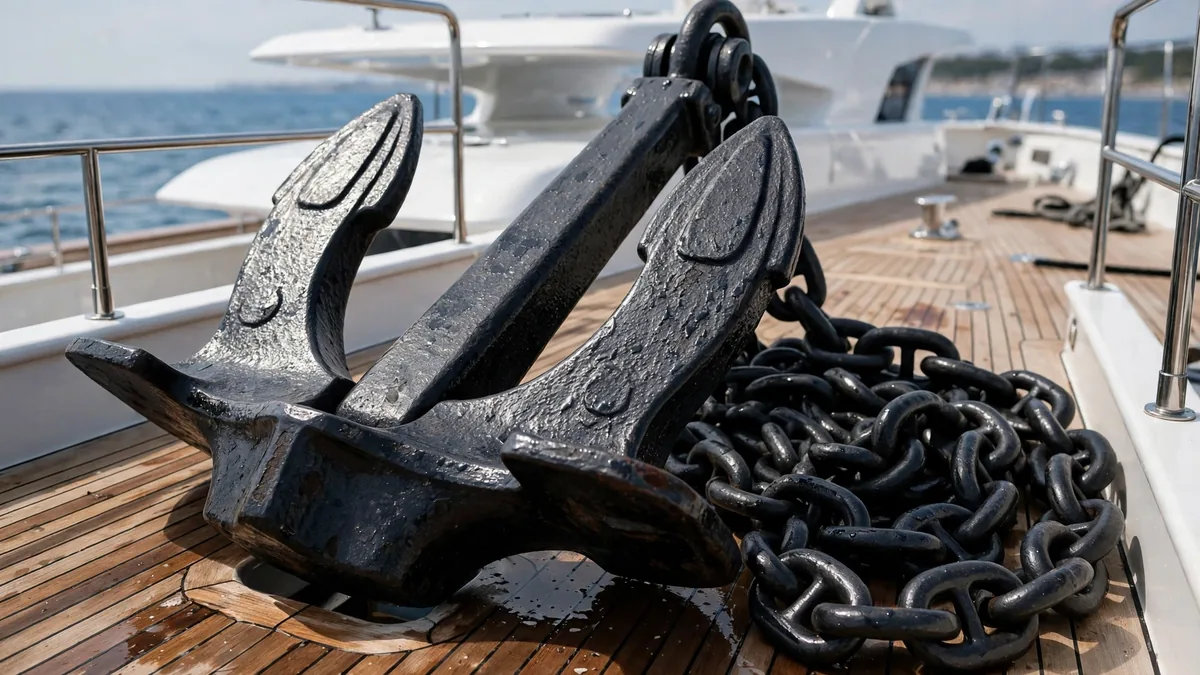
The anchor itself is a forged steel hook with two flukes, the broad, pointed arms that dig into the seabed, and a shank that connects them to the chain. The most common type on a luxury ship is the stockless anchor, which has no crossbar and stows neatly in a pocket in the bow called the hawse. When the anchor hits the bottom, the flukes catch and dig in as the ship drifts back, and the harder the ship pulls, the deeper they bite. The strength of the fittings matters as much as the anchor itself, and the care in the luxury ship anchor specs shows how much each number counts.
Step 2: The chain, the links, and the catenary
The chain is the anchor’s partner, and it is just as important. A luxury ship carries hundreds of metres of chain, each link forged from steel and as thick as a man’s wrist, with a stud across the middle to stop the link deforming under load. The chain is not just a rope. The chain is the reason the anchor works at all, and it is why the mooring gear on a luxury ship, described in the article on how luxury ship mooring gear is built, is designed as one system, not a set of parts.

Step 3: The windlass and the gypsy wheel
The windlass is the winch that moves the chain, and it is one of the most powerful machines on the ship. It has a gypsy wheel, a toothed wheel that grips the chain link by link, driven by a hydraulic or electric motor that can pull tens of tonnes. When the anchor is dropped, the windlass pays out the chain under control, with a brake that stops it running away, and when the anchor is raised, the windlass hauls the chain and the anchor back up, link by link, until the anchor is home in its hawse. The operator controls it from the bridge or from a local station on the foredeck, watching the chain marks and listening to the sound of the links.
Step 4: Dropping the anchor and setting it
Anchoring is a careful manoeuvre. The ship approaches the anchorage slowly, the crew lowers the anchor to the water, and the bridge orders the chain paid out as the ship drifts back. The scope, the ratio of chain to water depth, is usually five to seven times the depth, so that the chain lies flat and the pull stays horizontal. When the right amount of chain is out, the brake is set, the ship drifts back, and the anchor digs in. The bridge watches the ship’s heading as well, because a ship that swings too far has usually dragged its anchor. Setting an anchor is a skill, and on a luxury ship it is done by officers who have done it a hundred times, in the dark, in the rain, and in a rising wind.
Step 5: Riding at anchor and watching the weather
Once the anchor is set, the ship rides on its chain, swinging in a slow circle as the wind and tide change. The crew watches the position constantly, with GPS alarms that sound if the ship moves outside a small circle, and a watchkeeper on the bridge who checks the anchor bearing through the night. The ship’s stability at anchor is helped by the ballast low in the hull, and the luxury ship ballast system keeps the ship level as fuel and water are used.
Step 6: Weighing anchor and coming home
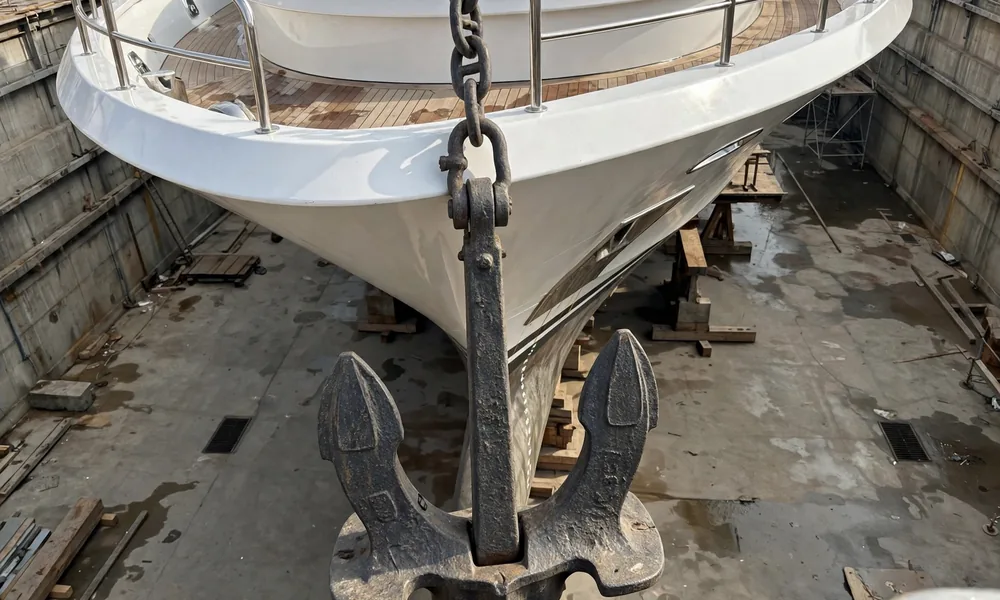
Weighing anchor, hauling it back up, is the reverse of dropping it, and it is just as careful. The windlass hauls the chain in, the ship moves slowly forward to take the strain off, and the anchor breaks free of the seabed with a shudder that runs through the hull. As the chain comes up, it is washed with seawater to remove the mud, and the anchor is checked for damage before it is stowed in its hawse. The whole operation takes about half an hour on a large ship, and it is the moment when the ship stops being a floating hotel and becomes a ship again, ready to sail.
Specifications
| Specification | Typical luxury cruise ship anchor system |
|---|---|
| Anchor weight | About 10 to 20 tonnes per anchor |
| Anchor type | Stockless, forged high-strength steel |
| Chain length | About 300 to 400 metres per side |
| Chain link diameter | About 80 to 110 mm, stud-link |
| Windlass | Hydraulic or electric, gypsy wheel, tens of tonnes of pull |
| Anchors carried | Two bow anchors, one spare |
| Typical scope | Five to seven times the water depth |
What a Luxury Ship Anchor Costs
A complete anchor system for a luxury ship, including the anchors, the chain, the windlass, and the hawse fittings, typically costs between about $500,000 and $2 million. These are estimates based on typical large-ship outfitting figures, not fixed prices. A single anchor can cost $100,000 or more, and the chain, at hundreds of metres of forged steel, is a major part of the bill. The windlass is the most expensive single item, and the installation, with its reinforced deck and chain locker, adds more. The price is the cost of a machine that has to hold a floating city still in a storm, and do it with nothing but steel and mud.
A Rare Fact
When a large ship drops its anchor, the chain can run out so fast that the links glow from friction in the hawse, and the sound of the chain is one of the loudest noises on the ship. Old sailors say you can feel the anchor hit the bottom through the deck, a dull thud that travels up through the steel, and the crew on the foredeck wear ear protection, because a hundred metres of chain running out sounds like a freight train in a tunnel.
The anchor is the oldest machine on a ship, and the most honest. It has no computer, no software, and no backup system. It is a hook, a chain, and a winch, and it works because steel bites into mud and the weight of the chain holds it there. The next time a luxury ship stops in a beautiful bay and swings gently on its chain, remember that the whole ship, with all its luxury and all its people, is being held by a piece of forged steel sitting quietly on the seabed.