On the top deck of a luxury ship at dusk, the cocktail bar is the busiest room aboard. Hundreds of guests drift in after dinner, the counter is three times as long as any yacht bar, and a team of bartenders works shoulder to shoulder, shaking and pouring without pause while the ship cuts through the sea below. Bottles by the hundred line the shelves, ice arrives by the crate, and glasses are washed, polished and sent back out in a loop that never stops.
A ship cocktail bar is a different machine from a yacht cocktail bar, because scale changes everything. A yacht bar serves a dozen guests from one bartender’s reach, but a ship bar serves thousands of guests a night from a team of twenty, with several stations along one long counter, a back room for storage and washing, and a supply chain that runs from the ship’s cold stores to the glass in a guest’s hand. This is how such a bar is made, from the steel deck beneath it to the last polished glass.

How It’s Made
The deck is levelled and the counter is built in sections
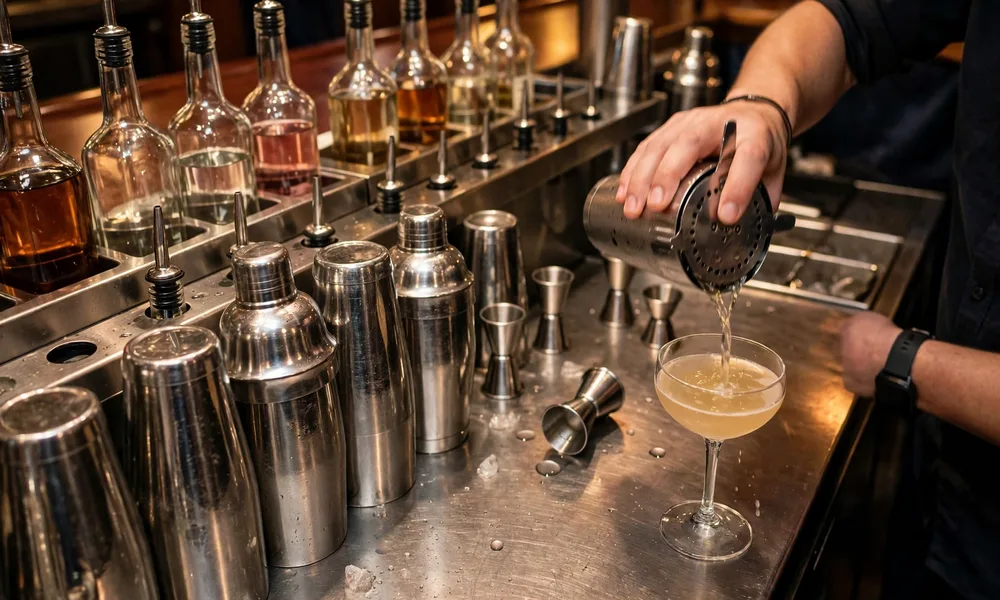
The bar starts with the deck itself, a steel floor that is levelled, sealed and covered with a non-slip surface, because a bar that serves thousands of drinks a night cannot afford a floor that gets slippery when it gets wet. On that deck, the counter is built in sections, each one a self-contained station with its own speed rail, ice bin, sink and till, so that one station can be closed for cleaning while the others keep serving. The sections are joined with seamless welds and sealed joints, and the whole counter is bolted to the deck through a steel frame, so it stays put when the ship rolls in heavy weather. The counter is the longest single piece of furniture on the ship, and it is built like a workbench, because that is what it is.
The back bar holds hundreds of bottles in tiers
Behind the counter, the back bar rises in tiers of lit shelves that hold hundreds of bottles, arranged by type and by how often they are used, with the busiest spirits at waist height and the rare bottles higher up behind glass. Each shelf is lined with a non-slip material and fitted with a rail, and the shelves are built in sections that lift out for cleaning, just as on a yacht, but on a ship the sections are wider, the rails are taller, and the whole wall is braced against the ship’s structure so it cannot flex when the ship moves. Feeding a ship’s guests on this scale is a kitchen problem too, and the way the ship’s great kitchens are organised is what a luxury ship galley at work shows, with the same ideas of stations, storage and flow.
The ice room and the cold chain keep the drinks cold
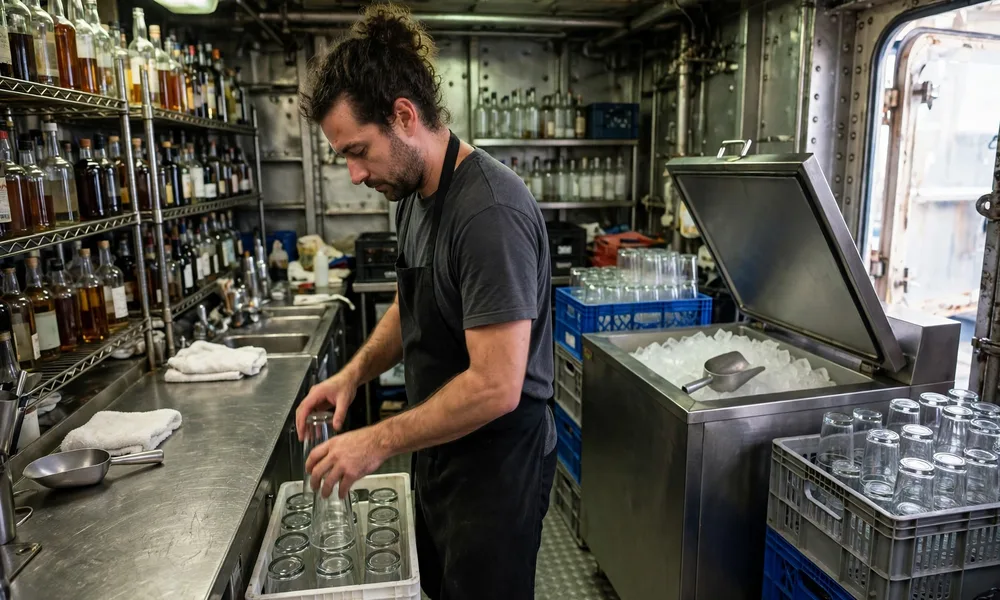
Ice on a ship is an industry of its own. A dedicated ice room sits behind the bar, with large machines that make ice around the clock and insulated bins that hold it through the busiest hours, and crew wheel it to the stations in sealed carts so it never touches a warm hand or a dirty surface. Below the counter, chillers keep wine, beer and mixers at the right temperature, and the glasses are kept in chilled cabinets so a cocktail lands in a glass that is already cold. The ice room drains to the ship’s grey water system, and its floor is sloped and sealed so a spill runs away instead of pooling underfoot. On a ship, cold is a system, not a single machine, and the bar is only as good as the cold chain behind it.
The back room: washing, polishing and storage
Behind the back bar lies a room the guests never see, and it is where the bar really lives. Glass washers run in a loop, taking dirty glasses in one end and sending clean ones out the other, and a team of crew polish each glass by hand, holding it up to the light before it goes back to the counter. The floor here is the same non-slip surface as the front, the sinks are deep and wide, and the drains are sized for hundreds of litres a day, because a ship bar washes more glassware in one evening than a yacht bar washes in a month. The building of the ship’s other great service rooms follows the same logic, and the way a crew mess is put together is what a ship’s crew mess is made describes.
Testing, training and the first night at sea
Once the counter, back bar, ice room and back room are in place, the bar is tested the way a ship tests everything: hard and in public. The crew run a full service with volunteers, shaking and pouring for hundreds of people, timing how long each drink takes, counting how many glasses come back broken, and watching where the bartenders collide or wait. The layout is adjusted, a rail is moved, a sink is shifted, a shelf is lowered, until the team can work without crossing each other’s path. A ship cocktail bar is never really finished, because every cruise teaches it something new, and the crew keep a list of small fixes for the next refit. The largest kitchens aboard work the same way, and the way a cruise ship galley runs at full stretch is what a cruise ship galley at work shows.
| Specification | Typical machine |
|---|---|
| Role aboard | High-volume cocktail bar serving thousands of guests a night from a team of bartenders |
| Counter | Long stone counter built in self-contained stations, bolted to a levelled steel deck |
| Back bar | Tiered, lit shelves holding hundreds of bottles, braced to the ship’s structure |
| Ice room | Dedicated ice machines and insulated bins, with clear ice cut for premium drinks |
| Cold chain | Chillers for wine, beer and mixers, plus chilled cabinets for glasses |
| Back room | Glass washers, polishing benches, crates of glasses and spare fittings |
| Floor and drains | Non-slip sealed floor with sloped drainage sized for hundreds of litres a day |
| Stations | Each station with its own speed rail, ice bin, sink and till, so one can close for cleaning |
A luxury ship cocktail bar costs an estimate of $1.5 million to $4 million to build, depending on the size of the ship, the length of the counter and the number of stations. The price covers the counter and its steel frame, the back bar and its hundreds of shelves, the ice room and chillers, the glass washers and back room, and the non-slip floors and drainage, but not the stock of spirits and glassware, which is bought separately and counted like a warehouse.
Here is a rare fact worth knowing. The first cocktail bars at sea were not built for pleasure at all, but for medicine, because ships once carried spirits as part of their stores and mixed them with citrus to keep scurvy at bay, and the daily tot of rum was a ration before it was a drink. A modern ship cocktail bar still carries that history in its bones: it is a store, a workshop and a theatre in one room, and the best ones are the ones where the guests never see the work that makes their drink possible.


