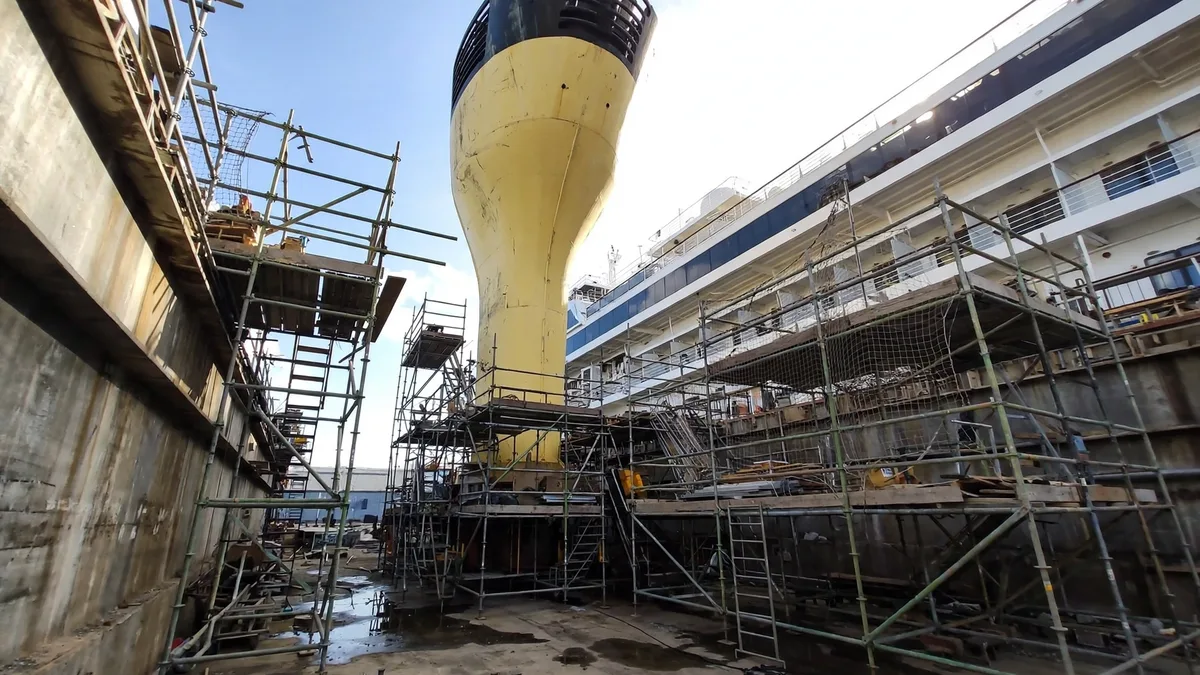
Every luxury ship has a funnel, and every passenger recognises it. It is the tall, sculpted shape that rises above the top deck, often painted in the line’s colours, often the first thing you see when a ship comes into port. From the dock it looks like a simple chimney, but a modern funnel is not a pipe. It is a building in its own right, a structure the size of a small house that carries exhausts from several engines, holds ventilation machinery and water tanks, and has to survive heat, salt and storms for thirty years, all while looking beautiful.
A funnel is not built in place on the ship. It is built as a whole in the yard, fitted out inside while it still sits on the ground, then lifted onto the ship in one great lift and welded down. This is how a luxury ship funnel is made.
How It Is Made
Step 1: The shape is drawn and the space inside is planned
Every funnel starts as a drawing, a shape worked out by naval architects and designers together, because the funnel must do two jobs that pull against each other. It must carry the exhaust clear of the decks so the smoke never reaches the passengers, and it must look like the ship it belongs to, slim and elegant on a yacht, broad and confident on a liner.
Step 2: The steel casing is shaped and welded
The casing is the funnel’s skin, built from steel plate that has to survive exhaust gas hundreds of degrees hot on the inside and salt spray on the outside. The plates are cut to patterns taken from the drawing, rolled to the funnel’s curves, and welded together on a jig, a great steel frame that holds the shape true while the welders work.
A luxury funnel is rarely a plain cylinder. Its sides slope, its top flares or rakes back, and its corners are rounded, so the plates must be rolled in two directions at once, a little at a time, and checked against the drawing after every pass. A plate bent too far cannot be bent back cleanly, so the work is slow, and the casing is checked with templates and lasers until the curves run smooth from base to top.
Step 3: The exhaust trunks are fitted inside
With the casing standing, the exhaust trunks go in. Each trunk is a pipe a metre or more across, built from heat-resistant steel, insulated on the outside so the heat does not roast the equipment sharing the funnel, and fitted with expansion joints, the flexible sections that let the pipe grow longer as it heats up without buckling or tearing its mounts.
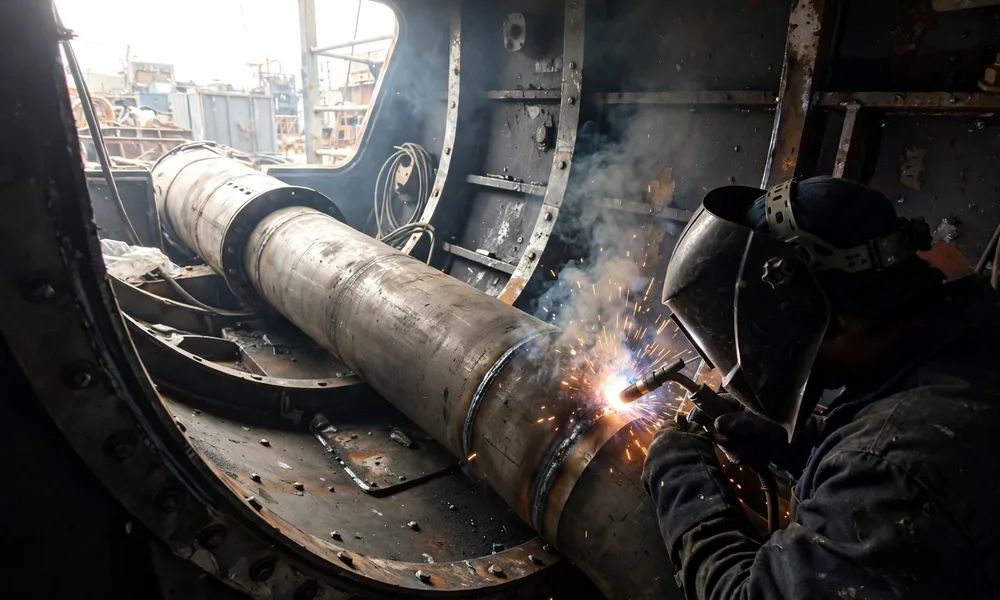
The trunks are lifted in through the open top of the casing and lowered into place by crane, then welded to the engine exhausts below and to the funnel top above. The joints must be gas-tight, because exhaust leaking into the casing would fill the funnel with soot and heat, so every weld is inspected, and the trunk is pressure-tested before the next piece of equipment goes in.
Step 4: The scrubbers, fans and tanks go in
Next comes the machinery that cleans the exhaust. The scrubber, a tower several metres tall that washes the exhaust with seawater to remove sulphur, is lifted into the casing and bolted to its own foundation, with pumps and pipework that must survive hot, acidic water. Beside it go the catalytic units that cut nitrogen oxides, and the fans that draw air through the engine rooms below.
Step 5: The funnel is lifted onto the ship
Lifting the funnel is the day the whole yard watches. The finished casing, with its trunks and machinery already inside, is lifted by a giant crane, swung out over the ship, and lowered onto its foundation on the top deck, where a ring of steel waits to receive it. The lift is planned to the minute, because the funnel is one of the heaviest single pieces ever put aboard, and the wind must be calm or the whole shape will swing like a sail.
Step 6: The funnel is painted and the top is finished
When the funnel is fixed, it is painted, and the painting is the part the passengers will judge. The casing is blasted clean, primed, and painted in the line’s colours, often with a band or a badge at the top, applied by hand and masked with great care, because a wavy line on a funnel is visible from every deck and from every quayside in every port the ship visits.
The top is finished last, with caps and deflectors that throw the exhaust upward and backward, away from the sun loungers and the balconies below, and with a soot catcher that keeps the decks clean. Before the ship leaves the yard, the engines are run at full power and the crew watch the top of the funnel from the decks below, to prove the smoke rises clear and nothing drifts down onto the passengers.
| Part | Detail |
|---|---|
| Casing | Rolled steel plate shaped on a jig, curved in two directions to match the drawn shape |
| Exhaust trunks | Large heat-resistant pipes, insulated and fitted with expansion joints for hot gas |
| Scrubber | A seawater tower inside the funnel that washes sulphur from the exhaust |
| Fans and tanks | Engine-room fans and fresh water tanks tucked into the spaces between the trunks |
| Lifting | One great crane lift onto a steel ring on the top deck, welded down around its full base |
| Finish | Primed and painted by hand in the line’s colours, with caps that throw exhaust clear of the decks |
What One Costs
Building a luxury ship funnel typically costs an estimated $3 million to $12 million, set mostly by its size, the number of exhaust trunks inside and the cost of the cleaning equipment. A smaller funnel with one engine sits near the bottom, while a large funnel with several trunks, scrubbers and catalytic units costs far more. The reasons behind the price are a different story, and why a luxury ship funnel costs so much walks through where the money goes, while the engines whose exhaust it carries are measured in luxury yacht engine specs explained, a guide to the power and heat the funnel must handle.
A Rare Fact
Funnels became so important to a ship’s identity that some liners carried fake ones. In the days when passengers judged a ship by the number of funnels she showed, a line would sometimes fit an extra funnel that carried no exhaust at all, built only to make the ship look more powerful and to balance her profile. The most famous had funnels that were really lounges and observation decks in disguise, with windows hidden behind the casing, and the crew joked that the finest room on the ship was inside a chimney.

A luxury ship funnel is drawn as a shape and a crowded interior at once, built from rolled steel on a jig, filled with exhaust trunks, scrubbers and fans while it still sits on the ground, then lifted onto the ship in one great crane lift and painted in the line’s colours. It is the ship’s signature and its chimney in one piece, and the vessel it crowns is measured in full in luxury ocean liner specs explained, where the funnel’s figures sit among the rest of a floating city.