Ask a yacht broker what makes a superyacht special and you will hear about the beach club, the cinema room and the size of the master suite. Ask a captain the same question and you will get a different answer: the engines. Two diesel engines the size of small cars sit low in the hull, and their numbers decide almost everything about life aboard. Top speed, range, fuel bills, noise at anchor, even how long the yacht can stay away from a marina: it all starts with the engines, and the spec sheet is where the truth lives.
Most buyers never read that sheet properly. Horsepower gets all the attention, but it is only one number among many, and on its own it can mislead. A yacht with huge engines and small fuel tanks is a sprinter that cannot cross an ocean. A yacht with modest engines and a big tank is a slow traveller that can go anywhere.
Superyacht Engine Specs at a Glance
| Specification | Typical 30 m Yacht | Typical 50 m Yacht | Typical 70 m Superyacht |
|---|---|---|---|
| Main engines | 2 x 1,900 hp diesels | 2 x 2,600 hp diesels | 2 x 4,000 hp diesels |
| Top speed | 22–25 knots | 16–18 knots | 16–17 knots |
| Cruising speed | 18–20 knots | 12–14 knots | 12–13 knots |
| Fuel burn at cruise | 180–250 litres/hour | 250–350 litres/hour | 450–650 litres/hour |
| Fuel capacity | 10,000 litres | 45,000 litres | 120,000 litres |
| Range at cruise | 800–1,000 nm | 3,000–4,000 nm | 5,000–6,000 nm |
| Engine speed at cruise | 1,800–2,100 rpm | 1,500–1,800 rpm | 1,400–1,700 rpm |
| Service interval | 500 hours | 500–750 hours | 750–1,000 hours |
These are typical figures, not rules. A performance yacht carries far more power per tonne than a long-range explorer of the same length, and a yacht built for the Mediterranean may trade range for speed. Length alone tells you very little; the balance of power, tankage and burn is what counts.
How the Power Gets to the Water
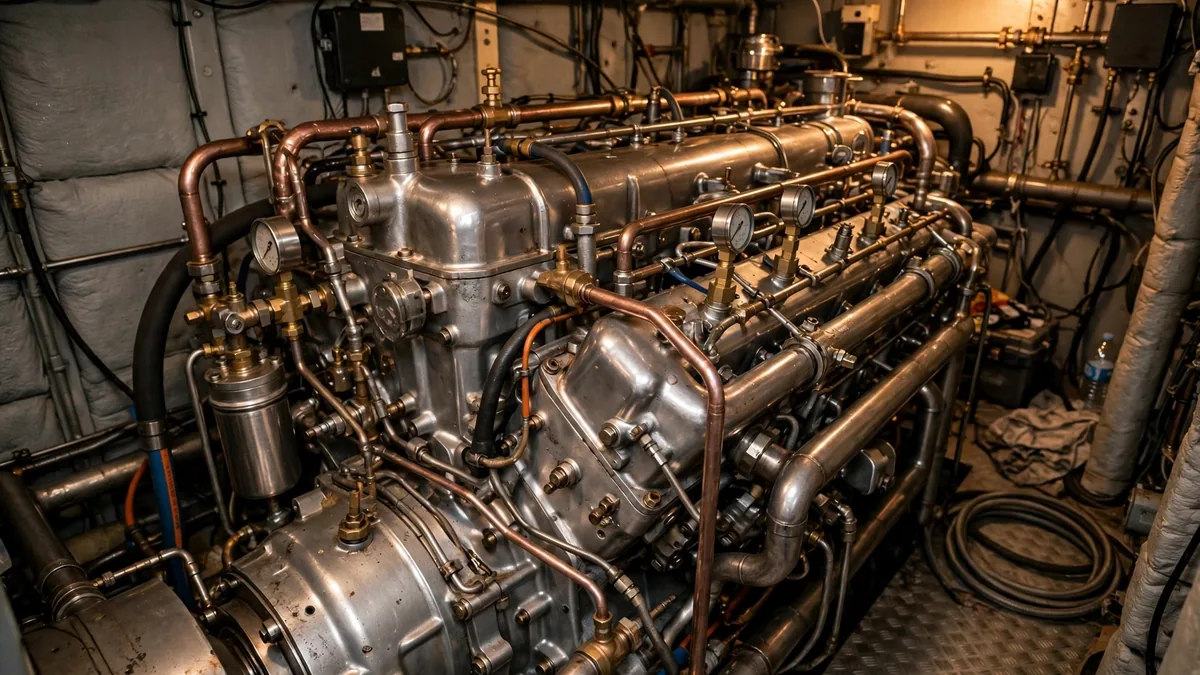
A marine diesel is a different animal from a car engine. It is built big, slow and tough, with a cast block and service intervals measured in thousands of hours rather than miles. It turns at a relaxed 1,400 to 2,300 revolutions per minute, and it spends its life pushing a heavy hull through water, a grinding continuous load quite unlike a car’s stop-start life. Torque matters as much as horsepower here, because the engine is fighting drag every second it runs.
From the engine, power travels through a gearbox and a shaft to the propeller, or to a pod drive that steers as well as pushes. Traditional shafts are simple and robust, and most large yachts still use them. Pod drives package the propeller into a steerable unit beneath the hull, improving efficiency and manoeuvrability at the cost of complexity. Hybrid setups add batteries and electric motors, letting a yacht glide silently into an anchorage on electric power alone. Each choice changes the fuel burn, the noise and the maintenance schedule, which is why the yacht engine room specs matter too: the room has to fit whichever system the owner chooses, with space to service it.
Cooling is the hidden half of the power story. A yacht engine at full load turns a large share of its fuel into heat, and that heat has to go somewhere. Seawater is pumped through heat exchangers, cooling the engine’s closed freshwater circuit, and a yacht at full speed can swallow thousands of litres of cooling water every minute. The exhaust system carries the rest away through insulated trunks and the funnel, while fans pull fresh air in and push hot air out of the engine room.
Propeller choice is part of the same equation. A bigger, slower-turning propeller is usually more efficient than a small fast one, but it needs clearance under the hull and a gearbox ratio to match. The yacht propeller specs explain how blade count, diameter and pitch are matched to the engine, and why a propeller that is perfect at cruising speed can be wasteful at full throttle. Get the match wrong and the engines work harder than they should, burning fuel and wearing out early.
Fuel Burn and Range: The Honest Numbers
Fuel burn is where the spec sheet gets honest. A 50-metre yacht at a 12-knot cruise might burn 250 to 350 litres of diesel per hour across both engines, while pushing to 16 knots can double that figure or worse, because the power needed rises steeply with speed. This is why experienced owners cruise slowly: dropping two knots can add hundreds of miles of range and save thousands of litres on a long passage. The top speed figure on the brochure is for showing off; the cruising speed figure is for living with.
Generators are the other half of the fuel bill. A yacht at anchor is a floating hotel, and its hotel load, the electricity for air conditioning, cooking, lighting and the water maker, can reach 60 to 100 kilowatts on a hot evening aboard a 50-metre yacht. Two generators are the standard, one running while the other rests, and their fuel burn is added to the main engines when the yacht is under way. A buyer who only looks at engine burn and forgets the generators will underestimate the real fuel budget by a wide margin.
Range follows from burn and tankage. A 50-metre yacht with 45,000 litres of fuel and a 300-litre-per-hour burn can cruise for about 150 hours, which at 12 knots is roughly 1,800 nautical miles in theory, though prudent captains keep a reserve and plan on less. The 3,000 to 4,000 nautical mile figures in the table assume slow, efficient cruising and a well-matched propeller. Push the throttles and the same yacht may manage half that distance. As an estimate, a 50-metre yacht burns roughly $15,000 to $30,000 of fuel on a two-week cruise, depending on speed and distance, and a 70-metre yacht can easily double that.
A Rare Fact From the Engine World
Here is a detail few guests ever learn: some of the largest yacht engines are designed to run on a single cylinder bank if the other fails, limping home at reduced speed rather than leaving the yacht dead in the water. The system is called limp-home mode, and it is built into the engine management software. A captain who loses an engine mid-ocean does not call for a tow; the yacht keeps moving, slowly, on what is left. It is a reminder that yacht engines are specified for survival first and speed second, and it is also why alternative power is taken seriously: the hydrogen fuel cell yacht specs now being tested promise quiet, clean power, though the supporting systems still take up serious room and the fuel infrastructure is years behind diesel.
What the Specs Mean for You
If you are reading a yacht listing, start with four numbers: total main engine power, fuel capacity, fuel burn at cruising speed and range at cruise. Those four tell you how fast the yacht goes, how far it can travel, how much it costs to run and how often it needs fuel. Horsepower alone is a headline; the other three are the story. The engines will never be the prettiest part of a yacht, but every quiet night at anchor and every ocean crossing depends on the numbers humming away below deck.


