On a workbench in a quiet factory, a small wooden box sits open like a musical instrument waiting for its strings. Around it lie the parts that will give it a voice: a round driver the size of a saucer, a smaller tweeter, a ring of tiny microphones, and a circuit board no bigger than a playing card. Nothing about the scene looks like a production line. It looks like a luthier’s bench, and in a way it is, because a luxury smart speaker is built to be heard, not just assembled.
This is how a luxury smart speaker is made, from the first cut of the cabinet to the final listening test, and why the best ones take far longer to build than their size suggests. Every stage is about sound, and every shortcut would be audible the moment the music starts.
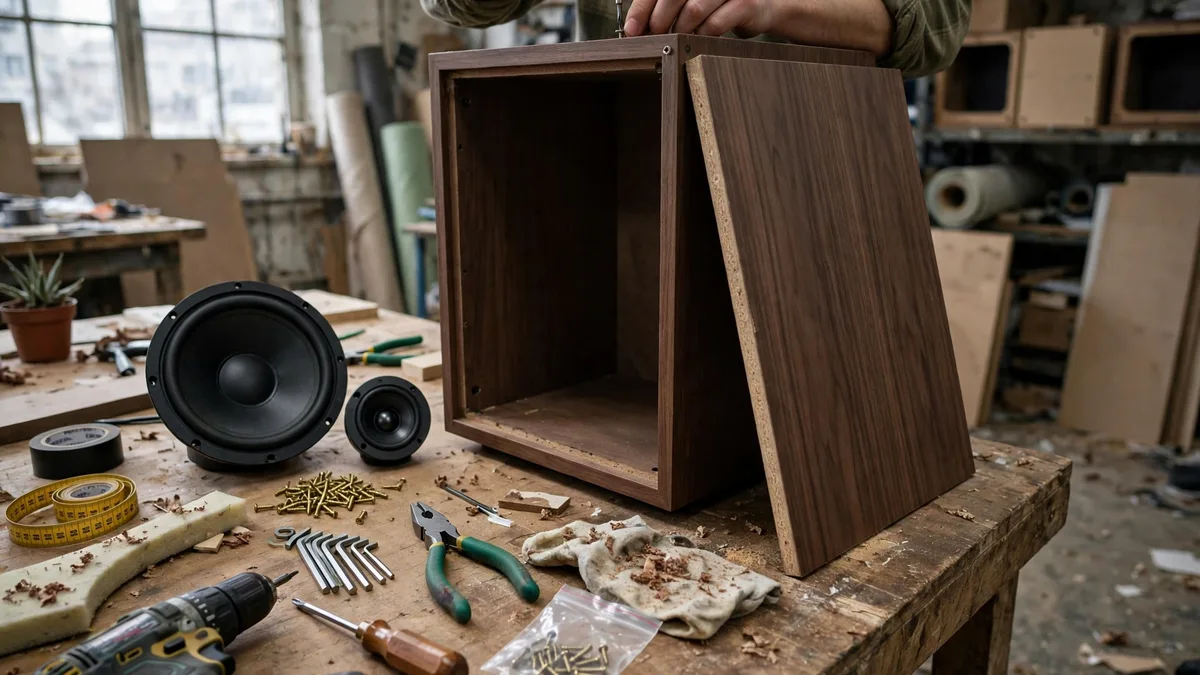
Step 1: The cabinet is built like an instrument
The cabinet is where a luxury speaker begins, and it is made from wood, not plastic. Sheets of dense fibreboard or real hardwood are cut to size, glued and clamped into a rigid box, then braced inside with ribs that stop the walls from flexing when the bass plays. The outside is veneered in walnut or oak, sanded smooth and finished with oil or lacquer until the grain shows through.
Step 2: The drivers are matched, not just fitted
The drivers are the speaker’s voice, and they are never taken straight from a crate and screwed in. Each woofer and tweeter is measured on a test rig first, and only drivers whose output matches within a tight tolerance are paired together, so the left and right of a stereo pair sound identical. The cones are made from paper, coated fabric or light metal, and they sit in a frame bolted to a baffle cut to the millimetre.

Step 3: The microphones learn to hear
A smart speaker must hear its name across a noisy room, and that job belongs to a ring of small microphones set into the top of the cabinet. The microphones are mounted on a flexible gasket that keeps vibration from the drivers from reaching them, and each one is tested for sensitivity before the ring is sealed. Once fitted, the array is calibrated with a test voice played from several directions, and the speaker is taught which microphone hears the voice first, because that tells it where the person is standing. The guide to how a luxury smart speaker works shows what that microphone ring does once the speaker is on its shelf at home.
Step 4: The amplifier and the brain go in
Inside the cabinet, below the drivers, sits the electronics: a small amplifier, a processor and a wireless board, all mounted on a single plate that slides into the base. The amplifier is chosen to match the drivers exactly, with enough power to drive the bass cleanly but not so much that it can damage the cones. The processor handles the voice commands and the room tuning, and it is fitted with a heat sink rather than a fan, because a fan would hum and spoil the silence between songs.
Step 5: The fabric goes on, and the speaker is tuned
With the hardware inside, the cabinet is dressed. A woven acoustic fabric is stretched over a frame and fitted around the speaker, chosen to let sound pass through while hiding the drivers and softening the look of the box. Then the speaker is switched on for the first time and tuned: a test tone is played, a microphone listens from across the room, and the built-in equaliser is adjusted so the sound is balanced rather than boomy or thin. The numbers on the box describe that balance in shorthand, and the guide to luxury smart speaker specs explained sets out what each figure really means.
Step 6: The listening test, in a quiet room
The last stage is not a machine test but a human one. Each finished speaker is carried into a quiet listening room, placed on a stand, and played through a short playlist of voices, piano and bass-heavy tracks while a tester listens for rattles, distortion or an uneven tone. The ones that pass are wiped down, boxed with their power cable and a quick-start card, and given a serial number that ties them to their test results. The same care goes into the smallest listening devices, and the story of how luxury earbuds are made shows how much hand work fits into something that weighs almost nothing.

The spec sheet at a glance
| Specification | Typical luxury figure | What it tells you |
|---|---|---|
| Cabinet | Braced wood or hardwood veneer | How still it stays when bass plays |
| Woofer | 100–165 mm matched driver | How deep and clean the bass is |
| Tweeter | 19–25 mm dome | How clear the high notes sound |
| Amplifier | 30–100 watts per channel | How much clean power it has |
| Microphones | 4–7 in a ring array | How well it hears across a room |
| Frequency response | 40 Hz–20 kHz | How much of the music it covers |
| Wireless | Wi-Fi and Bluetooth | How it connects to music and the home |
| Weight | 2–5 kg | How solid the cabinet feels |
| Finish | Walnut, oak or fabric wrap | How it looks on the shelf |
Keeping it in good shape
A luxury smart speaker lasts longest when it is treated like the instrument it is. Keep it on a solid shelf rather than a hollow cabinet, because a hollow surface will hum along with the bass. Dust the fabric gently with a soft brush and never use a wet cloth on it, and keep the speaker out of direct sun, which dries the veneer and fades the cloth. Update its software when prompted, because the updates often improve the room tuning as much as the features.
What it costs
A luxury smart speaker typically costs an estimated $300 to $1,200, depending on the size, the drivers and the finish. The estimate covers the speaker alone, not a second unit for stereo or any subscription to a music service.
A rare fact
One detail few owners ever learn is that some luxury speaker makers test their cabinets by tapping them and listening to the knock, the way a violin maker taps a soundboard. A good cabinet rings with a short, dull thud and no lingering note, and a tester can tell from that single tap whether the bracing is right before a single driver is fitted. It is an old craftsman’s test in a very modern device, and it survives because no machine has yet found a better way to hear a hollow box.
A luxury smart speaker is made slowly, by hand and by ear, because its job is to disappear into a room and leave only the music. The cabinet, the matched drivers and the quiet listening test are what separate it from a plastic box that merely makes noise, and they are why the finished speaker on the shelf sounds like it belongs there.