Drop a watch on a stone floor and it bounces, skids, and comes to rest face down. Your stomach drops with it. You pick it up, turn it over, and brace for the worst. But the crystal is perfect. Not a mark, not a scuff, not even a faint hairline where the stone met the glass. It looks the way it did the day you bought it, and it will look that way in ten years. The secret is not luck. It is a material that should not exist in a watch at all, and yet there it is, on millions of wrists.
That material is sapphire glass, and its name is a lie in the most interesting way. It is not glass. It is a single crystal of aluminium oxide, grown in a furnace, sliced into wafers, and polished until it is as clear as window glass and almost as hard as diamond. It is the same mineral as the blue gemstone, minus the colour, and it has quietly become one of the most important materials in watches, phones, and cameras.
How Sapphire Glass Works
1. It starts as powder, not stone
Natural sapphire is a gemstone, rare and expensive. The sapphire in a watch is synthetic, and it starts life as aluminium oxide powder, the same white powder used to make ceramics and sandpaper. The powder is purified until almost nothing remains but aluminium and oxygen, then melted in a furnace at more than two thousand degrees Celsius. The molten material is a glowing, honey-like liquid, and the trick is not melting it. The trick is turning it back into a solid without letting it become ordinary glass.
2. A seed crystal grows into a giant boule
The growth starts with a seed, a small piece of sapphire crystal lowered into the melt. As the seed is slowly pulled upward and rotated, molten material freezes onto it in perfect alignment with its crystal structure, and a long cylinder of solid sapphire grows behind it. This cylinder is called a boule, and a large one can weigh more than a hundred kilograms. The process takes days and demands extraordinary control: a single temperature wobble or vibration can introduce a flaw that ruins the whole boule. The result is a flawless, transparent crystal, clear as water and free of the internal stresses that make ordinary glass fragile.
3. The boule is sliced into thin wafers
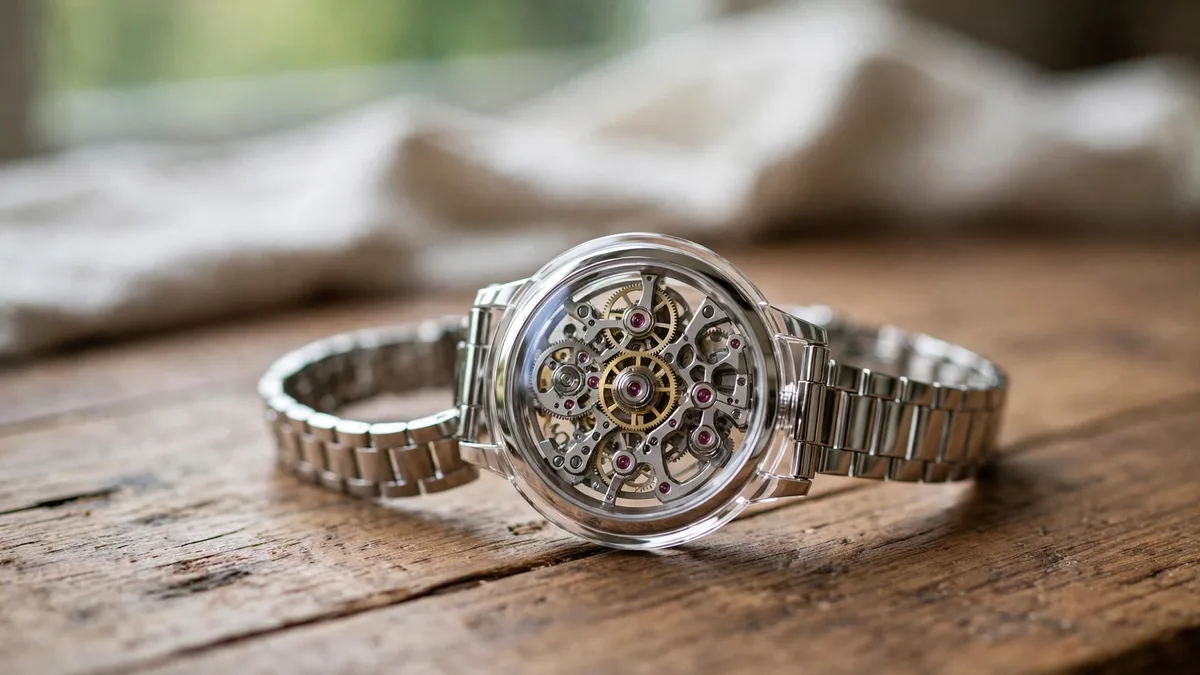
Once cooled, the boule is cut into thin discs with diamond-coated wire saws, because almost nothing else is hard enough to cut it. The wafers are then ground and polished in stages, each finer than the last, until their surfaces are flat to within a fraction of a wavelength of light. Any scratch or ripple would scatter light and dull the crystal, so the polishing is done in clean rooms by machines that measure flatness with lasers. A watch crystal starts as one of these wafers, cut to shape and given a gently domed or flat profile.
4. Hardness is what makes it work
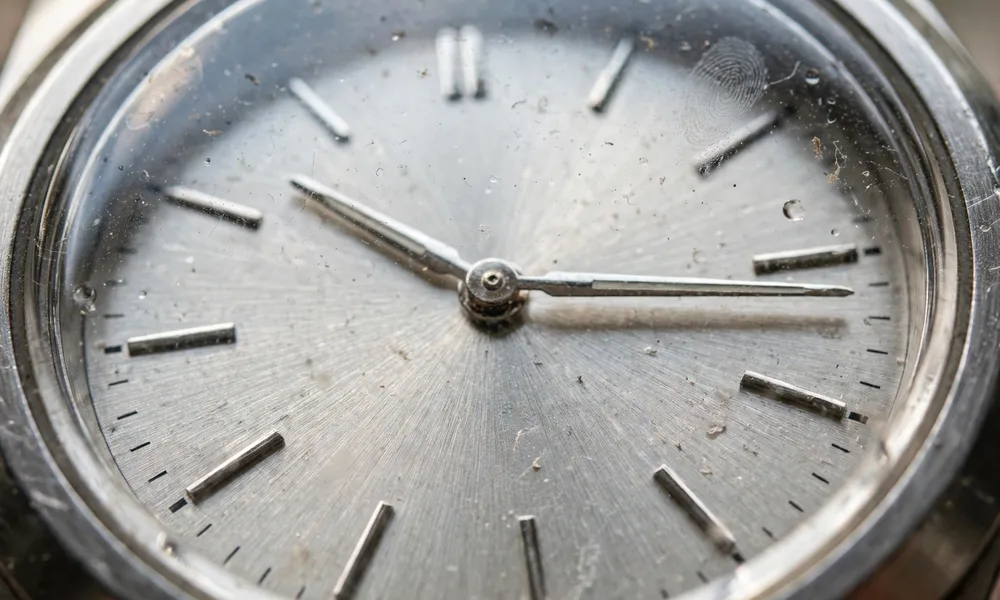
The reason sapphire is used at all is its hardness. On the Mohs scale, where diamond is ten and ordinary glass is about five and a half, sapphire scores nine. That means almost nothing in everyday life can scratch it. Keys, coins, sand, and stone all lose. Only diamond and a few exotic materials are harder. Hardness is not the same as toughness, and sapphire can still shatter if it is hit hard enough at the right angle, but for the daily abuse a watch face takes, hardness is the property that matters. A sapphire crystal does not scratch, so it stays clear for the life of the watch.
5. Anti-reflective coatings make it disappear
Sapphire has one weakness: it reflects more light than ordinary glass, which can make a watch face hard to read in bright light. The fix is a coating, usually several layers of metal oxides each only a few atoms thick, applied in a vacuum chamber. The layers are tuned so that reflections from each layer cancel each other out, and the crystal seems to vanish, leaving only the dial beneath it. The best coatings are applied to both sides of the crystal, and they are the reason a good watch can be read at a glance in sunlight. The coating is far softer than the sapphire, which is why it is usually placed on the inside of the crystal, where fingers cannot reach it.
6. It is shaped, drilled, and fitted like a jewel
The final step is fitting the crystal into the watch. It is cut to the exact diameter of the case, its edges are bevelled so it seats cleanly, and it is pressed into place with a gasket that seals it against water and dust. In a dive watch the crystal is made thicker, sometimes several millimetres, so it can resist the pressure of deep water. In a dress watch it is made as thin as possible, so the watch stays slim. The same material, shaped differently, does both jobs, and it does them without ever needing to be replaced.

Sapphire Glass Specs at a Glance
| Specification | Typical range |
|---|---|
| Material | Single-crystal aluminium oxide |
| Hardness (Mohs) | 9 |
| Melting point | About 2,050 degrees Celsius |
| Density | About 3.98 grams per cubic centimetre |
| Watch crystal thickness | About 1 to 4 millimetres |
| Transparency | About 85 percent, uncoated |
| Scratch resistance | Resists steel, sand, keys, and stone |
The price of this perfection has fallen steadily as production has scaled up. A sapphire watch crystal is estimated to cost about 20 to 100 dollars to make, depending on size, shape, and coating, while a complete sapphire-crystal watch is estimated at about 500 to 10,000 dollars and beyond. A large sapphire boule for industrial use is estimated at several thousand dollars, and the diamond wire saws that cut it are estimated at hundreds of dollars per blade. Prices are estimates and vary widely by manufacturer and market.
Sapphire sits alongside other engineered materials in modern devices. The anodised aluminium specs explained guide covers the metal that usually frames it, the e-ink display specs explained guide looks at another display technology built around unusual materials, and the AR glasses waveguide specs explained guide explains the optics that may one day sit behind sapphire lenses.
A Rare Fact About Sapphire Glass
Here is something few people know: the same sapphire used in watches has been to space. Sapphire windows have flown on satellites and spacecraft because the material survives radiation, extreme temperature swings, and micrometeorite dust that would pit ordinary glass in weeks. It is also used in the windows of high-pressure chambers and in the lenses of military lasers. A material that started as a gemstone now protects instruments in orbit, and the watch on your wrist is wearing a piece of the same technology.
The next time you glance at your watch and the crystal is flawless, remember what it took to get there. A powder melted at two thousand degrees, grown atom by atom into a single crystal, sliced with diamond wire, and polished to within a fraction of a wavelength of light, all so that a small disc on your wrist could stay clear for decades. That is sapphire glass. It is not glass at all, and it is better for it.