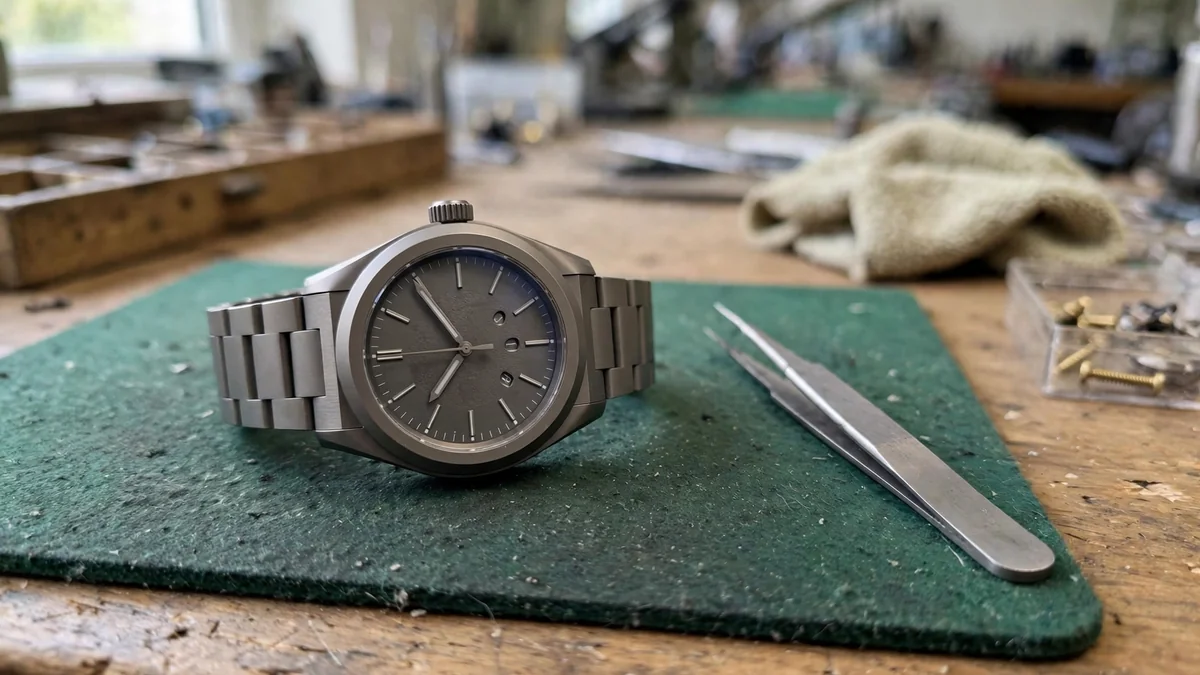
The watchmaker in the small Swiss atelier did not look up when the visitor asked why the grey metal watch in the tray cost more than a family car. He picked it up, turned it over in his palm, and held it out. It was light — shockingly light for a watch that size, lighter than the steel watch beside it, and the grey was different too, a soft matte grey that seemed to swallow light instead of throwing it back. “Steel is easy,” he said, finally. “Titanium fights you at every step. That is what you are paying for.” He put the watch down gently, the way you would put down something that had taken a week of someone’s life to make.
That small scene explains the titanium watch better than any price list. Titanium is not expensive because it is rare in the ground — it is the ninth most common element in the Earth’s crust. It is expensive because turning raw titanium into a finished watch case is one of the hardest jobs in manufacturing. The metal is stubborn, the tools wear out fast, and the finishing takes hours of skilled hand work.
The Metal Itself
Titanium’s appeal starts with its weight. It is about 45 percent lighter than steel while being just as strong, which means a big 44-millimetre watch that would feel like a brick in steel feels comfortable all day in titanium. Divers, pilots and soldiers noticed this first, and watchmakers followed. The metal is also almost completely resistant to corrosion, even in salt water, and it does not provoke skin allergies the way nickel in some steels can. For a watch worn against the skin every day, that matters more than any specification.
But the raw material is only the beginning. Titanium sponge, the porous grey metal that comes out of the refining process, must be melted in a vacuum, because molten titanium grabs oxygen and nitrogen from the air and turns brittle. The melting is done in vacuum arc furnaces or with electron beams, in equipment that costs millions and runs slowly.
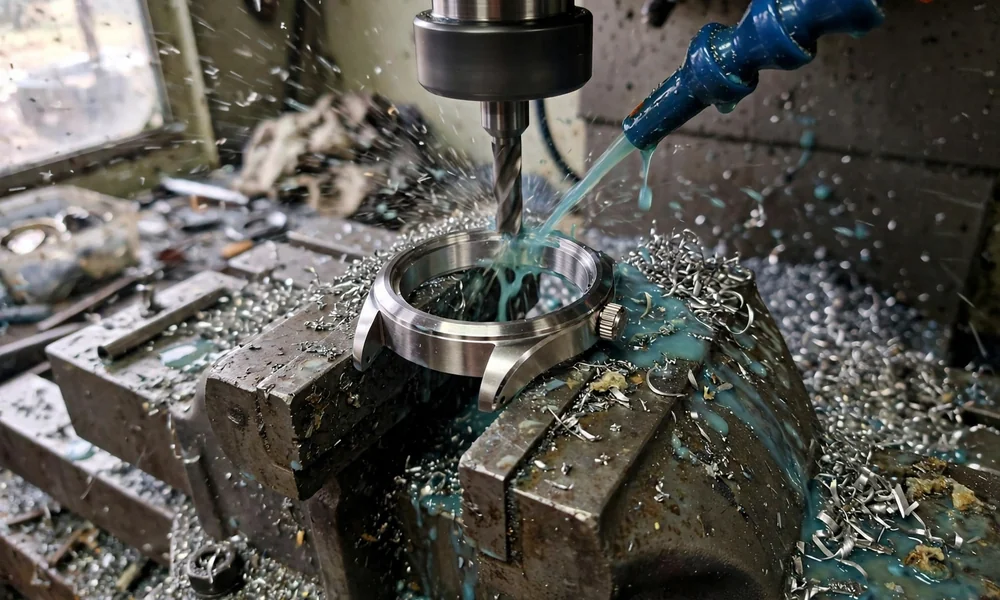
Machining is where titanium earns its reputation as a difficult metal. It is a poor conductor of heat, so the heat from cutting stays at the cutting edge instead of flowing away into the part. Tools overheat, wear out quickly, and sometimes weld themselves to the workpiece. Machinists run titanium slowly, with sharp tools, lots of coolant and constant attention, and a case that takes an hour to machine in steel can take three hours in titanium. Every broken tool and every scrapped case adds to the price of the ones that survive.
Finishing, Labour and Rarity
Finishing is the most labour-heavy part of all. Titanium scratches easily and shows every mark, so a brushed finish must be applied evenly by hand, and a polished finish takes far longer to achieve than on steel because the metal galls and smears under the polishing wheel. Many makers give up on polishing altogether and sell only matte titanium watches, which is why so many of them share that soft grey look. The ones that do polish titanium charge for the hours it takes, and the result is a watch that looks unlike anything else on the wrist.
Labour is the quiet cost driver that buyers rarely see. A titanium watch is not made on a faster line; it is made on the same line, more slowly, by people who have learned the metal’s moods. The case maker, the polisher, the assembler and the tester all spend longer on a titanium piece than on its steel twin, and skilled watchmaking labour in Switzerland is among the most expensive in the world. When a brand prices a titanium watch at twice its steel equivalent, much of that gap is simply hours — hours of cutting, finishing, checking and re-checking, all billed at Swiss rates.
Rarity plays its part too. Most watch brands make titanium watches in small numbers, as special editions or flagship models, because the production is slow and the demand is uncertain. Small runs mean the tooling, design and testing costs are spread across fewer watches, so each one carries a bigger share. Scarcity also does what scarcity always does: collectors pay more for a watch they know few other people own. The metal itself has a long story behind it, and why titanium is worth its price explains what makes the raw material so prized in the first place.
What a Titanium Watch Costs
So what does a titanium watch actually cost? A solid titanium watch from a respected maker typically starts at an estimated $2,000 to $5,000, while titanium watches from luxury houses run from an estimated $10,000 to $50,000 or more, and the most complicated pieces pass $100,000. The difference between the cheapest and the dearest is not the metal — the titanium in a $5,000 watch and a $50,000 watch may cost only a few hundred dollars apart. The difference is the movement inside, the finishing, the brand, and the number of hours a watchmaker spent on it.
The movement deserves a mention, because it is where the real money often sits. A titanium case wrapped around a simple quartz movement is a fashion purchase; the same case wrapped around a hand-finished mechanical movement with a tourbillon is a different object entirely. Buyers who compare titanium watches should compare movements first and cases second, because the movement decides whether the watch is a tool or a piece of horology. The machining behind the case is a craft of its own, and how precision CNC machining is made shows the level of accuracy a watch case demands.
There is a rare fact that collectors love to repeat: titanium was first used in a wristwatch in the 1970s, by a Japanese maker who wanted a watch for divers that would not corrode in salt water. The watch was a curiosity at the time, and most Swiss makers ignored it for another decade. Today almost every serious watch house has a titanium model, and the metal that was once a gimmick is now a mark of intent. The alloy itself is a science, and what a titanium alloy is explains why watchmakers use a particular grade rather than pure titanium.
The Numbers That Matter
| Specification | Typical Value | What It Means |
|---|---|---|
| Density | 4.5 g/cm³ | About 45% lighter than steel |
| Strength | Similar to steel | Light but just as tough |
| Corrosion resistance | Excellent | Safe in salt water and on skin |
| Case machining time | 2–3× steel | Slow cutting, fast tool wear |
| Alloy used | Grade 5 Ti-6Al-4V | The standard watchmaking alloy |
| Typical price | Estimated $2,000–$50,000+ | Depends on movement and finishing |
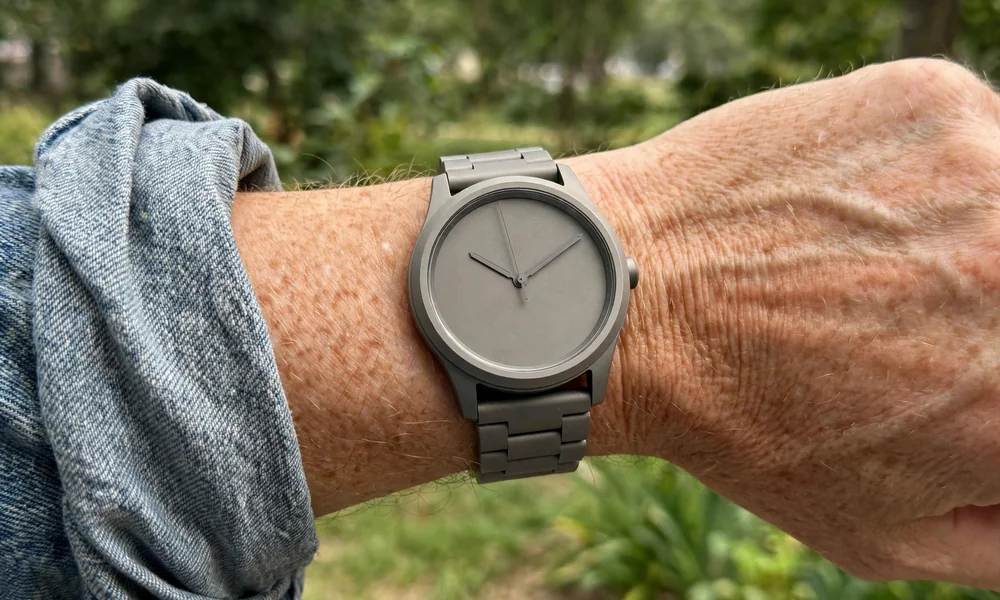
A titanium watch, then, is expensive because the metal resists every step of its making, because the people who tame it are highly skilled and highly paid, and because so few are made. The lightness on the wrist is real, the corrosion resistance is real, and the soft grey finish is unlike any other metal. Whether that is worth twice the price of steel is a question only the buyer can answer — but now, at least, they know what the money buys.