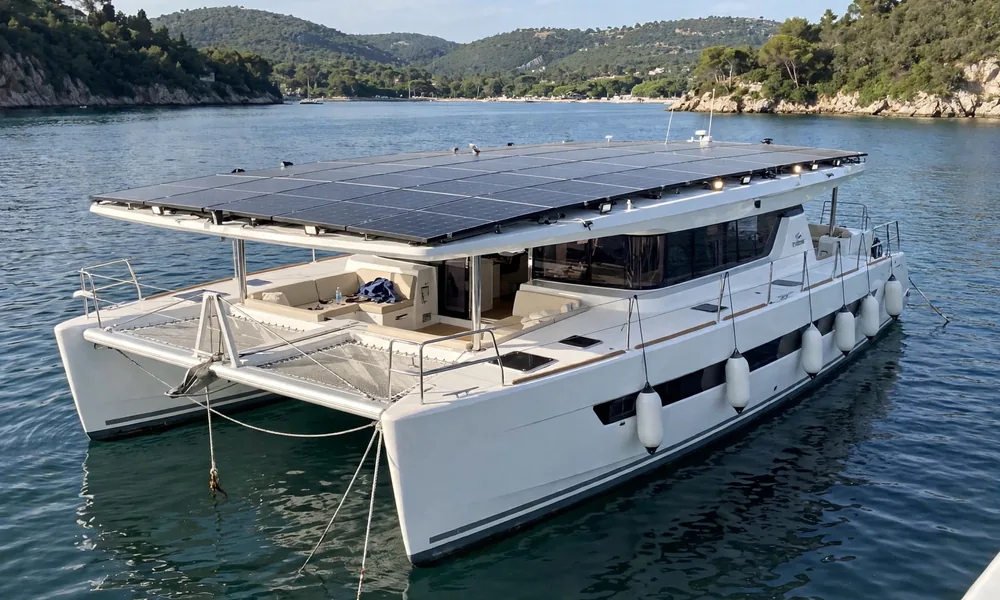
On a hard standing in the yard, a catamaran sits on cradles with its wide roof half covered in dark glass, and it looks less like a boat than a floating power station. There is no funnel, no engine room full of diesel, and no smell of fuel anywhere near it. The roof is the whole idea.
This is how a luxury solar catamaran is made, from the twin hulls laid up in their moulds to the solar roof, the battery banks and the first silent sea trial.

Step 1: The twin hulls are laid up in moulds
Every solar catamaran starts as two hulls, and each one is laid up in its own mould, layer by layer, from glass fibre or carbon over a foam core, brushed with resin and rolled free of air. The hulls are long, slim and light, because a catamaran does not need a deep keel to stay upright, and the weight saved here is spent on the solar roof and the batteries. The builders check the shape of each hull against the drawings again and again, because the two hulls must be twins in every way that matters.
Step 2: The hulls are joined by the bridgedeck
With the hulls out of their moulds, the yard joins them together with the bridgedeck, the wide structure that spans the gap between them and carries the saloon. The beams that link the hulls are bonded and bolted into reinforced sockets, and the joint is the strongest part of the whole boat, because it takes the twisting load of two hulls moving in different waves. The guide to how a solar catamaran works follows the finished boat from the panels on the roof to the propellers under the hulls, and the bridgedeck built in this step is what makes that wide, stable platform possible. Once the hulls are joined, the boat stops looking like two boats and starts looking like one.
Step 3: The solar roof is built as a structure of its own
The solar roof is the most visible part of the catamaran, and it is built as a structure in its own right. A framework of aluminium beams spans the full width of the bridgedeck, and the solar panels are mounted on it in rows, tilted slightly so rain runs off and the panels catch the sun through the day.
Step 4: Batteries and the twin electric motors go in
Below deck, the catamaran carries a large lithium battery bank, split between the two hulls to keep the weight balanced. The modules sit low in each hull, in ventilated compartments with cooling and fire protection, and they are wired together through the crossbeams so the two sides act as one large bank. A luxury build often carries several hundred kilowatt-hours of storage, enough to run the boat and its cabins for days without sun.

Step 5: The saloon and cabins are fitted like a quiet hotel
Once the engineering is in, the catamaran becomes a luxury room. The saloon sits on the bridgedeck with windows on three sides, and the joiners fit it with wide sofas, a low table, a galley and soft lighting, all fixed against the motion of the sea. The cabins sit down in the hulls, one or two in each, with berths, hanging space and a small head, and the whole interior is built light, because every kilogram spent on furniture is a kilogram taken from the batteries. The guide to how a luxury solar ferry is made follows a similar build on a bigger, single-hull boat, and the difference here is the width: a catamaran gives the builders a saloon no single-hull yacht of the same length can match.
Step 6: Wiring, controls and the helm go in
With the interior fitted, the electricians wire the boat together. The charge controllers that squeeze the most power from the panels as the sun moves, the battery management system that watches every module for heat and charge, and the helm display that shows the state of charge like a fuel gauge are all connected and tested. The helm itself sits high in the saloon, with a view over the roof, and the throttles are simple levers, because an electric motor needs no gearbox and no warm-up.
Step 7: Launch, charging trials and handover
Last, the boat is painted, the roof is washed, and the catamaran is lifted, carried to the water and launched. The first hours afloat are spent checking the plain things: that she floats level, that nothing leaks, and that the two hulls sit evenly in the water. Then the charging trials begin. The crew runs the boat through a full day, watching the panels fill the batteries in the sun and the motors draw them down under way, and they learn the boat’s real range in real weather, not just on paper. The guide to how a luxury electric ferry is made follows the same battery-first build on a ferry, and the sea trial here proves the same point: a boat that makes its own fuel is only as good as the day it was tested on.
The spec sheet at a glance
| Specification | Typical luxury figure | What it tells you |
|---|---|---|
| Hull material | Glass fibre or carbon over a foam core | How light the boat is, and how much the roof and batteries can weigh |
| Length overall | Roughly 12 to 24 metres | How long the boat is, and how much roof it carries |
| Beam | Roughly 6 to 11 metres | How wide the saloon is, and how stable the boat feels |
| Solar array | Often 10 kilowatts or more | How much power the roof makes in full sun |
| Battery bank | Often several hundred kilowatt-hours | How far the boat goes without sun, and how long the cabins run |
| Motors | Two electric motors, one per hull | How quietly the boat moves, and how tightly it turns |
| Cruising speed | Roughly 6 to 10 knots on solar and battery | How fast the boat travels in silence |
| Cabins | Often 3 to 5, in the twin hulls | How many guests the boat sleeps in comfort |
| Build time | Many months, much of it hand finishing | How much of the boat is fitted and tested by hand |
What it costs
A luxury solar catamaran typically costs an estimated $2 million to $12 million, depending on its size, its solar array, its battery bank and how lavish the interior is fitted. The estimate covers the boat alone, not the mooring, the crew or the running costs. Most of the price is in the twin hulls, the solar roof and the batteries, and in the careful balancing of all three, because a solar boat is a system, and a cheap part in one place makes the expensive parts everywhere else work harder.
A rare fact
One detail few owners ever learn is that a solar catamaran can gain range by slowing down, and the maths is kinder than it looks. Halving the speed can cut the power the motors need to roughly an eighth, because the drag of the water grows far faster than the speed does, so a boat that cruises gently on a sunny day can travel far further than the same boat hurrying in the morning.


