Deep under the sea, a submarine is a sealed steel tube, and the only way out in an emergency is up, through the water itself. The escape trunk is the part of the boat built for exactly that moment. It is a small, strong chamber set into the top of the hull, with a hatch at the bottom and a hatch at the top, and it is the one place on a submarine designed to be deliberately flooded.
It is easy to confuse the trunk with the hatch, but they are different things. The hatch is the door. The trunk is the room behind the door, the chamber where a crew member waits while the water rises around them, equalises with the sea outside, and then lets them out. This is how a luxury submarine escape trunk is made, and how a simple steel cylinder becomes the most important room on the boat.

How It Is Made
Step 1: Designing a chamber that can be flooded on purpose
The trunk starts on paper, long before any steel is cut. Engineers must decide how wide it should be, how tall, and how much water it will hold when it floods. It must be wide enough for a person wearing escape equipment to climb through, tall enough to stand in, and small enough that flooding it does not take too long or use too much of the boat’s air.
The design also has to answer a hard question: how will the trunk survive the same crushing pressure as the rest of the hull, while having two openings instead of none? Every opening in a pressure hull is a weak point, so the trunk is drawn as a short, thick-walled cylinder with heavy reinforcing rings, and its position is chosen where the hull frames can carry the extra load around it.
Step 2: Rolling and welding the steel cylinder
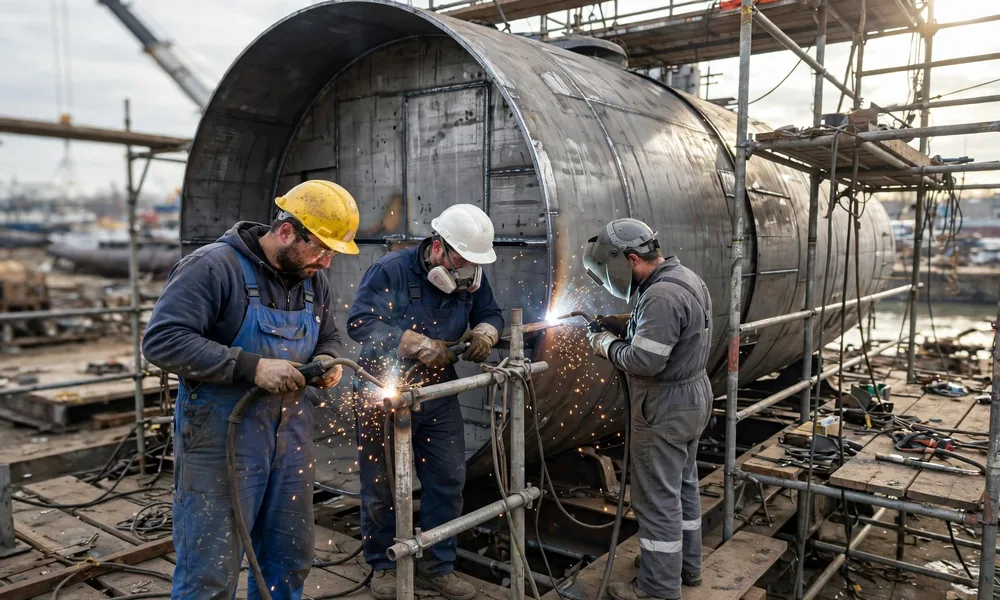
Once the design is set, the trunk itself is built from high-strength steel plate, the same kind of steel used for the pressure hull. The plates are rolled into a cylinder on a rolling machine, curving the flat steel a little at a time until the ends meet, and then the seam is welded shut. The weld is the most important joint in the whole trunk, so it is made in several passes, each layer fusing into the last.
After welding, the cylinder is checked for roundness. A trunk that is even slightly oval will not seal properly where the hatches sit, and a leak at depth is not a small problem. Inspectors measure the diameter at many points around the circle, and they check the welds with ultrasound, listening for hidden flaws inside the metal that the eye cannot see.
Step 3: Fitting the two hatches
A trunk needs two hatches, and they open in opposite directions for a good reason. The lower hatch opens downwards, into the boat, so the pressure of the water above keeps it pressed shut. The upper hatch opens upwards, out of the boat, so it can be pushed open once the pressure inside the trunk matches the sea outside. Each hatch is a thick steel disc, machined flat so it seats perfectly against its frame.
Each hatch gets its own seal, a heavy rubber ring set into a groove, and its own wheel handle, so it can be opened and closed by hand even when the person turning it is wearing gloves and breathing from escape equipment. The hatches are tested one at a time: the trunk is sealed, filled with water, and pressurised, and the inspectors watch for any drop in pressure that would mean a leak.
Step 4: Adding the flooding and air systems
A trunk that cannot flood cannot work, so the builders fit it with valves and pipes that control the water. A flood valve lets sea water in at a controlled rate, and a vent valve lets the air out as the water rises. The crew member inside controls these valves by hand, watching the water climb and listening for the moment when the trunk is full and the pressure has equalised.
There is also an air supply inside the trunk, so the person waiting in the chamber can breathe while the water rises, and a drain system so the trunk can be emptied and used again after training. Every valve is placed where it can be reached by someone standing in the trunk in the dark, because in a real emergency the lights may be out and there is no second chance to find a handle.

Step 5: Welding the trunk into the hull
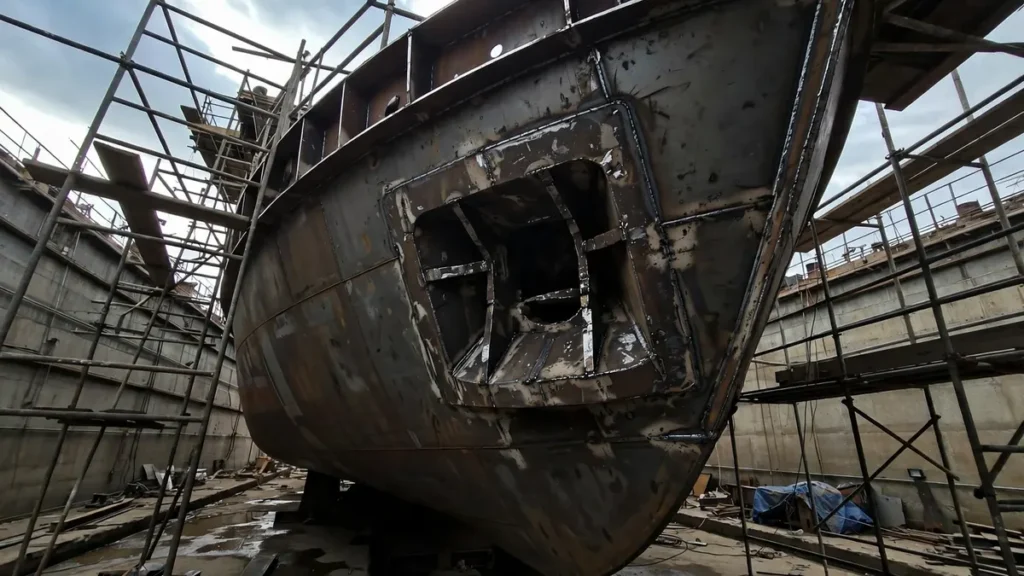
When the trunk is finished on its own, it is lifted into place and welded into the submarine’s pressure hull. This is one of the most delicate jobs in the whole build, because the trunk must become part of the hull, not just a tube stuck through it. The opening in the hull is cut to match the trunk exactly, and the two are welded together with full-penetration welds that fuse the trunk wall into the hull plate.
Reinforcing rings are welded around the joint, spreading the load from the hull frames into the trunk wall. Then the whole area is tested again, first with ultrasound and then with a pressure test of the hull section. The trunk and the hull are now one piece of steel, and they must behave as one piece when the boat dives deep and the sea presses on every square inch.
Step 6: Testing the flood, the ascent, and the seal
The final stage is testing the trunk the way it will be used. In a test tank or during harbour trials, the trunk is flooded with a crew member inside wearing escape equipment, the upper hatch is opened, and the ascent begins. Trainers watch every second: how fast the water rises, whether the valves respond, whether the hatch opens cleanly once the pressure has equalised.
After each test the trunk is drained, dried, and inspected. The seals are checked for wear, the hinges are checked for smooth movement, and the valves are exercised again. Only when the trunk has flooded, equalised, and emptied without a single fault is it signed off. From the outside, a finished submarine shows almost nothing of the trunk, just a small hatch on the top of the hull. Inside, it is a room that was built, welded, and tested to do one job perfectly, on the worst day the boat will ever have.
Why It Matters
An escape trunk is a strange piece of engineering: a room designed to fill with water, built into a vessel designed to keep water out. It is also the part of a submarine that nobody wants to use and everybody wants to know is there. Its value is not in how often it is used, but in the confidence it gives the crew, the knowledge that there is a way out, built into the boat from the first day of construction. The trunk works together with the submarine escape hatch, the door that seals the chamber, and with the wider submarine escape systems that cover the whole boat. For the final part of the journey to the surface, the crew relies on the submarine escape pod, and all three are built to the same standard: simple, strong, and tested until they cannot fail.