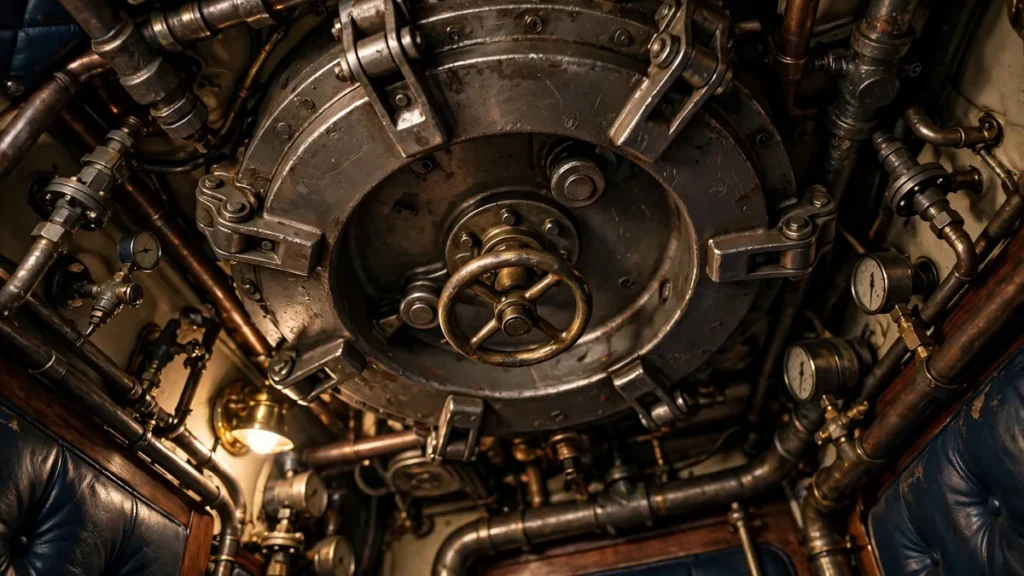
Deep under the sea, a submarine is a sealed steel tube, and the only way out in an emergency is up, through the water itself. The escape trunk is the part of the boat built for exactly that moment. It is a small, strong chamber set into the top of the hull, with a hatch at the bottom and a hatch at the top, and it is the one place on a submarine designed to be deliberately flooded.
It is easy to confuse the trunk with the hatch, but they are different things. The hatch is the door. The trunk is the room behind the door, the chamber where a crew member waits while the water rises around them, equalises with the sea outside, and then lets them out. Nothing about it is fast or comfortable, and everything about it is planned, because the trunk has to work at depth, in the dark, when nothing else on the boat does.
On a luxury submarine the trunk is built to the same standard as on any working boat, and the crew train on it until every step is automatic. This is how a submarine escape trunk works, from the moment the crew climb in to the moment they reach the surface.

How It Works
Step 1: Climbing into the trunk
Everything starts inside the boat, at the bottom hatch of the trunk. The crew member climbs a short ladder into the chamber, which is just big enough to stand in, and the hatch below is closed and dogged shut behind them. The hatch is a thick steel disc with a rubber seal and a handwheel that clamps it tight, and once it is shut, the trunk is sealed off from the rest of the boat. The trunk is deliberately small, with room for one person at a time, because a small chamber floods faster and uses less of the boat’s stored air.
Before the hatch closes, the crew member checks the escape equipment: the breathing set, the hood or mask, and the buoyancy aid, all of which are stowed inside the trunk or carried in. The trunk also holds a small light, a pressure gauge and the flooding valve, all within arm’s reach, because once the water starts rising there is no room to search for anything. The way a luxury submarine escape trunk is made sets the size of the chamber, and the way it works starts with everything being in its place before the hatch shuts.
Step 2: Flooding the chamber
With the bottom hatch sealed, the crew member opens the flooding valve, and seawater begins to enter the trunk. The water comes in through a pipe from outside the hull, and it rises steadily around the crew member’s legs, then waist, then chest. The air inside the trunk has nowhere to go, so it is compressed as the water rises, and the pressure gauge climbs with it.
The flooding is controlled, not sudden. The valve is opened in stages, and the crew member breathes from the escape set as the water rises, keeping calm and watching the gauge. The chamber is small on purpose, so flooding it does not take too long and does not use too much of the boat’s air, but it is big enough to stand in, and the ladder inside gives the crew member something to hold onto while the water comes up. A small vent at the top of the trunk lets the crew member check the water level by sound, and the gauge is checked twice before the hatch is touched. The wait is the hardest part of the escape, and the training is mostly about staying calm through it.

Step 3: Equalising with the sea
The trunk cannot be opened until the pressure inside it matches the pressure of the sea outside. If the top hatch were opened early, the sea would rush in with enormous force, and if the pressure inside were higher, the hatch would be blown open. So the crew member waits until the gauge shows the same pressure as the water outside the hull, which happens naturally as the trunk fills. At the depth of a typical luxury submarine escape drill, the pressure is only a few times that at the surface, but even that is enough to hold the hatch shut until the trunk is full.
The equalising is the key to the whole system. At shallow depth the pressure is low and the wait is short; at greater depth the pressure is higher and the wait is longer, and the trunk fills almost completely before the pressures match. The crew member knows the hatch is ready to open only when the gauge is steady and the water has stopped rising, and the training drills this check until it is automatic, because opening the hatch at the wrong pressure is the one mistake the trunk cannot forgive.
Step 4: Opening the top hatch and getting out
Once the pressures match, the top hatch can be opened. The crew member turns the handwheel, the hatch swings up and out, and for the first time the trunk is open to the sea. The crew member climbs the last rungs of the ladder, pushes up through the hatch, and leaves the boat, rising towards the surface with the buoyancy aid doing most of the work.
The exit is deliberately simple: one hatch, one ladder, one direction, up. There are no controls to set and no machinery to start, because at this point the trunk has done its job and the sea does the rest. The crew member rises steadily, breathing out on the way up, and the surface is reached in well under a minute from a shallow escape. Once clear of the boat, the crew member keeps rising without stopping, because the air in the lungs expands on the way up and must be breathed out steadily to stay safe. The top hatch is left open behind them, and the trunk stays flooded until the boat is recovered.

Step 5: Draining, resetting and training
After an escape, or after a training run, the trunk has to be put back into service. The crew pump the water out, either with the boat’s own pumps or by blowing it out with compressed air, and the bottom hatch is opened again from inside. The chamber is dried, the seals are checked, and the escape equipment is replaced, because every piece of it is single-use once it has been in the water. The seals are inspected for nicks and wear, and the handwheels are greased, because a hatch that is hard to turn in training will be harder still in a real escape.
The trunk is also the most drilled piece of equipment on the boat. The crew practise the climb, the flooding and the hatch work in a training tank on shore, again and again, until the whole sequence takes minutes and feels routine. The drills are logged and timed, and any step that takes too long is practised again until the whole crew can run the sequence without thinking. The submarine hatch is the door they practise on most, and the snorkel mast is the part that lets the boat stay down longer so the trunk never has to be used at all. A trunk that is never used is the best outcome, and a trunk that works first time is the reason the crew train on it so hard.