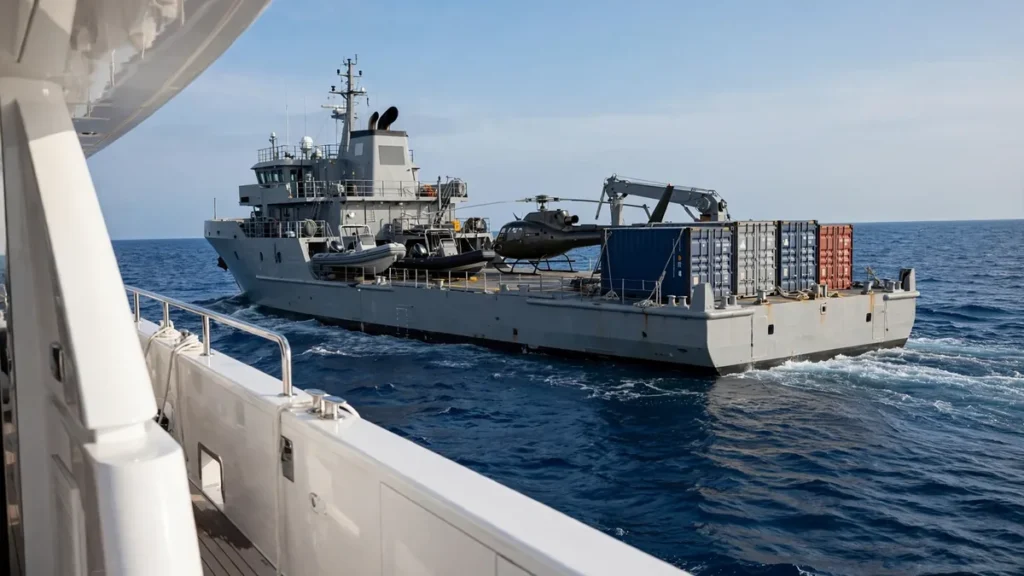
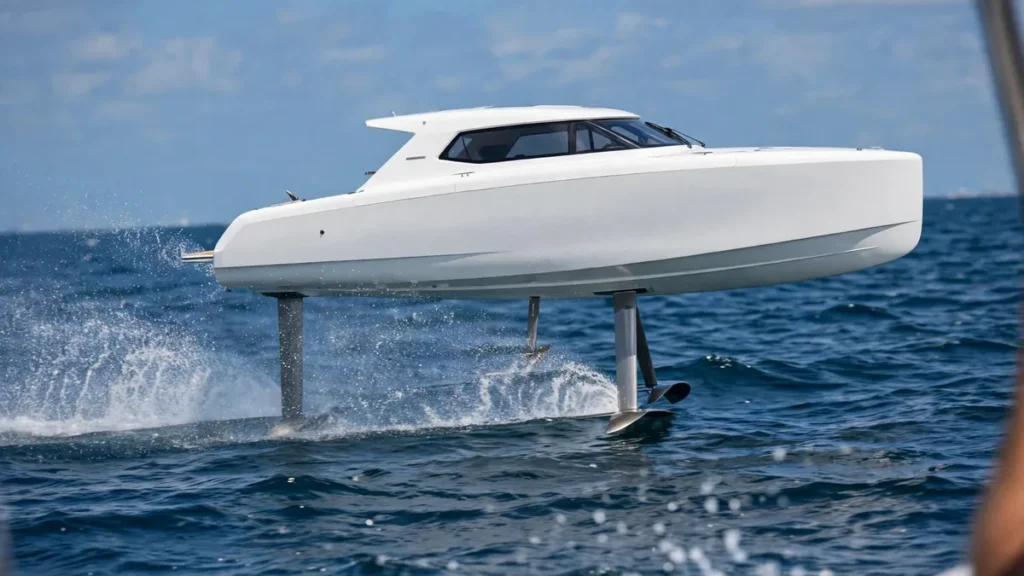
From the harbour wall, the vessel looks wrong. Two slim hulls float low in the water, joined by thin struts to a wide deck that sits high above the waves, and the whole thing looks less like a ship than a table standing in the sea. Then a swell rolls in, the other boats in the harbour rock and pitch, and the strange vessel barely moves at all.
That stillness is the whole idea of a SWATH vessel, short for Small Waterplane Area Twin Hull, and it is the reason luxury owners who hate rolling choose it over a conventional yacht. By putting almost all of its buoyancy deep underwater, in two torpedo-shaped hulls, and keeping only slim struts at the surface, it escapes the waves that throw other ships around.
This is how a luxury SWATH vessel works, from the twin hulls and the struts to the engines, the stabilisers and the deck above, and why a ship that looks odd on the water feels calmer than almost anything else afloat.

Step 1: The twin hulls carry the weight, underwater
Everything starts with the two submerged hulls, long torpedo-shaped forms that spend their whole working life below the surface. Each hull is built from steel plate, rolled and welded into a smooth cigar shape, and each one carries a propeller and a rudder at its tail. Together they hold almost all of the vessel’s buoyancy, which means the waves at the surface have very little to push against. The guide to how a luxury SWATH vessel is made follows the yard as it builds and joins these hulls, and the shape built there is what makes the calm ride in this article possible.
Step 2: Slim struts cross the waterline
From each submerged hull, two slim struts rise vertically through the waterline to support the deck. These struts are the vessel’s most delicate feature, because they are the only part of the ship that the waves can actually reach. Their cross-section at the surface is deliberately small, so a passing wave meets almost nothing to lift or push, and the vessel stays level while the sea moves around it.
Step 3: The wide deck rides high and dry
Above the struts sits the wide deck, and it is the part the guests actually live on. Because the hulls are spread apart and the deck spans between them, there is far more usable floor space than on a conventional yacht of the same length, and it sits high above the water, dry even in a swell. Cabins, a lounge, a galley and an open deck are fitted across that span, with the weight balanced carefully from side to side, because a SWATH vessel is sensitive to loading: too much weight on one side and the vessel will list, and the crew trims the ballast to keep it level. A catamaran spreads its two hulls on the surface, as the guide to how a luxury catamaran works describes, with both hulls riding the waves. A SWATH vessel does the opposite, hiding its hulls below the waves and letting the sea pass over them.
Step 4: Engines, propellers and steering
Deep in each hull sit the engines, or in newer vessels the electric motors fed by generators on the deck, driving a propeller at the tail of each hull. Having a propeller on each side gives the vessel fine control: the two can be run at different speeds to turn the ship, and together they push it forward at a steady cruising pace. The rudders sit behind the propellers, and the helm answers through a steering system that has to work through long runs from the bridge to the hulls below. The vessel is not built for speed, and it does not need to be, because its job is to arrive with its guests rested, not to arrive first.
Step 5: Stabilisers and the ride control system
Even a SWATH vessel needs help in a real seaway, and that help comes from fins and a ride control system. Small fins mounted on the hulls and struts are moved by hydraulics to counter pitch and roll, guided by sensors that read the vessel’s motion many times a second. The system is quiet and constant, trimming the fins as each wave passes, and the crew can tune it for the conditions, stiffening the ride in a beam sea or softening it in a following swell.
Step 6: Living, working and arriving rested
On board, the calm shows up in the small things. Glasses stay on tables, laptops stay open, and guests sleep through a swell that would have kept a conventional yacht’s cabins awake. The guide to the luxury SWATH vessel spec sheet, explained reads the numbers behind this stillness, from waterplane area to displacement, and the ride described here is what those numbers add up to in real life. The trade-off is real too: a SWATH vessel draws more water than a yacht of the same size, needs a wider berth, and costs more to build, which is why it is chosen by owners who value the calm above all else.
The spec sheet at a glance
| Specification | Typical luxury figure | What it tells you |
|---|---|---|
| Hull form | Two submerged torpedo hulls, four struts | Why waves barely move the vessel |
| Waterplane area | Small, by design | How little of the vessel the waves can push against |
| Length overall | 25 to 45 metres | How much deck and cabin the vessel carries |
| Beam | 12 to 18 metres | How wide and stable the deck is |
| Displacement | 200 to 800 tonnes | How much ship is in the water |
| Draft | 3 to 5 metres | How deep the hulls sit, and which harbours it can enter |
| Cruising speed | 12 to 18 knots | How fast it travels in comfort |
| Stabilisation | Fins, ride control, ballast tanks | How the vessel stays level in a real seaway |
| Guest cabins | 4 to 8 cabins | How many guests it sleeps |

What it costs
A luxury SWATH vessel typically costs an estimated $15 million to $60 million, depending on its size, its cabin fit and how much of the ride control and stabilisation is fitted. The estimate covers the vessel alone, not the crew or the running costs. Most of the price is in the twin-hull structure, the precision struts and the stabilisation system, and in the engineering that joins two submerged hulls, four struts and a wide deck into a single rigid frame that stays level in a seaway.
A rare fact
One detail few visitors ever learn is that a SWATH vessel can be steadier at anchor than a conventional yacht twice its size, and the reason is simple: a yacht at anchor still floats on the surface, so every wave lifts it, while a SWATH vessel’s buoyancy sits below the waves, where the water barely moves. In a swell, the sea’s energy fades quickly with depth, so the hulls sit in calm water while the surface churns above them, which is why the strangest-looking ship in the harbour is often the calmest one to sleep on.