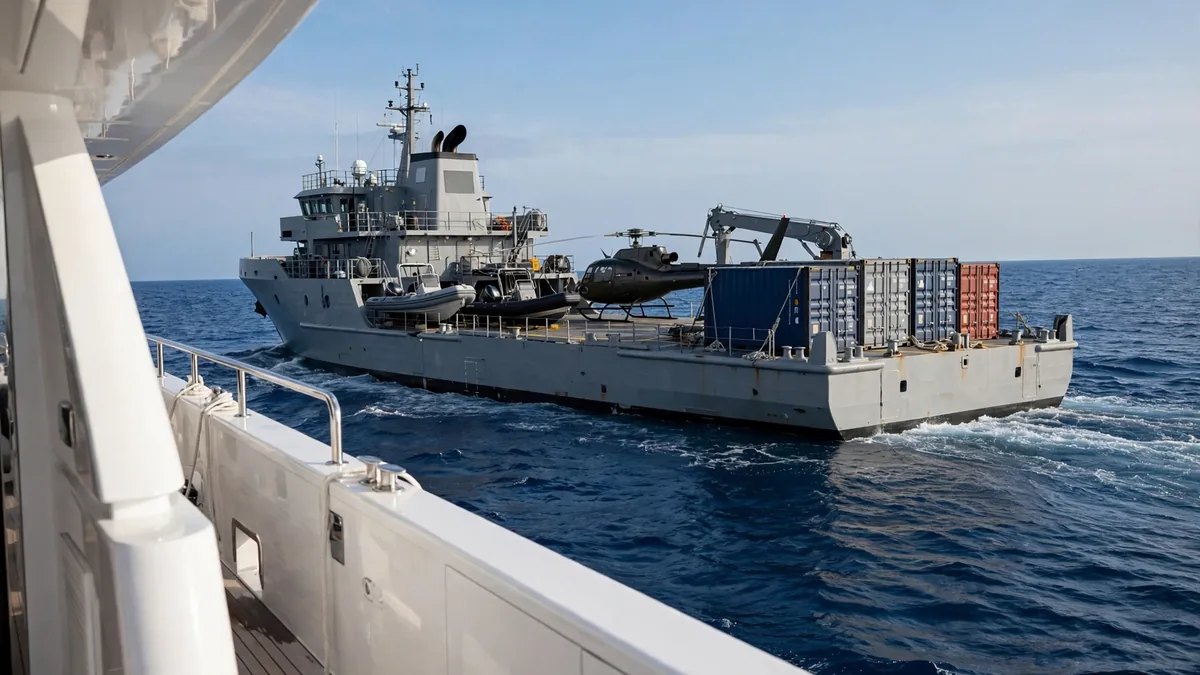
Behind every superyacht you have ever admired in a photograph, out of frame, there is another ship. It carries the helicopters, the submarines, the jet skis, the tenders, the fuel, the spare parts and the crew the yacht cannot fit aboard, and it follows the yacht everywhere it goes, a floating garage, warehouse and hotel in one. The yacht gets the photograph, and the ship behind it gets the bill. That ship is a support vessel, and it costs as much as it does because it must be several ships at once.
This is why a luxury support vessel is so expensive, in seven costs, from the deck that carries everything to the cranes, the hangar, the crew, the range and the yards that build them. Each reason alone sounds reasonable, and it is only when they are added together that the price starts to make sense, because a support vessel is not a ship with a job, it is a ship with a dozen jobs, all at once.
Reason 1: A deck that carries everything the yacht cannot
The first cost is the deck, and it is the reason the vessel exists. A support vessel has a vast open aft deck, strengthened to carry a helicopter, a submarine, several tenders, jet skis, containers of spare parts and a fuel bowser, all lashed down in weather that would throw unsecured cargo overboard. The guide to how a luxury support vessel is made follows this deck from the steel to the finished ship, where the open space is the whole point.
Reason 2: Cranes that lift a submarine over the side
The second cost is the cranes, and a support vessel carries more lifting gear than a ship twice its size. The main crane must lift a submarine or a tender over the side and lower it gently into the sea, in a swell, with the ship rolling, and it must do it precisely, because a swinging load beside a hull is a danger to both. The cranes are hydraulic, computer-controlled, and fitted with heave compensation, a system that pays out and takes in wire as the ship rises and falls, so the load stays still while the ship moves around it.
Reason 3: A hangar, a helideck and a submarine garage
The third cost is the enclosed spaces, and a support vessel is full of them. The tenders live on cradles, the jet skis in racks, and every one of these spaces needs light, power, ventilation and fire protection, so the vessel is a floating workshop as well as a floating garage, and the guide to luxury support vessel specs, explained sets out the numbers behind these spaces, the deck area, the hangar size and the lift capacity, in the same plain terms.
Reason 4: Crew, guests and a hotel that never closes
The fourth cost is the people, and a support vessel carries more of them than a ship its size usually does. There are the crew who run the ship, the technicians who maintain the helicopter and the submarine, the deck crew who handle the cranes, and the relief crew for the yacht itself, who live aboard the support vessel and transfer to the yacht when they are needed.
Reason 5: Range and endurance, because the yacht never stops
The fifth cost is the range, and it is the one that follows from the job. A support vessel must go wherever the yacht goes, and the yacht goes everywhere, so the vessel carries fuel for thousands of miles, fresh water for months, and stores for a season at sea, because there may be no port where the yacht anchors. The guide to how a luxury SWATH vessel works shows a different answer to the same problem of staying steady and going far, where a twin-hull design carries the load instead of a single hull, and the lesson is the same: a support ship must be able to stay out as long as the yacht stays out.

Reason 6: Systems that serve two ships, not one
The sixth cost is the duplication, and it is the hidden cost of the whole idea. A support vessel carries fuel for the yacht as well as for itself, and the fuel system must transfer it at sea, through hoses and pumps, without spilling a drop. It carries fresh water for the yacht, spare parts for the yacht’s engines, and a workshop that can fix the yacht’s tenders, and its communications must link the two ships, so the yacht’s captain can call the support vessel’s captain as if they were on the same bridge.
Reason 7: Few yards, few ships, and owners who do not haggle
The seventh cost is the simplest: very few support vessels are ever built, and the people who buy them do not haggle over the price. A yard that builds a support vessel is building a one-off, designed around the yacht it will serve, with a deck laid out for that yacht’s helicopter and that yacht’s submarine, and the design alone costs a fortune before any steel is cut.
The support vessel at a glance
| Part | Typical luxury figure | What it tells you |
|---|---|---|
| Deck | Large open aft deck, strengthened for heavy loads | What the vessel can carry for the yacht |
| Cranes | Main crane lifting tonnes, heave-compensated | How a submarine is launched at sea, in a swell |
| Hangar | Helicopter hangar with helideck | Where the aircraft lives, serviced and out of the spray |
| Garage | Submarine dock or cradle, under cover | Where the submersible is kept, charged and maintained |
| People | Crew, technicians, relief crew for the yacht | How many live aboard, and how they are housed |
| Range | Thousands of miles, months at sea | How far the vessel can follow the yacht without a port |
| Fuel transfer | At-sea refuelling for the yacht | How the yacht is kept running far from any quay |

What it costs
A luxury support vessel typically costs an estimated $30,000,000 to $100,000,000, depending on its size, its deck, its cranes and its hangar. The estimate covers the vessel alone, not the helicopter, the submarine or the tenders it carries, which are the yacht’s toys, and which cost as much again before the support vessel ever leaves port.
A rare fact
One detail few yacht watchers ever learn is that a support vessel often carries more crew than the yacht it serves, and its crew includes people the yacht never has aboard: submarine pilots, helicopter engineers and crane operators, specialists who live on the support vessel and transfer to the yacht only when their machine is needed.
Add the seven costs together, the deck, the cranes, the hangar, the people, the range, the duplication and the bespoke build, and the price of a luxury support vessel stops looking like an extravagance and starts looking like arithmetic. It is the price of a superyacht that can actually do what its brochure promises, charged to the ship that makes the promise true, sailing just out of frame.


