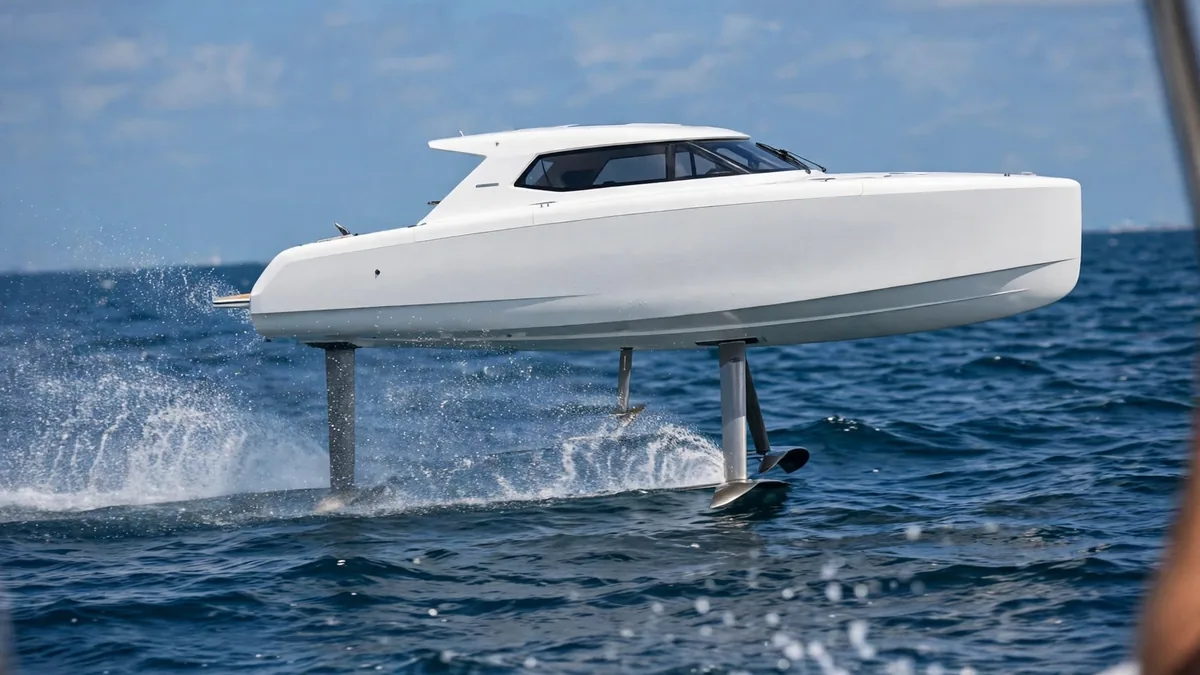
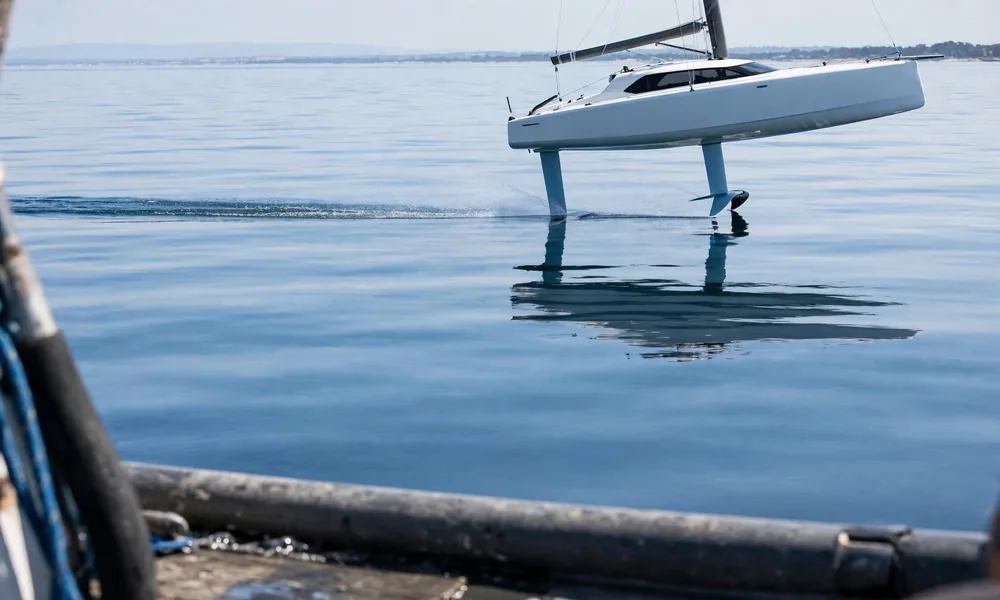
On a calm morning in a harbour, a yacht leaves its berth, and as it gathers speed, something strange happens: the hull rises out of the water, the spray falls away, and the boat begins to fly, skimming the surface on two thin wings, with the hull itself clear of the waves. The passengers feel the ride go smooth, the noise drop away, and the speed climb past forty knots, and the boat is no longer sailing through the water, it is flying just above it. The boat is a hydrofoil yacht, and it works by lifting itself out of its own element.
This guide explains the numbers on a luxury hydrofoil yacht spec sheet in plain English: what each one means, which ones decide when the boat takes off and how fast it can fly, and how to tell a genuinely capable foiling yacht from a merely well-marketed one.
Take-off speed: the moment the hull leaves the water
The first number on the sheet is the take-off speed, the speed at which the foils generate enough lift to raise the hull clear of the water, usually around fifteen to twenty knots. Below that speed the yacht is an ordinary boat, pushing water aside with its hull, and above it the hull is in the air, and only the foils and the propeller touch the sea. Once airborne, the drag falls away, and the yacht accelerates quickly to its cruising speed, which is why a foiling yacht feels like two boats: a slow one below take-off, and a fast one above it.
The foils: wings under the water
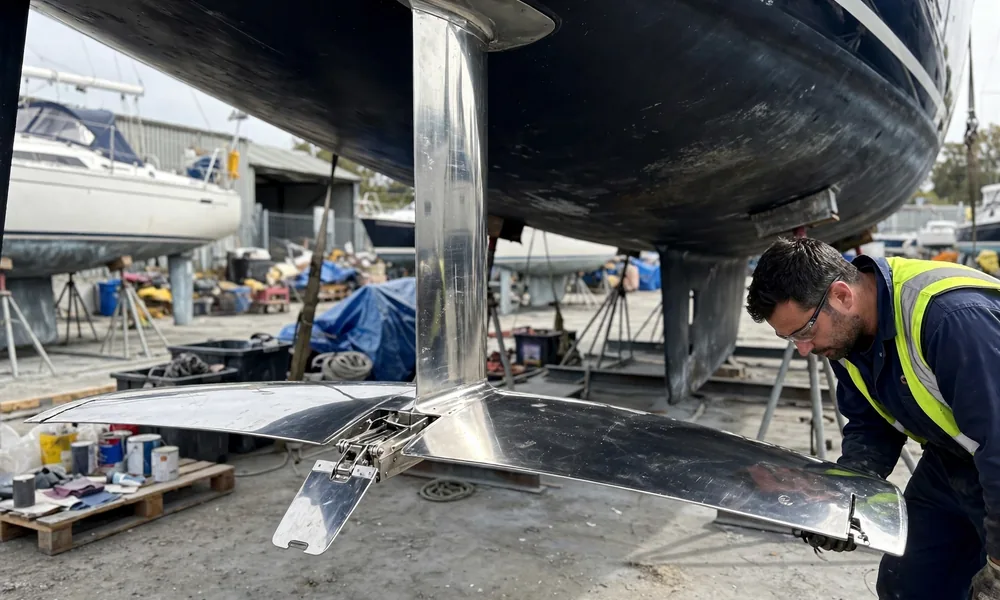
The foils are wings, shaped like aeroplane wings but working in water, which is eight hundred times denser than air, so they can be small and still lift a heavy yacht. The front foil carries most of the weight and the rear foil steers, and both are made from carbon fibre or stainless steel, polished to a mirror finish, because a rough foil creates drag and a smooth foil lifts cleanly. The guide to how a luxury hydrofoil ferry is made shows the same foils built larger and stronger for a boat that carries passengers on a timetable, where the foils must lift a heavier load every day.
Top speed and range: what flying buys you
A foiling yacht is fast because it has escaped the drag of the water, and the sheet quotes a top speed of forty to fifty knots, nearly twice what a hull of the same size could manage in the water. The range is quoted at cruising speed, usually thirty to forty knots, and it is longer than a conventional yacht’s range at the same speed, because the foils use less power to hold the boat up than the hull uses to push water aside.
Control: the computer that keeps the boat level
A foiling yacht is balanced on two thin wings, and it cannot stay level without help, so the sheet quotes the control system, a computer that reads sensors a hundred times a second and adjusts the foils to keep the boat steady. The crew set the height they want, usually about a metre, and the computer holds it, and the guide to luxury trimaran specs, explained sets out a different answer to the same problem, where three hulls spread the load instead of lifting it, and the ride is stable without a computer at all.
Power: engines that push a flying boat
The yacht needs power to reach take-off and to stay flying, and the sheet quotes it in horsepower, usually over a thousand, delivered by diesel engines or by a hybrid system with electric motors. The propellers sit on pods below the hull, or on the rear foil itself, where they stay in the water even when the hull is flying, and they are designed to work in the thin, fast water behind the foils. The guide to how a luxury racing yacht is made follows a different kind of speed, where the power comes from the wind and the hull is built light, but the lesson is the same: speed is bought with power, and the sheet shows exactly how much.
Seakeeping: what happens when the sea is not calm
The last numbers describe what happens when the sea is rough, because a foiling yacht is at its best in calm water and must be able to cope when the waves grow.
The spec sheet at a glance
| Specification | Typical luxury figure | What it tells you |
|---|---|---|
| Take-off speed | Roughly 15 to 20 knots | When the hull leaves the water, and the flight begins |
| Top speed | Roughly 40 to 50 knots, foiling | How fast the yacht goes once it is flying |
| Cruising speed | Roughly 30 to 40 knots, foiling | How fast it travels comfortably, and how far it goes |
| Foils | Carbon fibre or stainless steel, retractable | What lifts the yacht, and how it is stowed in the marina |
| Power | Roughly 1,000 horsepower or more | How much push it takes to reach take-off and stay flying |
| Control | Computer, sensors, flaps, adjusted 100 times a second | How the yacht stays level on two thin wings |
| Seakeeping | Foils in waves up to about 1 metre | When the yacht must come down and sail as an ordinary boat |
| Range | Longer at foiling speed than a hull at the same speed | What the flight saves in fuel, once the take-off is paid for |
What it costs
A luxury hydrofoil yacht typically costs an estimated $5,000,000 to $20,000,000, depending on its length, its foils and its control system. The estimate covers the yacht alone, not the crew, the marina fees or the foils, which must be inspected and polished regularly, and which are a real and recurring cost of keeping a flying boat in the air.
A rare fact
One detail few harbour visitors ever learn is that the foils on a yacht work in water so dense that a wing the size of a coffee table can lift a boat weighing twenty tonnes. Water is eight hundred times denser than air, so a small foil at speed generates enormous lift, and that is why the foils can be thin and the struts slender, and why a foiling yacht looks so improbable: a great white hull balanced on wings you can barely see, flying on water that would sink an aeroplane’s wing in an instant.
Read the spec sheet in that order, take-off first, then the foils, the speed, the control, the power and the sea, and the numbers stop looking like a dare and start looking like a description of a machine. The best hydrofoil yachts are not the ones with the biggest single number, but the ones whose numbers agree with each other, foils the engines can lift, a computer the crew can trust, and a hull that is happy to fly, and equally happy to come down when the sea says so.


