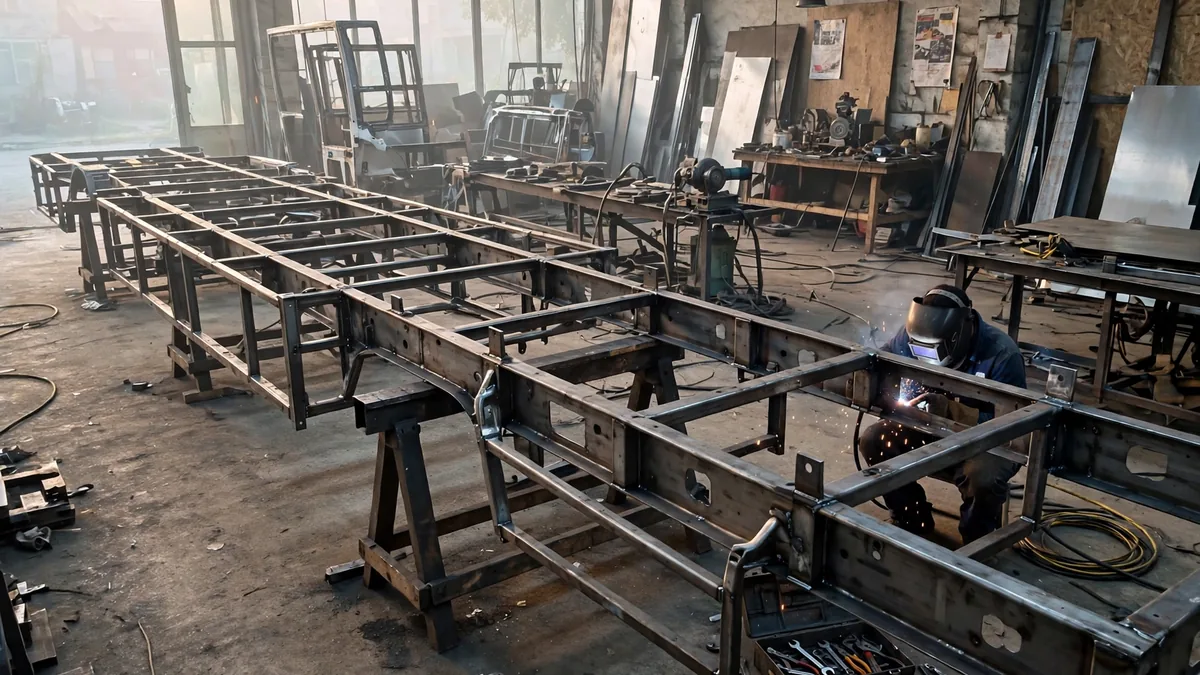
At half past five on a cold morning, the factory floor is already loud with work. There is no paint on it yet, no glass, no seats, nothing that looks like a bus at all. In eight weeks this frame will be a luxury tour bus, carrying twenty-four people across a continent in leather chairs, and the transformation starts here, with steel.
This is how a luxury tour bus is made, from the welded frame and the hand-fitted body to the seats, the kitchen, the wiring and the final road test, and why building one takes weeks of hand work rather than hours on a production line.
Step 1: The frame is welded and squared
Every luxury tour bus starts with a frame, and the frame decides everything that follows. Each weld is checked as it cools, because a frame that twists by a few millimetres will make every panel, door and window fight for its place later. The suspension mounts, the engine cradle and the steering gear are bolted to the frame while it is still bare, so the fitters can reach every bolt without crawling under a finished floor. The whole frame is then measured corner to corner with tapes and lasers, and it is not allowed to move on until the diagonals match. The guide to how a luxury tour bus works picks up where this build leaves off, showing what the finished chassis has to carry for days on the road.
Step 2: The body shell is raised around the frame
With the frame square, the body begins to rise. Large panels of steel and aluminium are cut, folded and welded into a single shell, roughly twelve to fourteen metres long, with the roof, the sides and the floor joined into one rigid box. The doors are hung and adjusted until they close with a soft thunk, and the luggage bay doors under the floor are fitted with gas struts so a driver can open them with one hand. A luxury tour bus shell takes shape slowly, panel by panel, because no two operators order quite the same bus.
Step 3: The engine, suspension and brakes are fitted
Under the floor, the running gear goes in next. A large diesel engine, tuned for torque rather than speed, is lifted into its cradle and bolted down, and the air suspension and the brakes, sized for a fully loaded bus coming down a mountain pass, follow it into place. Every connection is tested before the floor goes down, because reaching a buried pipe later means stripping the cabin apart. The reasons all of this hardware costs so much are set out in the guide to why a luxury tour bus costs so much, which follows the money through the body, the seats and the systems.

Step 4: The cabin is fitted out like a lounge
Once the shell is painted and the running gear is tested, the cabin work begins, and this is where the bus stops looking like a vehicle and starts looking like a hotel. The floor is laid in carpet and wood-effect panels, the ceiling is lined with soft fabric and fitted with reading lights, and the walls are panelled in veneer cut to match across every joint. The guide to how a luxury camper van works shows the same living-space logic on a smaller scale, a vehicle built to be lived in rather than just travelled in.
Step 5: The wiring, air and screens are connected
A modern tour bus carries more wiring than a small house, and fitting it is a job for patient hands. Looms run the length of the bus behind the panels, feeding the lights, the screens, the charging sockets, the air conditioning and the guide’s microphone system, and every circuit is labelled at both ends. The air conditioning unit sits on the roof, with ducts running above every seat, and the heater is sized to warm the whole cabin on a cold morning before the first passenger boards. Personal screens are fitted to the seat backs, each one wired to a central media system, and the guide’s station at the front gets a microphone, a small desk and a screen showing the route. The battery bank is fitted under the floor, big enough to run the lights, the fridge and the screens with the engine off, so the group can stop for lunch without losing power. The whole electrical system is then powered up, circuit by circuit, and every light, socket and screen is tested before the panels are screwed shut for the last time.
Step 6: Testing, tuning and the first road run
The finished bus is not handed over on the day the last panel goes on. Inside, the fitters ride along and listen, hunting for rattles, whistles and buzzes, and every noise is chased to a loose clip or a panel that needs a felt pad. The air conditioning is run at full heat and full cold, the kitchen is used as if a tour were under way, and the washroom is flushed a dozen times. Only when the bus is quiet at motorway speed, level on its springs and free of rattles does it go for its final wash, its final polish and its first real tour.
The spec sheet at a glance
| Specification | Typical luxury figure | What it tells you |
|---|---|---|
| Length | Roughly 12 to 14 metres | How long the bus is, and which roads it can use |
| Seats | 20 to 24, leather recliners | How many people it carries, and how much room each has |
| Frame | Welded steel ladder chassis | How stiff the body stays over years of touring |
| Engine | Large diesel, high torque | How easily it climbs hills fully loaded |
| Fuel range | Roughly 1,000 kilometres or more | How far it can run without stopping for fuel |
| Suspension | Air springs, height adjustable | How smooth the ride feels, and how it kneels at a stop |
| Kitchen | Fridge, coffee machine, boiler | How the group is fed on the road |
| Build time | Several weeks of hand work | Why no two tour buses are quite the same |
| Washroom | Toilet, sink and mirror | How the group stays fresh on long days |
What good design looks like
A well-built luxury tour bus gives itself away in small details. The best test is the simplest: stand in the aisle with the engine running and listen. If you hear the engine, the build is not done yet.

What it costs
A luxury tour bus typically costs an estimated $500,000 to $1.2 million, depending on its length, its seats, its kitchen and the systems fitted inside. The estimate covers the bus alone, not the driver, the guide or the running costs. Most of the price is in the hand-built body, the twenty-four leather seats and the air, power and kitchen systems, and in the weeks of skilled labour that fit them all together.
A rare fact
One detail few passengers ever learn is that a luxury tour bus can kneel. The air suspension can lower the whole body by several inches at a stop, so the step up from the kerb is no higher than a single stair, and older passengers can board without climbing. The driver raises it again before pulling away, and the bus settles back onto its air springs as smoothly as it lowered, which is also why the builders spend so long getting the suspension geometry exactly right.