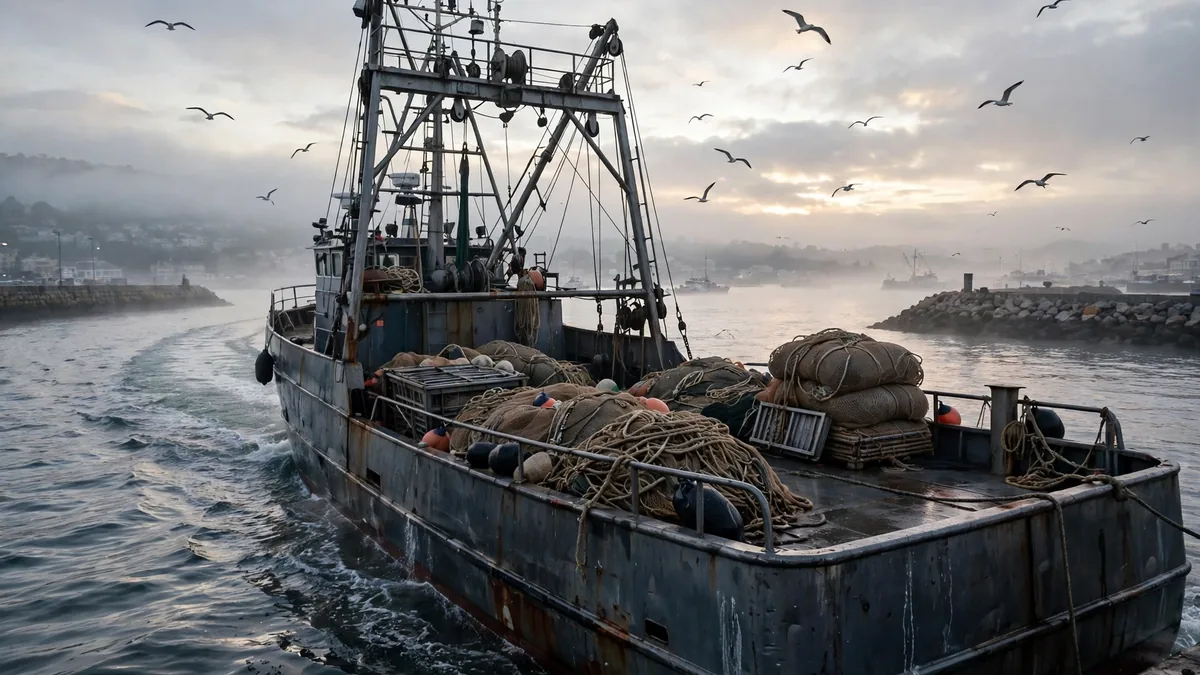
Before dawn in the fishing port, the trawler is already awake. Deck lights buzz on, the winch crew checks the warps, and the smell of diesel and salt hangs in the cold air. She is not a yacht dressed up as a workboat. She is a working fishing vessel, built to drag a net through the sea for hours, haul a catch aboard in all weathers, and keep her crew fed, warm, and safe while she does it.
That distinction matters, because the word trawler is used for two very different boats. A trawler yacht is a pleasure craft shaped like a fishing boat, built for slow, comfortable cruising. A luxury fishing trawler is the real thing: a commercial vessel with trawl gear, fish holds, and a working deck, built to earn her keep. This article is about the second kind, and about how a shipyard builds a boat that can work hard at sea and still treat her crew well. The trawler yacht is a fine way to travel, but the boat described here is built to fish.
How a Luxury Fishing Trawler Is Made
Step 1: A hull built for heavy weather
A fishing trawler’s hull has to do two jobs that pull in opposite directions. It must be strong enough to tow a heavy net through rough water, and stable enough that the crew can work safely on an open deck while the boat rolls. Shipyards build the hull from thick steel plate, welded over closely spaced frames, with a rounded bow that lifts over waves rather than punching through them. The steel hull of a cargo ship is built for a similar kind of punishment, but a trawler’s hull is shaped for the North Sea or the North Atlantic, where a wave can arrive from any direction and the boat must take it and keep fishing.
Step 2: The engine room and propulsion
The engine is the heart of the trawler, and it is chosen for pulling power rather than speed. A large, slow-turning diesel engine drives a single propeller through a gearbox, and many modern trawlers add a controllable-pitch propeller, which lets the captain change the bite of the blades without changing the engine speed, giving fine control while towing. A bow thruster helps the boat hold position while the net is shot or hauled, and a shaft generator makes electricity from the main engine while it is running, so the boat does not need to run separate generators all day. The hybrid ship propulsion now fitted to some new trawlers adds a battery bank that can take over in harbour, cutting noise and exhaust while the crew unloads.
Step 3: Trawl gear and the working deck
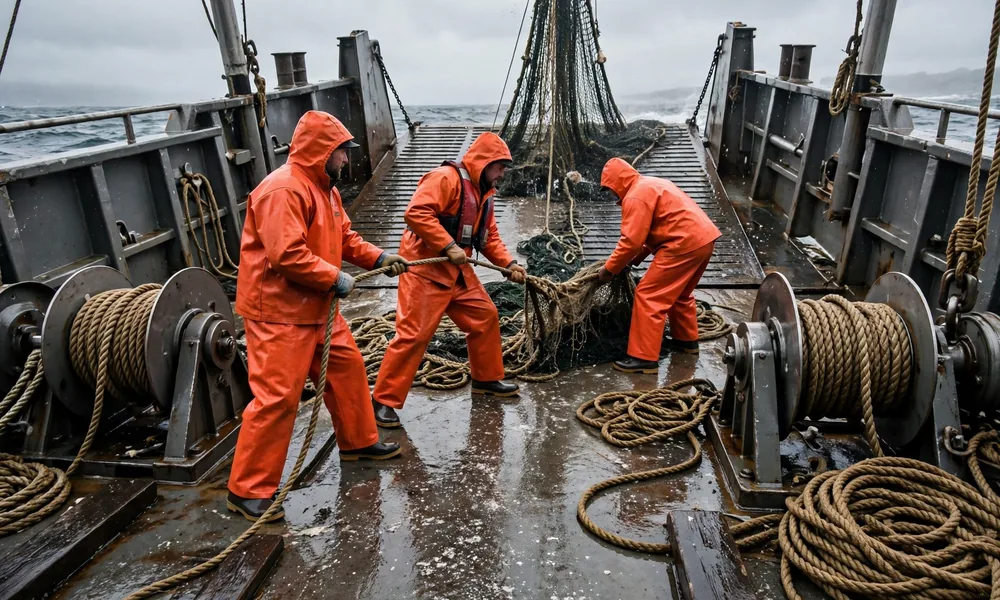
The working deck is where the trawler earns her living, and it is laid out like a factory floor. A tall stern gantry, sometimes called an A-frame, carries the trawl warps, the steel cables that tow the net, and a stern ramp lets the net slide into the water and the catch slide back aboard. Powerful winches, each the size of a small car, wind the warps in and out under precise control, and net drums store spare trawls ready to be rigged. The trawl doors, heavy steel plates that hold the mouth of the net open as it is towed, are stowed in racks on either side of the deck. Every fitting is oversized and easy to reach in gloves, because trawl gear is handled in the dark, in the rain, and with cold hands.
Step 4: Fish holds and the catch handling line
Below the working deck, the catch is handled with the same care a good restaurant gives its fish. The catch comes aboard through the stern, is sorted on a conveyor, and is gutted and washed before it goes into refrigerated seawater tanks or ice holds, where it is chilled to just above freezing within hours of being caught. The holds are insulated with thick foam panels and lined with smooth, washable surfaces, and the refrigeration plant is duplicated, so that one failure cannot spoil a whole trip’s catch. A full hold is worth a great deal of money, and the shipyard designs the whole boat around keeping it cold.
Step 5: Cabins, galley, and crew comfort
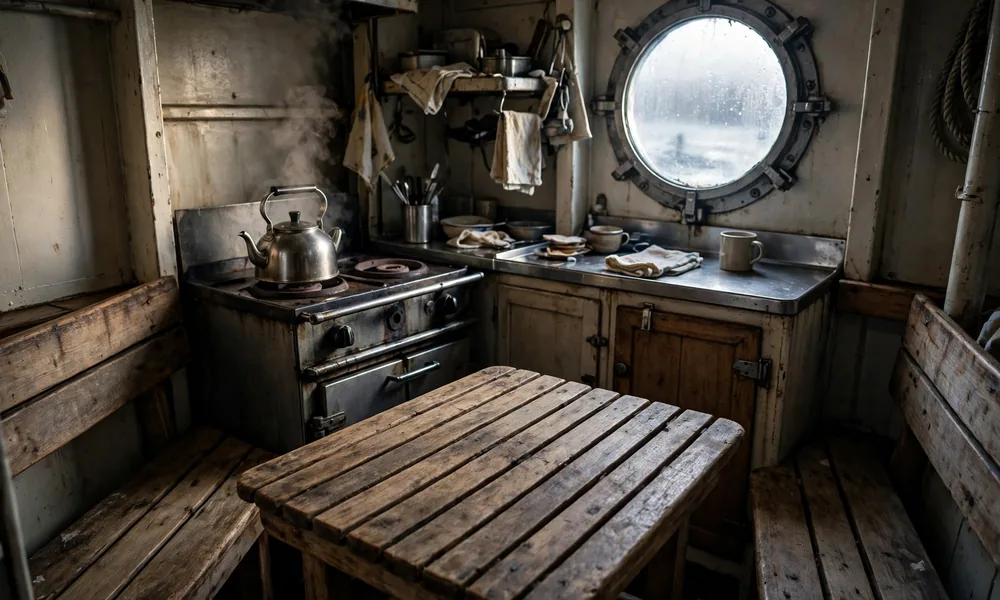
This is where the luxury in a luxury trawler actually lives. Older trawlers were famous for cramped, noisy cabins, and modern owners have learned that a rested crew fishes better and stays safer. Cabins are now single or double berths with real mattresses, blackout blinds, and individual heating, set as far as possible from the engine room and insulated against noise and vibration. The galley is a proper working kitchen with a large cooker, cold storage, and a mess room where the whole crew can eat together, and there is a drying room for wet oilskins, a laundry, and a small gym or lounge for off-watch hours.
Step 6: Bridge, electronics, and sea trials
The wheelhouse of a modern trawler is a wall of screens. Sonar shows the shape of the seabed and the shoals of fish below it, radar and satellite navigation track the boat’s position to within a metre, and a computer records exactly where every tow was made, so the skipper can return to a productive patch of sea. Once the electronics are fitted, the trawler goes to sea for trials: towing a net, testing the winches under load, checking stability with a full hold, and running the engines at full power. Only when she has proved she can fish safely, and bring her crew home in comfort, is she handed over to her owner.
Specifications
| Feature | Typical luxury fishing trawler |
|---|---|
| Length | 30 to 70 metres |
| Beam | 9 to 15 metres |
| Crew | 10 to 25, depending on size and fishery |
| Main engine | 1,500 to 6,000 kilowatts, slow-speed diesel |
| Fish hold | 200 to 1,500 cubic metres, refrigerated |
| Endurance | 14 to 21 days at sea |
| Trawl gear | Stern trawler, twin winches, stern ramp and gantry |
What It Costs
A new luxury fishing trawler is a serious commercial investment. A smaller vessel of around 30 metres, fitted for inshore fishing with good crew accommodation, is estimated to cost roughly $8 million to $15 million to build. A larger deep-water trawler of 60 metres or more, with a full processing line, large refrigerated holds, and premium crew quarters, is estimated to cost roughly $40 million to $80 million. Those are estimates, and the final figure depends on size, fishing gear, and processing equipment.
A Rare Fact
Here is a detail that surprises most people who have never worked a trawler: the net is not dragged along the seabed like a plough. On many modern trawlers the net fishes in mid-water, held open by trawl doors that fly through the water like kites, and sonar on the net itself tells the skipper exactly how deep it is and how many fish are passing through it. The skipper can raise or lower the net by metres while it is still towing, steering it through a shoal the way a pilot steers through a cloud. The same sonar can even tell the skipper what species is below, because different fish reflect sound in different ways, and an experienced skipper reads those echoes the way a musician reads a score. It is a skill no machine has fully replaced.


