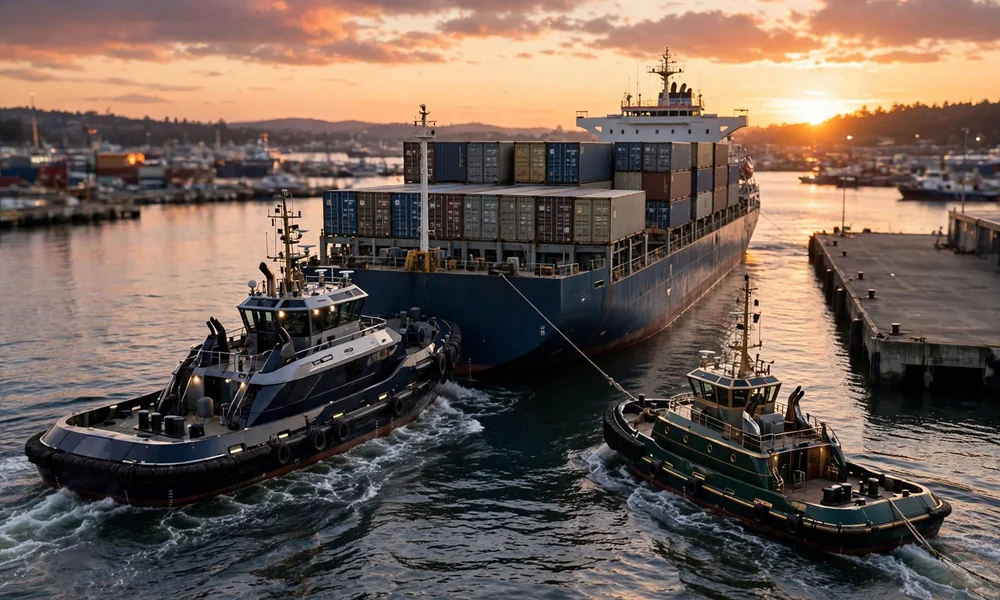
The container ship is longer than three football fields, and it is coming into port with a crosswind pushing it sideways and a tide running against it. So it waits at the harbour entrance, and out come the tugs, small and stubby beside it, looking almost comical against the steel wall of the ship’s hull. A luxury tugboat is the strongest small boat in the harbour, and its luxury is in the power packed into a hull barely thirty metres long.
Tugs have been pushing ships around for two centuries, but the modern luxury tug is a precision instrument, not a blunt workhorse. It works in all weathers, day and night, and it is expected to handle ships worth hundreds of millions of dollars without ever scratching their paint. The crew is small, often just four or five people, and the boat does the heavy lifting for them.
The secret of a tug is leverage and control. It does not need to be big, because it does not fight the ship. It nudges it, holds it, and steers it, using its own thrust and the shape of its hull to turn the ship’s momentum in the direction the pilot wants. This is how a luxury tugboat works, from the first line ashore to the last push into the berth.

How a luxury tugboat works
Step 1: The call-out and the approach
A tug’s job starts with a call from the harbour pilot, who is already aboard the incoming ship and knows exactly what help it needs. The approach is the first test of the crew’s skill, because the tug must come alongside a moving ship without touching it, matching its speed in a channel that may be barely wider than the ship itself. The same harbour craft that guides ships in from the sea is the one described in how a luxury pilot boat works, where the approach is also the hardest part of the job.
Step 2: The hull, fenders and towing gear
A tug’s hull is short, wide, and deep, built to be stable and to take punishment. The bow and sides are protected by heavy rubber fenders, thick tyres or moulded rubber blocks that let the tug push directly against a ship’s hull without damaging either vessel, and the deck is kept clear and low so the crew can handle lines safely. The towing gear is the heart of the working deck: a powerful winch at the stern that pays out and recovers the towline, a towing hook that can release the line instantly in an emergency, and a towline itself made of high-strength synthetic rope that is stronger than steel wire at a fraction of the weight.
Step 3: The engines and the propulsion system
Power comes from two large diesel engines, each producing well over a thousand horsepower, driving a propulsion system designed for thrust at low speed rather than speed itself. Most modern luxury tugs use azimuth thrusters, propellers mounted in pods that can rotate through 360 degrees, which means the tug can push in any direction without turning its hull, and can even hold a fixed position against wind and current. That force is called bollard pull, and a good harbour tug can pull more than seventy tonnes, enough to move a ship that outweighs it a hundred times over. The figures behind that power are laid out in the luxury tugboat specs explained guide, from bollard pull to engine power.
Step 4: Pushing, pulling and steering the ship
Once the line is made fast, the tug goes to work, and the work is a conversation between the tug captain and the pilot on the ship. The pilot calls for a push here and a pull there, and the tug answers with its thrusters, pushing against the ship’s bow or pulling from the stern, turning the ship a degree at a time. The tug must constantly adjust for wind and tide, because a ship that big is a sail in a crosswind, and the pilot’s job is to bring it to the berth at a walking pace, exactly parallel to the quay.
Step 5: Berthing and letting go
The final approach to the berth is the most delicate part of the job. The ship is moving at barely a knot, the tugs are holding it off the quay and nudging it sideways, and the mooring lines are going ashore one by one. The tug holds the ship in position while the lines are made fast, then eases away, its fenders peeling off the hull without a mark. Then the tug lets go, backs clear, and heads for its next job, often before the ship’s gangway is even down. The same quiet precision serves the biggest ships in the harbour, including the one whose journey is described in how a luxury car carrier works, where the final berthing is also a team effort.
Step 6: Escort, rescue and harbour standby
Between berthing jobs, a luxury tug does other work that the harbour depends on. It escorts large ships, especially tankers, in and out of port, running alongside them ready to take a line if the ship loses power or steering, a job that has prevented more than one grounding. Many tugs also stand by for emergencies, crewed around the clock, because a harbour never really sleeps, and a ship in trouble does not wait for office hours.

Specifications
| Specification | Typical figure |
|---|---|
| Length | 25 to 35 metres |
| Bollard pull | 60 to 80 tonnes |
| Engine power | 2,000 to 4,000 horsepower combined |
| Top speed | 12 to 14 knots |
| Crew | 4 to 6 people |
| Propulsion | Azimuth thrusters, 360 degree thrust |
| Estimated price | From around $8,000,000, an estimate |
The price of a luxury tugboat is an estimate, because the final figure depends on the bollard pull, the thrusters, and the deck gear. A well-equipped luxury harbour tug typically starts from around $8,000,000, and a top-specification escort tug with the most powerful thrusters, firefighting monitors, and a full rescue fit can pass $12,000,000. The tug is small, but the trade it serves is enormous.
A rare fact
Here is a detail that surprises even sailors: a luxury tugboat can pull harder than it can push, and its bollard pull, the force it can exert on a towline, is measured by tying the tug to a bollard on the quay and running its engines at full power, like a tug-of-war against the harbour itself. A tug that pulls seventy tonnes is not showing off. It is proving it can hold a ship that weighs a hundred times more than it does, and that proof is what the pilot trusts when the wind gets up.
A finished tugboat is the harbour’s strongman in miniature: a short, wide, powerful boat that spends its life making giants look graceful. Its luxury is in the wheelhouse with its view in every direction, in the thrusters that answer a fingertip, and in the crew that can bring a ship the length of three football fields to a berth without a scratch. That is the tug’s quiet achievement, and it happens every day, in every port in the world.