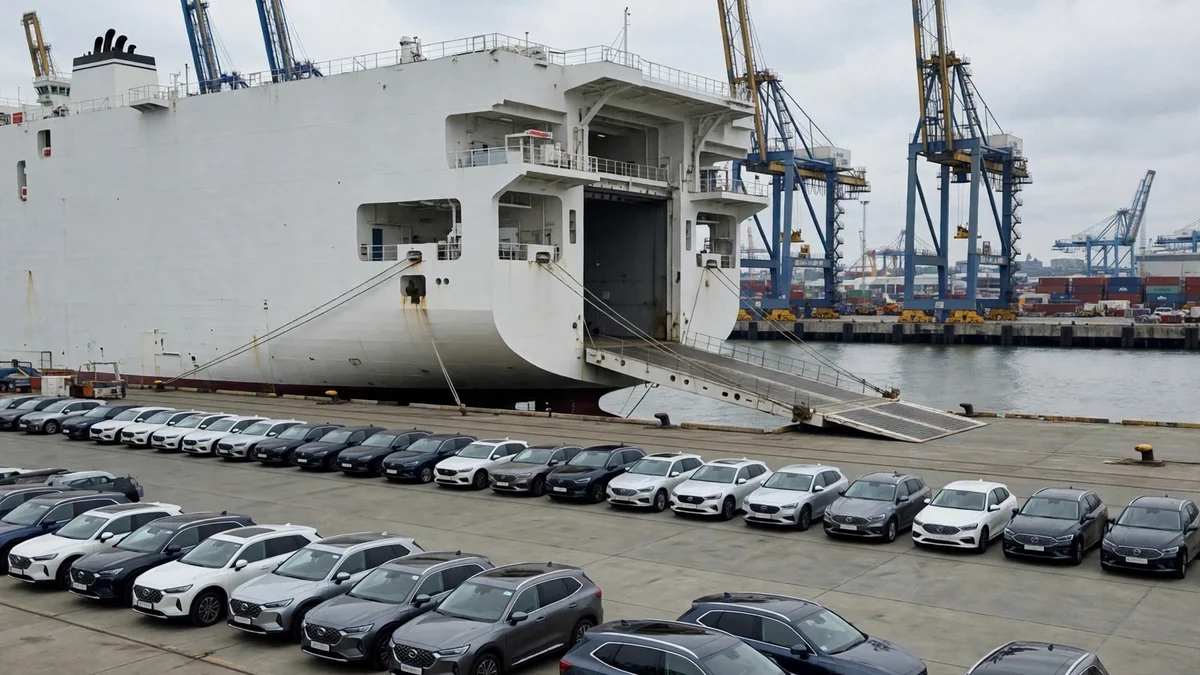
The ship looks like a floating multi-storey car park, a great white box with no windows and a stern door as tall as a house. It has come from Japan, and in its belly are five thousand new cars, parked in neat rows on thirteen decks, strapped down and waiting for the ramp to drop. On the quay, a line of drivers waits with keys in hand. In a few hours, the first cars will roll down the ramp and out into the daylight.
A luxury car carrier is a ship built to move thousands of vehicles across oceans without scratching one. It is a floating garage, a warehouse and a ship in one, and its crew treats every car aboard as if it were their own.
How a Luxury Car Carrier Works, Step by Step
Step 1: The hull and the garage decks
A car carrier is built around its decks, not its holds. Inside the hull are up to thirteen decks, stacked like the floors of a car park, connected by ramps and lifts. The decks are flat, painted, and fitted with lashing points, small steel eyes in the floor where the cars are tied down. The sides are high and solid, with no windows, to keep the weather and sea out, and the whole hull is one vast, dry garage. The size and layout of the decks are the ship’s real specification, and the full figures are in the guide to luxury car carrier specs explained.
Step 2: Loading through the stern ramp
Cars come aboard through a stern ramp, a huge door at the back of the ship that lowers to the quay. Drivers drive the cars up the ramp and onto the decks, parking them in rows with barely a hand’s width between them, then lash each car down with straps over the wheels. The loading is done in a careful order, with the cars to be unloaded first parked last, so they are nearest the ramp at the next port. A large carrier can take on five thousand cars in a day, and every car is checked for damage as it comes aboard.
Step 3: The engine and the propeller
The engine is a large, slow-running diesel, similar to the one in an oil tanker, driving a single propeller. It is efficient rather than fast, pushing the ship at eighteen knots, enough to keep a schedule between continents. The engine room is manned around the clock, because a car carrier that breaks down at sea is a car park full of cars going nowhere. Generators power the ventilation fans, the lifts and the lighting, because a garage full of cars needs fresh air and light at all times.
Step 4: Ventilation and fire safety
A garage full of cars is a fire risk, so a car carrier has some of the strictest fire safety at sea. The decks are ventilated by large fans that change the air constantly, sweeping away fuel vapour and exhaust fumes. Smoke detectors watch every deck, and the ship carries a carbon dioxide system that can flood a deck with gas to smother a fire, as well as water sprinklers and a crew trained to fight fires in a garage. The cars are part of the safety plan: their fuel tanks are kept nearly empty during the voyage, and their batteries are disconnected.

Step 5: The bridge and navigation
The bridge sits at the top of a tall, white superstructure at the front of the ship, with a view over the bow and the sea ahead. From here the captain and officers steer, using radar, satellite navigation and electronic charts, with an autopilot holding the course between ports. The ship is high-sided and catches the wind, so the officers watch the weather carefully and plan routes to avoid the worst storms. The bridge is quiet, the watch changes every four hours, and below, five thousand cars sit in the dark, waiting for land.
Step 6: Unloading at the far end
Unloading is loading in reverse. The ship ties up, the stern ramp drops, and the drivers walk aboard, unlash the cars, and drive them down the ramp and onto the quay, one after another. Each car is checked again as it leaves, and any damage is noted before it reaches its owner. The cars are then parked in the port’s storage yard, washed, and collected by trucks or driven to dealers. The ship is emptied deck by deck, from the top down, and when the last car is off, the crew sweeps the decks. The rhythm of a carrier’s port call is not so different from a tanker’s, and the scale of the cargo operation is set out in the guide to luxury oil tanker specs explained.
Step 7: Life aboard and the crew
A car carrier sails with a crew of about twenty-five, housed in the white superstructure at the front, with single cabins, a mess room, a gym and a small library. The crew works in watches, four hours on and eight off, and the days at sea are spent on maintenance, drills and paperwork. The cargo needs little attention at sea, but the crew still walks the decks every day, checking the lashings and the ventilation. The luxury of a car carrier is in the quiet: a ship that carries five thousand cars and makes less noise than a car park. The cars it carries are getting quieter too, as more of them are electric, and the way those cars are built is described in the guide to how a luxury electric car is made.
Specifications at a Glance
| Feature | Typical Luxury Car Carrier |
|---|---|
| Length | 180 to 230 metres |
| Vehicle capacity | 5,000 to 8,000 cars |
| Decks | 10 to 13, connected by ramps and lifts |
| Engine | Single slow-speed diesel, 15,000 to 20,000 horsepower |
| Speed | 17 to 19 knots |
| Crew | About 25 |
| Loading | Stern ramp, drive-on drive-off |
| Fire safety | Ventilation, smoke detection, CO2 flooding |
What a Luxury Car Carrier Costs
As an estimate, a new large car carrier might cost roughly $60 million to $100 million to build, depending on its size, the number of decks, and its loading and fire safety systems. Shipping a single car across an ocean could cost an estimated $800 to $2,000, depending on the route and the size of the car. Those are estimates, and the running costs are large too: fuel, crew wages, insurance, maintenance and port fees run to millions of dollars a year. The economics are simple: the ship earns its keep by moving more cars, more safely, than any other way of carrying them across the sea.
A Rare Fact
The largest car carriers can carry more than eight thousand cars at once, which is more cars than most towns have on their roads. The first purpose-built car carriers appeared in the 1960s, when Japanese car makers needed a way to send thousands of cars to America, and the ships they built looked so strange that port workers called them floating shoeboxes. The design has barely changed since, because it works: a big box, full of decks, with a ramp at the back. The most unusual cargo a car carrier has carried was not cars at all, but a fleet of buses, a shipment of tractors, and once, a whole train, loaded onto the decks in pieces and reassembled at the far end.
A luxury car carrier is a ship that does one thing, and does it quietly: it takes five thousand cars across an ocean and delivers them without a scratch. The crew measure success the same way a tanker crew does, in voyages where nothing happened, and every car arrived exactly as it left the factory.