The container ship is drifting sideways toward the quay, fifteen thousand tonnes of steel moving at walking pace, and the wind is pushing it faster than the captain would like. The only thing between the ship and a very expensive crunch is a tugboat the size of a city bus, its engines roaring, its bow pressed against the ship’s flank, pushing with a force that seems impossible for something so small. The ship slows, straightens, and slides into its berth. The tug backs away, its crew already looking for the next job.
A tugboat is the strongest machine for its size on the water. It is short, wide, and heavy, with engines that would be at home in a ship three times its length, and a hull built to take punishment every working day. The luxury end adds more power, better manoeuvring, and quieter cabins. But the numbers are what matter, because a tugboat lives and dies by its pulling power.
This is the plain-English guide to those numbers, from bollard pull to engine power, and what they mean when a small boat has to move a very large ship.

How a luxury tugboat is made
A tugboat is built around its engines and its towing gear, and every other part serves them.
1. The hull is short, wide, and heavily built
The hull is usually steel, short and beamy, with a rounded bow that can press against a ship without damaging it. Fenders of thick rubber run around the bow and sides, absorbing the impact of every push. The hull is divided into watertight compartments, so damage to one section does not sink the boat.
2. The engines are oversized on purpose
A modern harbour tug carries two diesel engines of about 2,500 horsepower each, far more power than a boat of thirty metres would normally need. The extra power is the whole point: it becomes pulling force. The engines drive either propellers with nozzles or azimuth thrusters that rotate through 360 degrees, letting the tug push in any direction without turning.
3. The towing winch is the heart of the boat
On the aft deck sits a towing winch, a heavy drum wound with a steel wire or synthetic rope, with a brake that can hold enormous loads. The winch lets the tug pay out line, take it in, and hold a ship steady in wind and current. The best winches are controlled from the wheelhouse, so the master can work the line without leaving the controls.
4. The wheelhouse gives a full view of the work
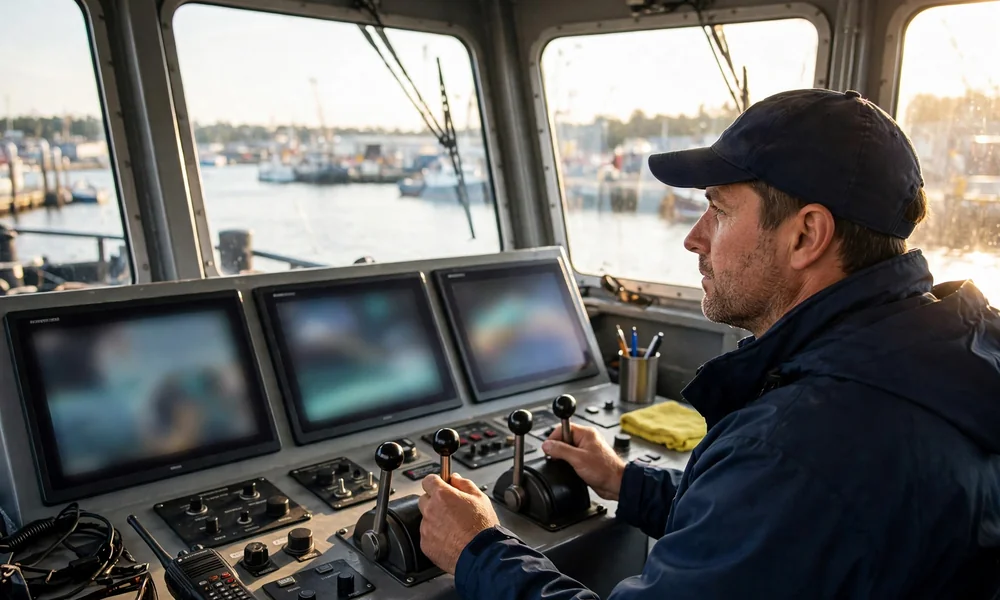
The wheelhouse sits high and forward, with glass all round so the master can see the tow, the ship, and the water ahead at the same time. Controls for the engines, thrusters, and winch are grouped within easy reach, and modern boats add dynamic positioning systems that hold the tug in place automatically.
5. The crew spaces are built for long days
A harbour tug may work around the clock, so the cabins, galley, and mess are fitted to a proper standard: comfortable bunks, a working galley, and sound insulation that keeps the engine noise down. Luxury tugs treat the crew well, because a rested crew is a safe crew.
6. Firefighting and safety gear are fitted early
Many tugs carry firefighting monitors, foam systems, and rescue equipment, because they are often first on the scene of a harbour incident. The gear is fitted during the build. A tug that can fight a fire as well as tow a ship is worth far more to a port than one that can only tow.
7. Trials measure pulling power, not just speed
Before delivery, the tug is tested with a bollard pull trial: it is tied to a fixed point on the quay and pulls at full power while instruments measure the force. A tug that fails its bollard pull trial does not get delivered, however fast it is.

The numbers that matter
Here are the headline figures for a modern luxury harbour tugboat.
| Specification | Typical figure |
|---|---|
| Length overall | 28 to 32 metres |
| Beam | 11 to 13 metres |
| Bollard pull | 60 to 80 tonnes |
| Main engines | Two diesels, about 2,500 horsepower each |
| Top speed | 12 to 14 knots |
| Propulsion | Azimuth thrusters, 360-degree rotation |
| Fuel capacity | About 150,000 litres |
| Crew | 6 to 8 |
The figure that deserves the most attention is bollard pull, the measure of how hard the tug can pull. A bollard pull of 70 tonnes means the tug can exert a force of about 700 kilonewtons, enough to move a loaded container ship against wind and current. It is the single number that decides which jobs a tug can take. A bigger bollard pull means bigger ships, harder conditions, and higher day rates.
Engine power is the number behind the bollard pull, and it is what makes a tugboat so surprising. Five thousand horsepower in a boat of thirty metres is an enormous amount of power, and it is why a tug can accelerate hard, stop a drifting ship, and hold position in weather that sends other boats home. The azimuth thrusters are the other half of the story: they let the tug push sideways, backwards, or spin on the spot. The way a luxury tugboat is built shows how the hull, engines, and thrusters are matched to each other, and the result is a boat that handles like nothing else on the water.
What a luxury tugboat costs
A luxury harbour tugboat costs an estimated 10 to 20 million dollars, depending on size, bollard pull, and equipment. The estimate covers the hull, engines, thrusters, winch, and electronics, but not the crew or the running costs that follow. The engines and thrusters are the most expensive systems, and a high bollard pull specification adds cost quickly, because every extra tonne of pull needs more power, more fuel capacity, and a stronger hull.
Running costs are high, because the engines are large and the boat works hard every day. Fuel is the biggest expense, followed by maintenance on the thrusters and the towing gear. Ports accept this because a tugboat is what keeps a harbour moving: without tugs, large ships cannot berth safely. The tug is expensive, but it pays for itself many times over. The electric alternative is arriving too, and the making of an electric tugboat shows how battery power is starting to replace diesel in harbour work, cutting emissions and noise while keeping the pulling power.
A rare fact about tugboats
Some tugboats can pull more than their own weight many times over, and the most powerful harbour tugs have a bollard pull of over 100 tonnes, more than the weight of the tug itself. The secret is the propeller nozzle, a ring around the propeller that turns wasted sideways thrust into forward pull, adding up to a third more force from the same engine. It is the reason a small boat can hold a ship that outweighs it a hundred times. The basic physics is explained in the guide to how a tugboat works, and it is worth reading if you want to understand why the tug’s size is so misleading.
A luxury tugboat is a study in doing one thing extremely well. Its specifications are not about speed or comfort or style. They are about force: how much, in which direction, and for how long. The bollard pull is the promise. Everything else is how the boat keeps it.


