It is not the owner’s suite, with its marble bathroom and its private terrace, and it is not the dining room, with its chandeliers and its white tablecloths. It is a room with wide windows, a single chair, and a wall of screens that glow through the night, and it costs more than any cabin on the ship. The bridge is where a vessel worth hundreds of millions of dollars is steered, and everything in it is built to a standard that would make a hospital operating theatre look relaxed.
A luxury ship bridge is the most expensive room on a ship because it is the room where mistakes are most expensive. A wrong turn can ground the ship, a missed contact can cause a collision, and a failed screen at the wrong moment can leave the crew blind. The money goes into glass, electronics, redundancy, and the quiet, unglamorous work of making sure that nothing fails when it matters. Here is where it goes.

The cost at a glance
| Cost driver | Typical luxury figure |
|---|---|
| Bridge windows | Laminated, heated, 270-degree view |
| Navigation consoles | Radar, ECDIS charts, autopilot, conning display |
| Communications | Satellite, VHF, GMDSS distress system |
| Redundancy | Duplicate systems, separate power supplies |
| Helm and controls | Steering, thrusters, engine telegraph |
| Captain’s chair | Adjustable, heated, with its own controls |
| Night vision | Low-light cameras, dimmed lighting throughout |
| Certification | Class approval, sea trials, annual surveys |
| Typical fit-out | Estimated $2 million to $10 million |
| Annual upkeep | Estimated $100,000 to $300,000 |
Cost driver 1: the glass
The windows are the first thing anyone notices on a bridge, and they are also one of the most expensive parts of it. The glass is laminated in layers, heated to keep it clear in cold and rain, and set at an angle that stops reflections from bouncing back into the crew’s eyes at night. The view wraps around about 270 degrees, so the watchkeeper can see the bow, both sides, and part of the stern without moving, and the glass must be flawless, because a distortion in the wrong place can hide a small boat. The guide to how a luxury ship bridge works follows a watch from dusk to dawn, and the glass is the part the crew mentions first.
Cost driver 2: the navigation consoles
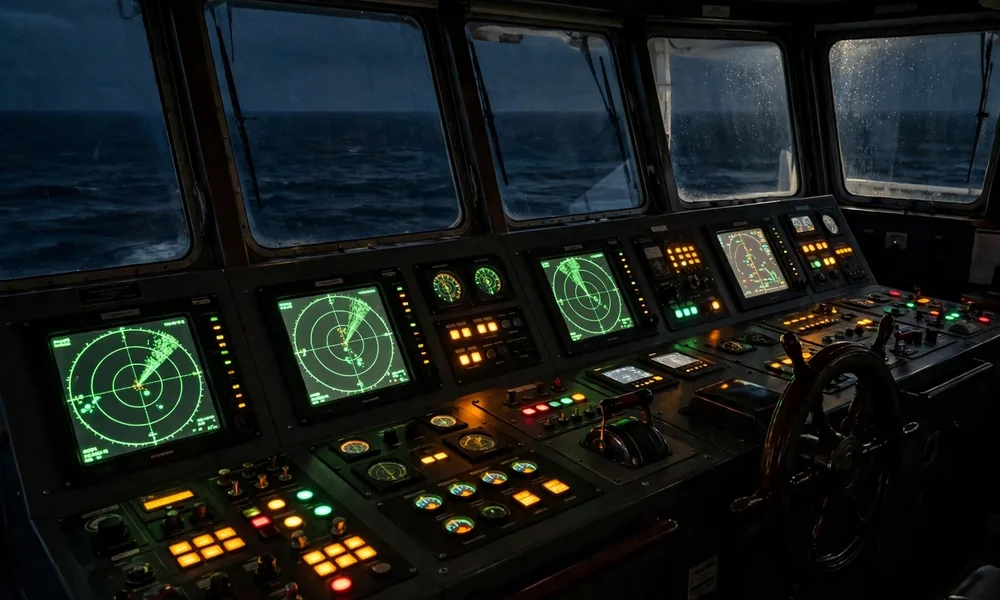
The consoles are the heart of the bridge, and they hold the radar, the electronic charts, the autopilot, and the conning display that shows the ship’s speed, heading, and rudder angle at a glance. Radar paints other vessels and the coastline as bright traces on a dark screen, the chart system plots the ship’s position on an electronic map and warns of shallow water ahead, and the autopilot holds the course while the watchkeeper watches the sea. Each system is built to marine standards that are far stricter than the standards for a car or an aeroplane, because salt air, vibration, and years of continuous use will kill anything weaker.
The screens are sunlight-readable, which means they are bright enough to read in full daylight and dim enough not to ruin night vision, and they are coated to resist fingerprints and glare. The specification of luxury ship radar specs covers the most important of these systems in detail, and the radar alone can cost as much as a luxury car.
Cost driver 3: redundancy, or paying twice for everything
Redundancy is the most expensive idea on the bridge, and it is simple: everything important exists twice. Two radars, two chart systems, two steering systems, two power supplies, each on its own circuit, so that a single failure cannot leave the ship blind or unsteerable. The backup systems are not cheaper versions; they are full equals, kept warm and tested regularly, and the crew practises switching to them until the changeover is automatic.
The power supplies are separate too, with batteries that keep the bridge alive if the ship’s generators fail, and the cables run by different routes through the ship so that a fire in one place cannot cut both. The account of how a luxury ship gyroscope works explains one of the quieter systems on the bridge, the compass that never needs the sky, and it too is duplicated, because a ship that does not know which way it is pointing is in trouble.

Cost driver 4: communications and distress systems
The communications suite links the ship to the shore, to other vessels, and to rescue services anywhere in the world. Satellite terminals carry voice and data, VHF radios handle ship-to-ship calls, and the GMDSS distress system can send an automatic mayday with the ship’s position at the press of a button. The antennas are mounted high on the mast, away from interference, and the cables are armoured against the weather.
Cost driver 5: the helm, the chair, and the human
The helm itself is often a piece of craftsmanship, a polished wheel or a modern joystick, linked to steering gear that can move a rudder the size of a house. Beside it sit the engine telegraph, which tells the engine room how fast to go, and the thruster controls, which let the captain slide the ship sideways into a berth. The captain’s chair is adjustable, heated, and fitted with its own small controls, because the captain may sit there for hours in bad weather, and a tired captain is a dangerous captain.
The layout of the bridge is designed around the human body: the distance from the chair to the radar, the height of the consoles, the angle of the screens, all of it tested with real watchkeepers. A bridge that fights its crew will eventually cause a mistake, and the designers know it, so they spend money on the details that nobody photographs.
Cost driver 6: night vision and the dark bridge
At night the bridge goes dark, and that darkness is deliberate. The lights are dimmed to red or to a low warm glow, the screens are turned down, and the crew’s eyes are given time to adapt, because a watchkeeper who can see the sea will spot a small fishing boat long before the radar does. Low-light cameras help, but the human eye is still the best sensor on the bridge after dark, and the whole room is built to protect it.
Price
A luxury ship bridge fit-out typically costs an estimated $2 million to $10 million, depending on the size of the ship and the sophistication of the equipment, with the largest and most advanced bridges at the top of that range. These are estimates, not list prices, because bridge equipment is built to order for each vessel, and the final figure depends on the ship’s size, its trading area, and the owner’s specification. What the buyer is paying for, in the end, is not a room but a margin of safety: the knowledge that when the weather turns and the traffic closes in, the people steering the ship can see clearly, think clearly, and act in time.
A rare fact
The bridge of a large ship is so high above the water that the captain cannot see the sea directly below the bow, a blind spot that can stretch for hundreds of metres ahead of the vessel. To deal with it, the crew use cameras, radar, and lookouts, and some ships carry a small camera on the bow that feeds a picture back to the bridge.