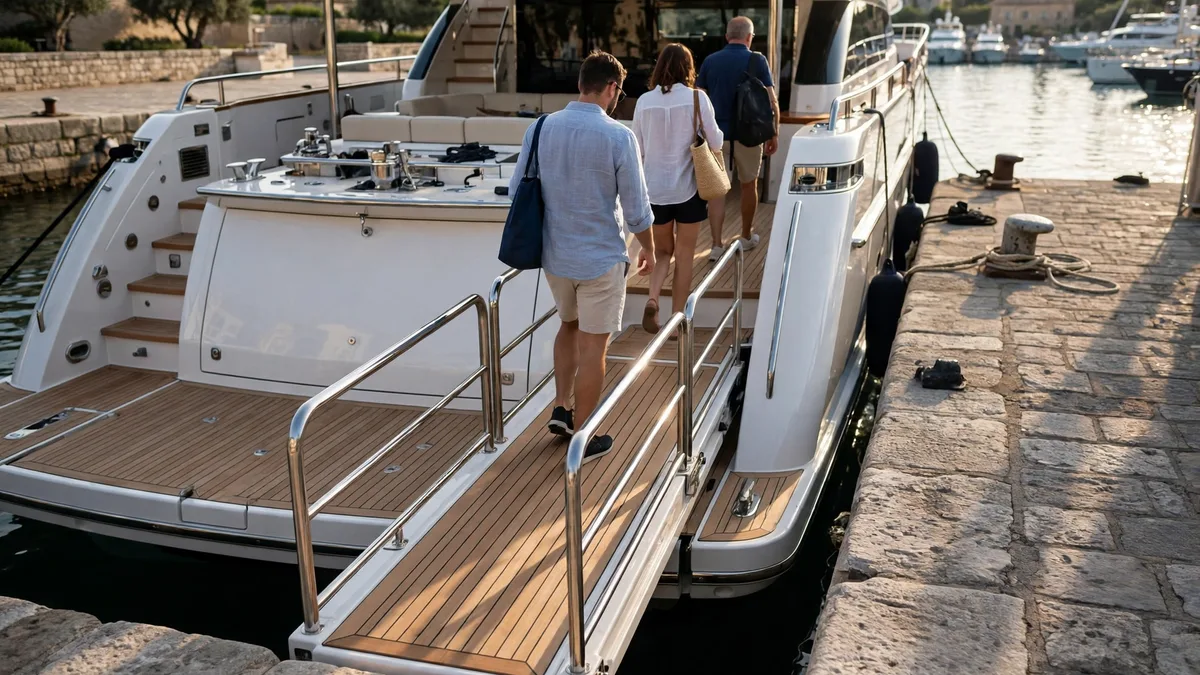
Watch a superyacht arrive at a Mediterranean quay and you will see the moment the crew have been waiting for. A section of the bulwark swings aside, a slim bridge slides out over the water, and within a minute guests are walking ashore on a carpeted walkway with polished handrails, as if the yacht had grown a front door. That bridge is the passerelle, the yacht’s gangway.
It looks like a simple plank, but it is a piece of machinery. The passerelle must reach across a gap of moving water, stay level while the yacht rises and falls on the swell, carry the weight of guests and luggage, and then fold itself away into a space barely wider than a wardrobe. Here is how it manages all of that.
How It Works
The gangway that moves
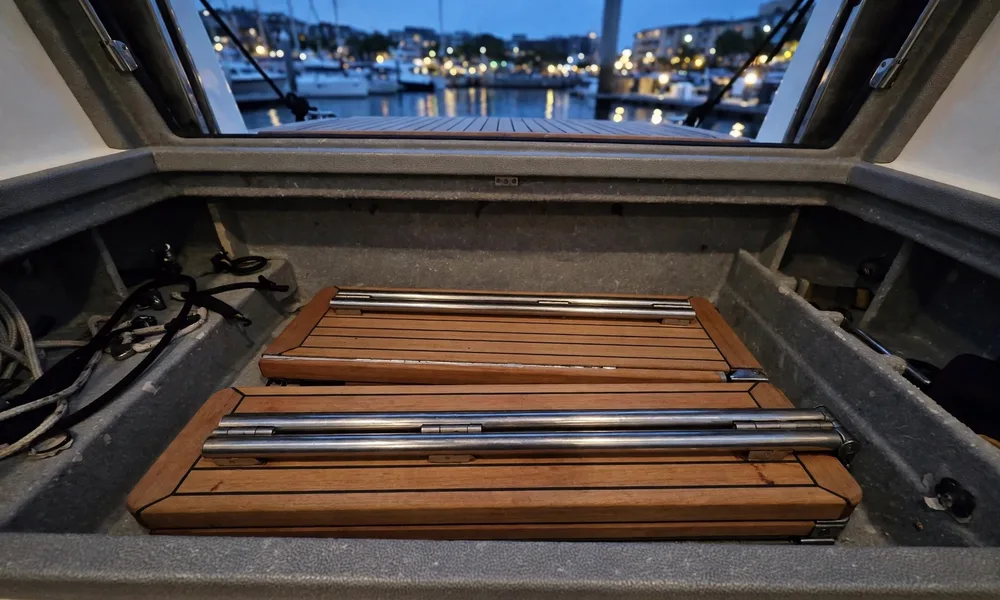
At rest, the passerelle lives inside the yacht, usually in a compartment in the stern or along the side deck, hidden behind a flush panel. It is a long, narrow bridge, often between four and seven metres, built from aluminium or carbon fibre so it is light enough to move yet strong enough to carry several people at once. The walking surface is teak or a non-slip composite, and the handrails fold flat so the unit can slide into its berth.
When the yacht docks, a crew member opens the compartment and starts the deployment. On most modern yachts this is done from a small control panel or a remote, and the passerelle extends on rollers or a telescoping track until its far end reaches the quay. The crew guide it by eye, because no two quays are the same height, and the final centimetres are always adjusted by hand.
The hinge and the pivot
The secret of the passerelle is its hinge. The inboard end is pinned to the yacht on a heavy pivot, so the bridge can swing up and down as well as slide in and out. That pivot is what lets the passerelle cope with the gap between the yacht and the quay, which is never the same twice: the tide rises and falls, the yacht loads and unloads, and the quay itself may be higher on one side of the harbour than the other.
The pivot is built around a large steel pin set in bronze bushes, greased and sealed against salt water. It is strong enough to carry the full load of the bridge plus its passengers, and it is fitted with a locking pin that holds the passerelle at the chosen angle once the crew are happy with it. A gangway that could swing freely would be dangerous, so the lock is tested every time the bridge is deployed.
Hydraulics do the lifting
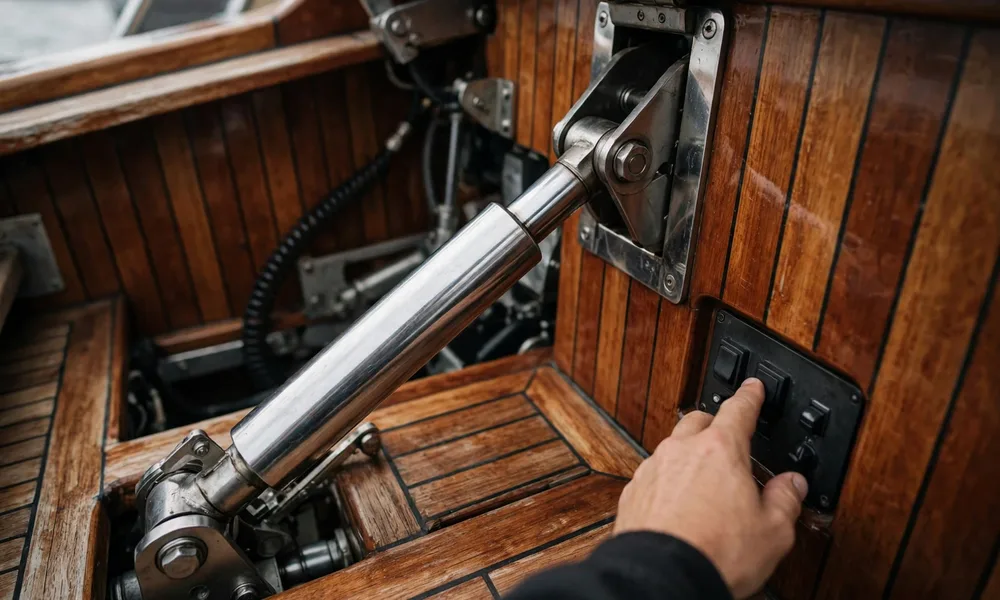
Moving a bridge that weighs hundreds of kilos is a job for hydraulics. A pair of hydraulic rams, tucked into the compartment beside the passerelle, push it out and lift it into position. The rams are fed by a small pump, and the crew control them with a joystick, raising and lowering the far end until it sits neatly on the quay.
The hydraulic system has a safety valve that holds the pressure even if the pump stops, so the passerelle cannot drop suddenly if power is lost. There is also a manual override, a hand pump the crew can use to bring the bridge home if the electrics fail. The crew test both systems regularly, because a passerelle stuck halfway out is worse than no passerelle at all. The same care for a safe way back aboard shapes the yacht’s other boarding gear, and the way a luxury yacht swim ladder is made shows how a simpler piece of boarding equipment is built to the same standard of grip and strength.
Levelling on a moving deck
The hardest part of the passerelle’s job is that the yacht never stops moving. Even in a calm harbour, the yacht rises and falls on the swell and rolls gently with the wash of passing boats. If the passerelle were fixed rigidly, every movement would lift its far end off the quay or grind it against the stone.
The answer is a floating end. The far end of the passerelle rests on the quay on a small wheel or a padded foot, and the hinge at the yacht end lets the bridge pivot as the yacht moves. Some yachts go further and fit a self-levelling system, with a sensor that watches the angle of the bridge and adjusts the hydraulics to keep the walking surface flat. The crew still watch it constantly, and if the movement grows too much, they bring guests aboard and wait for calmer water. The lifting gear that handles the yacht’s boats works on the same principle of controlled movement, and how a luxury ship davit is made shows how a crane built for the same deck handles heavy loads over open water.
Safety at the edge
A passerelle is a walkway over open water, so safety is built into every part of it. The handrails are waist high and lock upright with a firm click, and the walking surface has a raised edge so a rolling suitcase cannot slip off the side. At night, small lights along the rails switch on automatically, marking the path from the yacht to the quay.
The crew fit a safety net or a canvas skirt beneath the bridge when guests are using it, so nothing dropped can fall into the water, and they post a crew member at the gangway whenever the yacht is open to visitors. The passerelle is rated for a set load, and the crew know the number: it is printed on a plate inside the compartment, and it is never exceeded, however grand the occasion.
Stowing it away
When the yacht leaves, the passerelle must disappear. The crew fold the handrails flat, retract the bridge on its rollers, and slide it back into its compartment, where it is lashed down against the motion of the sea. The compartment door closes flush with the hull, and within minutes there is no sign the yacht ever had a gangway at all.
Stowing is as much a part of the design as deploying. The compartment is drained and ventilated so the bridge does not sit in salt water, and the hydraulic rams are parked in their retracted position, protected from corrosion. A passerelle that is cared for in its berth will deploy cleanly for years, and one that is left damp and loose will jam at the worst possible moment. The cost of getting all of this right is part of what makes the fitting so dear, and why a luxury yacht passerelle costs so much explains where the money goes, from the carbon fibre bridge to the hydraulics that move it.
Why It Matters at Sea
A passerelle is the yacht’s front door, and on a luxury yacht the front door has to work perfectly every time. Guests arrive in evening dress, luggage is carried aboard, and the crew come and go at all hours, and all of them trust a slim bridge over moving water to hold them.
Its working is a quiet piece of engineering: a hinge that lets it follow the sea, hydraulics that lift it gently into place, a floating end that keeps it level, and a compartment that swallows it whole when the yacht sails. When it works, nobody notices it. They simply step ashore, and the yacht has done its job.