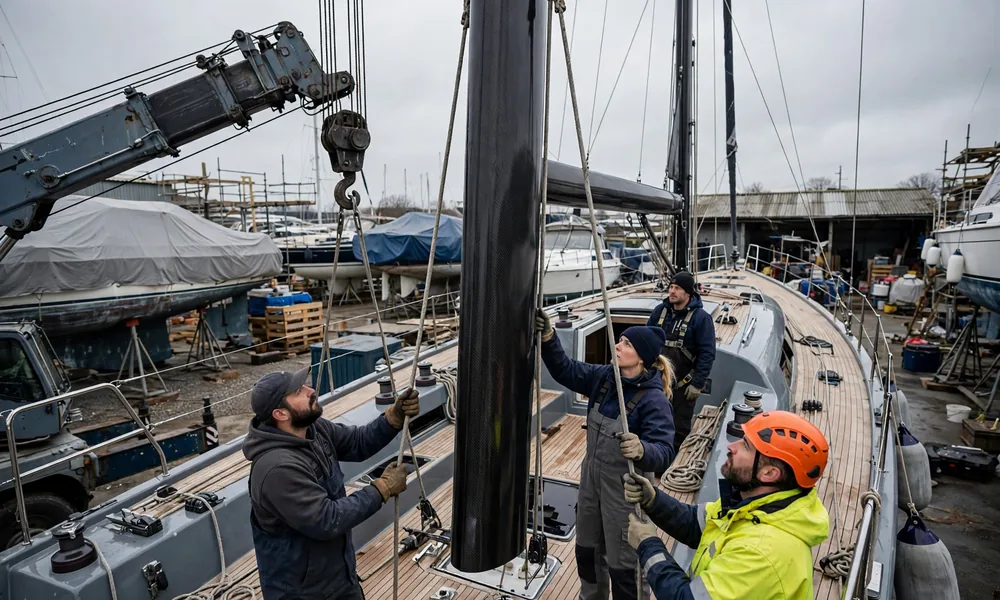
The marina is quiet at dawn, and the boat at the end of the pontoon is easy to spot: its mast rises black and slender against the pale sky, taller than the masts around it and thinner, too. A rigger is already aloft, clipped to a harness, checking the fittings at the top. Down on the deck, the owner is looking at an invoice. The mast — a single tapering tube of carbon fibre — cost more than the boat’s engine, more than its electronics, and more than the sails it carries.
That is the strange economics of a yacht carbon mast. It is a pole that holds up a sail, and it is also one of the most expensive single components on a sailing yacht. A carbon mast can cost ten times what an aluminium mast of the same height costs, and the difference is not a luxury markup. It is the price of a material that has to be perfect, a shape that has to be exact, and a build process that takes weeks and tolerates no mistakes.
This guide explains why the black pole costs so much — the fibre, the layup, the curing, the testing, and the rarity — and what a sailor gets for the money.

Why It Costs So Much
The first cost is the fibre itself. A carbon mast is made from carbon fibre, a material woven from threads of carbon so fine that a single strand is thinner than a human hair, yet stronger than steel by weight. The fibre used in masts is the high-grade kind, made by heating a precursor thread through a long, energy-hungry process until almost nothing is left but pure carbon. That process is slow and wasteful — much of the starting material burns away — and the fibre that survives is expensive by the kilogram. Anyone who wants to understand the material itself should start with carbon fibre weave specs, which set out what the numbers on a fibre datasheet actually mean.
Then comes the layup, which is where the real craftsmanship lives. A carbon mast is not extruded or cast; it is built up layer by layer, by hand, on a long mould. Workers lay sheets of carbon cloth over the mould, each layer oriented in a different direction so the finished tube is strong in exactly the directions the loads demand. A mast carries enormous loads — the pull of the sails, the compression of the rigging, the bending of a gust — and the layup schedule, the map of which layer goes where, is a closely guarded piece of engineering. The layup of a large mast takes a team of skilled workers days.
Curing is the next cost, and it is a test of patience as much as of money. Once the layers are laid, the mast is sealed in a vacuum bag and cured — heated under pressure in an oven or autoclave large enough to hold a tube twenty metres long. The heating cycle takes hours, and the temperature has to be controlled precisely, because if the resin cures too fast it becomes brittle, and if it cures too slowly it never reaches full strength.
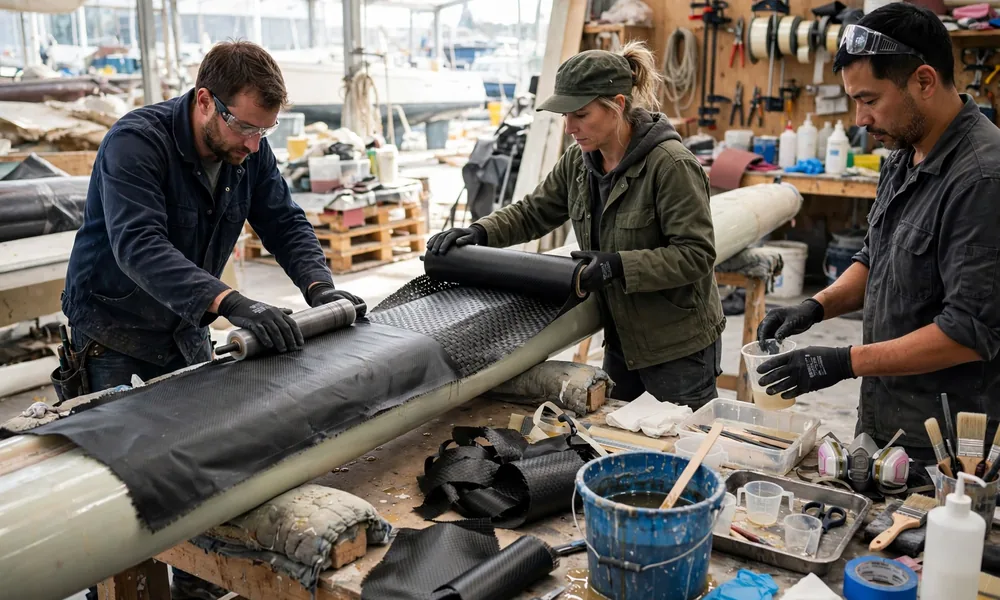
Rarity and low volumes do the rest. Every carbon mast is effectively a one-off. Even two masts for the same model of yacht will differ, because the rigging, the sails, and the owner’s preferences are never identical. There is no production line, no economy of scale, and no way to spread the cost of the mould, the engineering, and the design across hundreds of identical units. That is why a carbon mast is priced like a bespoke suit rather than a factory part: because that is what it is. The engineering behind the shape is covered in how a yacht carbon mast works, which explains how the tube carries loads that would bend an aluminium mast of the same weight.
Testing is the final cost driver, and it is uncompromising. A finished mast is inspected with ultrasound and X-rays to look for voids and delaminations hidden inside the laminate. It is load-tested, bent under controlled forces to prove it can take the loads it will meet at sea. Fittings are proof-tested one by one — the masthead, the spreaders, the halyard exits — because a fitting that pulls out under load can bring the whole rig down.
Cost Breakdown
All prices below are estimates, based on typical costs for a carbon mast for a mid-size cruising yacht, and they vary enormously by boat size, mast height, and builder. They show where the money goes rather than a quote for any specific mast.
| Part of the cost | Estimated share | Estimated amount | Why it costs that much |
|---|---|---|---|
| Carbon fibre and resin | About 30% | $9,000–$18,000 | High-grade fibre, hundreds of kilograms, with waste |
| Hand layup labour | About 25% | $7,500–$15,000 | Days of skilled work, layer by layer, by hand |
| Mould and tooling | About 15% | $4,500–$9,000 | A precision mould tens of metres long, used for a few masts |
| Curing and oven time | About 10% | $3,000–$6,000 | Hours in a huge autoclave, one mast at a time |
| Fittings and hardware | About 10% | $3,000–$6,000 | Titanium and stainless fittings, each proof-tested |
| Inspection and testing | About 10% | $3,000–$6,000 | Ultrasound, X-ray, and load testing, with scrapped failures |
| Total mast cost | 100% | $30,000–$60,000 | Typical estimated range for a mid-size yacht |
For a large superyacht, the same logic scales up dramatically: masts over fifty metres tall can cost an estimated $500,000 or more, and the biggest racing masts are priced in the millions.
Yacht Carbon Mast Specs
| Spec | Typical figure | What it means |
|---|---|---|
| Mast height | 15–30 m | Height above the deck for a mid-size cruising yacht |
| Weight | About 80–200 kg | Finished mast, before rigging and fittings |
| Weight saving | About 40–50% | Less than an aluminium mast of the same strength |
| Wall thickness | About 5–25 mm | Thicker at the base, thinner toward the top |
| Build time | About 3–6 weeks | Layup, curing, fitting, and testing, per mast |
| Service life | 20–30 years | With regular inspection, often the life of the yacht |
| Inspection interval | Every 1–2 years | Visual and ultrasound checks for damage and wear |
The detailed figures are worth studying before ordering, and yacht carbon mast specs set out height, weight, and wall thickness in plain terms.
A Rare Fact
The first carbon masts were so light that sailors did not trust them. When the material arrived in yacht racing in the 1980s, crews expected the slender black tubes to snap in the first strong gust — and some early ones did, because builders were still learning how to lay up the fibre. The breakthrough came when engineers realised that a carbon mast does not need to be as stiff as possible: it needs to bend in exactly the right way, flexing to spill wind in a gust and springing back when the gust passes. A well-built carbon mast is, in effect, a spring as well as a pole, and its bend is tuned like a musical instrument.


