On the deck of a luxury ship, the lifeboat hangs quietly in its cradle, orange or white against the steel of the superstructure, waiting for a day nobody wants. A lifeboat should be invisible until the moment it is needed, and then it should work perfectly, first time, in the dark, in bad weather, with frightened people inside.
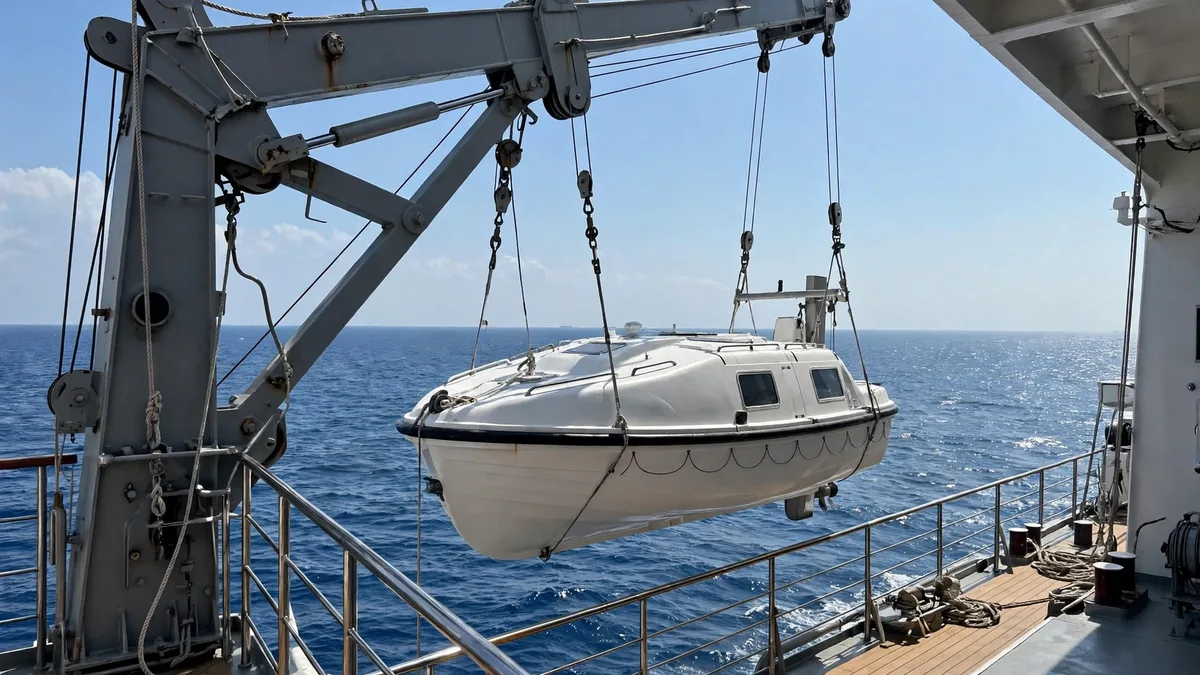
The machine that makes that possible is the davit, a strong steel arm that lifts the lifeboat off the deck, swings it out over the water and lowers it gently to the sea. A luxury lifeboat davit is built to do all of that smoothly and safely, even when the ship is rolling, even when the power fails, and even when the crew operating it has never done it for real before.
How It Works
Step 1: Holding the lifeboat ready
When the ship is sailing normally, the davit holds the lifeboat in its stowed position, tucked close to the deck so it does not catch the wind or block the walkway. The boat sits in a cradle or hangs from its falls, the wire ropes that will lower it, and the whole assembly is locked in place with a brake that cannot slip on its own.
The davit itself is a frame of heavy steel, bolted to the deck and to the ship’s structure below. It is designed to carry the full weight of the boat, its passengers and its equipment, plus a safety margin for the shock of a wave hitting the boat as it touches the water. The way a luxury lifeboat davit is made shows how that steel frame is built, welded and tested before it ever carries a boat.
Step 2: Releasing the brake and swinging out
When the order to abandon ship is given, the crew loads the lifeboat while it is still on deck, then releases the brake. On a modern davit, the arm swings the boat out over the side of the ship, clear of the hull, using gravity, hydraulics or a small electric motor. The movement is slow and controlled, so the boat does not swing wildly, even if the ship is rolling.
The crew member operating the davit stands at a control station with a clear view of the boat and the water below. The controls are simple on purpose, a lever or a wheel that does one thing at a time, because in an emergency nobody should have to remember a complicated sequence. The same demand for simple, reliable controls appears on other deck machinery, and the way a luxury ship anchor winch works shows how a heavy machine is kept under the control of one person.
Step 3: Lowering the boat on the falls
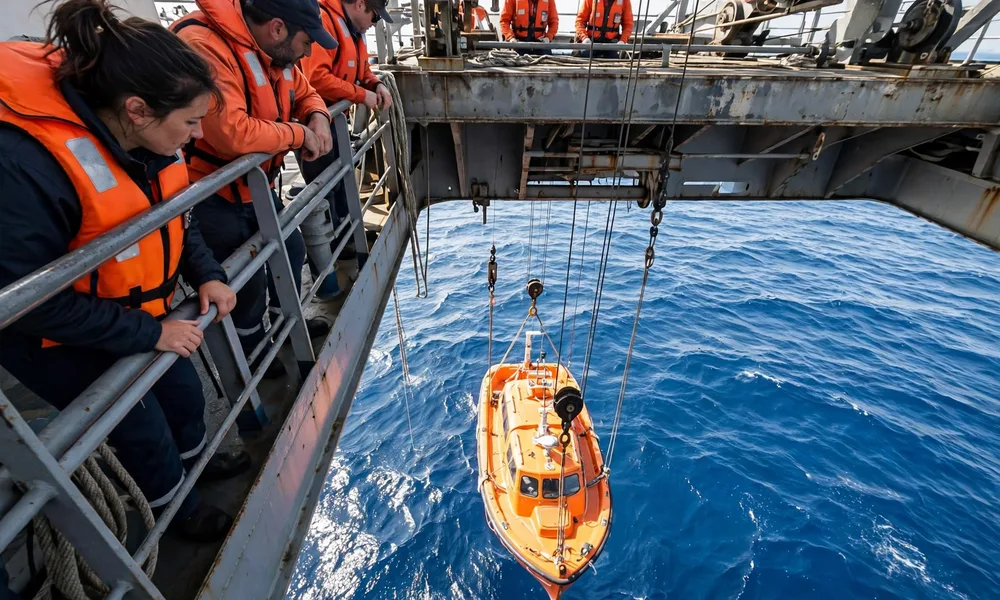
Once the boat is clear of the ship, the winch lowers it on two wire ropes, one at each end, so the boat stays level as it goes down. The winch is fitted with a centrifugal brake, a clever device that lets the boat descend at a steady, safe speed no matter how heavy it is, and stops it if the rope runs too fast. The crew does not have to judge the speed by feel, because the brake does it for them.
The falls are checked constantly for wear, rust and broken wires, because they are the only thing holding the boat. A lifeboat that cannot be lowered smoothly is worse than no lifeboat at all, because it gives people false hope.

Step 4: Reaching the water and releasing
When the boat touches the water, it floats free of the ship, but it is still attached by the falls. The crew inside the boat pulls a release handle, and both ends of the boat let go at the same moment, so the boat does not tip or hang by one rope. The release is designed so it cannot be pulled by accident while the boat is still in the air, and so it works even if the boat is full of water or the crew are wearing gloves.
The crew on deck winds the falls back up, checks the arm for damage, and prepares the davit for the next boat, because a large ship carries many lifeboats and many davits, and each one must work in turn.
Step 5: Working when the power fails
A luxury lifeboat davit must work even if the ship loses power. The lowering is driven by gravity, not by electricity, so a blackout cannot stop a boat from reaching the water. The brake that controls the descent is mechanical, the release is mechanical, and the only thing the crew needs is the strength to pull a handle and the training to know when to pull it.
Some davits also have a hand winch, so the boat can be raised again by muscle power if it needs to be recovered after a drill. The crew practises this regularly, winding a heavy boat back up to the deck by hand, because a machine that only works when the power is on is not a safety machine at all. The cost of that reliability is part of what makes a lifeboat system expensive, and the way a luxury ship lifeboat is so expensive explains where that money goes.
Step 6: Drills, inspection and readiness
The davit is only as good as its last drill. International rules require lifeboat drills at regular intervals, and on a luxury ship the crew practises lowering a boat, releasing it and bringing it back, until the whole routine takes minutes and nobody hesitates.
Between drills, the davit is inspected, greased and tested, and every fault is written down and fixed. The ropes, the brake, the release gear and the arm itself are all checked by the crew and by outside surveyors, who will not sign the ship off if a davit is not ready. A luxury lifeboat davit is a quiet machine, hanging on the deck in all weathers, and its whole purpose is to be ready for the one day it is needed, and to work perfectly on that day.
| Specification | Typical luxury lifeboat davit |
|---|---|
| Type | Gravity davit, with hydraulic or electric swing |
| Safe working load | About 5 to 10 tonnes, boat plus passengers |
| Lowering speed | Steady, controlled by a centrifugal brake |
| Falls | Two wire ropes, one at each end of the boat |
| Release | Simultaneous release at both ends, from inside the boat |
| Power failure | Lowering by gravity, no electricity needed |
| Material | Marine-grade steel, painted against salt water |
| Inspection | Daily crew checks, regular drills and surveyor sign-off |
A luxury lifeboat davit is an estimate of $100,000 to $400,000 per davit and lifeboat set, depending on the size of the boat, the number of passengers it carries and the type of davit. A large ship needs many sets, so the total cost runs into millions, yet it is the one part of a ship where nobody argues about the price, because it is the part that saves lives.
Here is a rare fact worth knowing. The gravity davit, which lowers a lifeboat using its own weight, was invented after the sinking of the Titanic, when it became clear that lifeboats needed to be launched quickly and reliably, even by a frightened crew in the dark. More than a century later, the same idea is still at the heart of every modern davit, because gravity never runs out of power, never needs fuel, and never fails to show up.