The hypercar is doing 180 miles an hour down the straight, and the driver lifts off the throttle for the corner ahead. In that instant, the rear wing rises, tilts, and stretches backwards, the flaps in the front splitter open, and the whole car seems to hunker down onto the tarmac. Nothing has touched the car. The air itself has changed its mind about what the car should do.
That transformation is the McLaren W1’s aerodynamics at work. The W1 is McLaren’s flagship hybrid hypercar, and its body is not a fixed shape but a system that reshapes itself with speed, braking, and steering. At low speed it slips through the air with as little drag as possible. At high speed and under braking it turns the air into downforce, pressing the tyres into the road so the car can corner and stop far harder than its weight alone would allow.
The system has a name inside McLaren: Aerocell. It combines a long-tail rear wing, an active front splitter, underbody venturi tunnels, and air channels that run through the doors and over the roof. Here is how the whole system works, step by step.

How It Works
Step 1: Shaping the air at the nose
Everything starts at the front of the car. Air hits the nose at speed and must be told where to go, because air that tumbles uselessly under the car creates lift, the enemy of grip. The W1’s nose is low and narrow, and a splitter juts forward beneath it, slicing the airflow in two. Some air is sent over the bonnet and along the flanks, and some is channelled underneath, where it is accelerated through venturi tunnels. The science of shaping a hypercar’s body for the air is laid out in hypercar aerodynamic body specs explained.
Step 2: The venturi tunnels underneath
Under the floor, the air speeds up as the tunnels narrow, and fast-moving air presses less hard on the surfaces around it. That pressure drop sucks the car downwards, creating downforce without a big wing and without much drag. The floor is shaped like an upside-down wing, and the tunnels grow wider towards the rear, where the air expands and exits through a tall diffuser. The diffuser’s job is to slow the air down gently and return it to the atmosphere without the turbulence that would undo all the work upstream.
Step 3: Air through the doors
One of the W1’s strangest features is what happens at the doors. Air entering the front wheel arches is guided into channels that run through the door structure itself, emerging behind the doors to feed the rear of the car. This does two jobs at once: it clears turbulent air away from the front wheels, and it delivers clean, fast air to the radiators and the rear wing.
Step 4: The long-tail active rear wing
At the back sits the most visible part of the system: the McLaren Active Longtail rear wing. In its road setting the wing sits low and flush, extending the tail so the car slips through the air with minimal drag. When the driver brakes hard or turns in at speed, the wing rises by up to 300 millimetres, tilts to a steep angle, and extends backwards, turning into an airbrake and a downforce device in one movement. The whole mechanism is driven by compact actuators and controlled by the car’s brain, which reads speed, steering, throttle, and braking hundreds of times a second.
Step 5: The brain that ties it together
None of these parts works alone. A central controller watches the car’s speed, lateral grip, brake pressure, and steering angle, and decides in real time how much downforce the car needs. Under hard braking, the wing rises and the front flaps adjust to keep the car balanced, nose and tail pressing down together so the car stays level. On a straight, it sheds drag so the hybrid powertrain’s 1,258 horsepower can do its work. The suspension plays its part too, keeping the car’s ride height steady as the aero load grows, and its workings are explained in how hypercar suspension works.

Step 6: Cooling without spoiling the airflow
A 1,258-horsepower hybrid makes a great deal of heat, and cooling it without wrecking the aerodynamics is one of the hardest parts of the design. The W1 feeds its radiators through intakes hidden in the bodywork, and the hot air is vented through exits placed where it will not disturb the airflow over the wing or the diffuser. The engine bay itself is part of the aero path, with air entering low and leaving high, over the tail. It is a balancing act: every litre of cooling air is a litre that is not making downforce, so the cooling system is tuned as carefully as the wing. The factory story of how such a body is built is told in inside hypercar aerodynamic body production.
| System | McLaren Aerocell with active long-tail rear wing |
| Rear wing travel | Rises up to 300 millimetres and extends backwards |
| Front aero | Active splitter flaps and underbody venturi tunnels |
| Door channels | Air ducted through the doors to the rear |
| Power | 1,258 horsepower from hybrid V8 powertrain |
| Downforce | Up to 1,000 kilograms at high speed, estimated |
| Top speed | 217 miles per hour, electronically limited |
| Control | Central controller reading speed, steering, and braking |
What Does a McLaren W1 Cost?
The McLaren W1 is estimated at roughly $2.1 million before options, and all 399 cars were sold before production began. That price buys more than a fast car: it buys a carbon-fibre monocoque, a bespoke hybrid V8, and an active aero system that no other road McLaren has carried. The W1 is not a car that earns its price on a spreadsheet. It earns it as a showcase of what McLaren can do when cost, comfort, and compromise are pushed aside and the air itself becomes part of the engineering.
A Rare Fact
The W1’s long tail is a nod to McLaren’s past. In the 1990s, the McLaren F1 GTR Longtail stretched its bodywork to tame the air at Le Mans, and the road-going F1 GT that followed wore the same extended tail. The W1 brings the idea back, but active: its tail is long only when the car needs it to be. At cruising speed the wing sits flush and the car is compact, and only under braking or in a fast corner does the tail stretch out. It is a piece of racing history that now moves on command, a longtail that appears and disappears in less than a second.
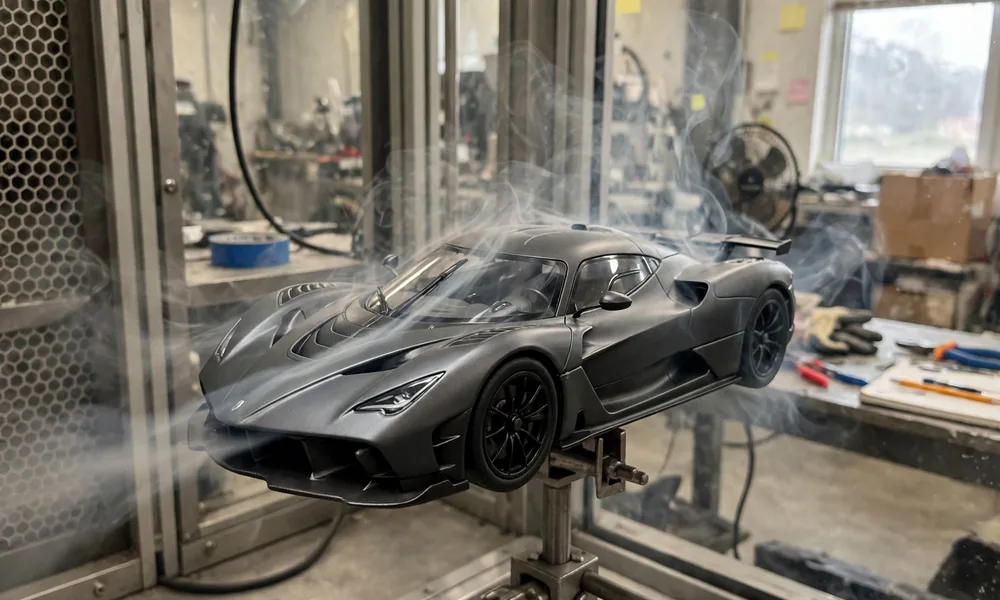
The next time a hypercar’s wing rises as it brakes, it is worth remembering that the wing is only the visible part. Under the floor, tunnels are sucking the car to the road. Through the doors, air is racing to the rear. At the nose, flaps are deciding how much air goes where. The W1 does not fight the air. It hires it, shapes it, and puts it to work, and the driver feels the result as grip that seems to break the rules of weight and speed.


