Pick up a modern phone or television and switch it on. The picture that greets you is impossibly vivid: blacks that look like the screen is switched off, colours that glow without ever looking harsh, and an image so thin it seems painted onto glass. That is an OLED display panel at work, and it is one of the most demanding things ever mass-produced. Each panel is built layer by layer, in rooms cleaner than an operating theatre, by machines that place materials a few dozen atoms thick.
The wonder of an OLED panel is that every pixel makes its own light. There is no backlight shining through, no lamp behind the picture. Millions of tiny organic light-emitting diodes switch on and off individually, which is why black on an OLED screen is truly black: the pixels simply stay dark. But those organic layers are fragile. A single speck of dust, a breath of damp air, or a layer a few atoms too thick can kill a pixel — or a whole panel.
Making one therefore reads like a recipe written by a perfectionist. Glass enters at one end of a factory the size of several football pitches, and days later a glowing panel comes out the other end, having passed through vacuum chambers, evaporation machines, and inspection stations that photograph every pixel. This is how that journey works.

How It Is Made
Step 1: Preparing the glass substrate
Everything begins with a sheet of ultra-flat glass, often larger than a dining table, which will eventually be cut into many individual panels. The glass is washed in a series of chemical baths and rinsed with ultra-pure water until not a single particle remains, because anything left on the surface becomes a defect in the finished screen. The sheet is then dried in filtered air and inspected by cameras that can spot flaws invisible to the human eye. Only a perfect sheet moves on; anything less goes back for cleaning or is discarded.
Step 2: Building the transistor backplane
Next comes the backplane: the layer of thin-film transistors that will switch each pixel on and off. Using photolithography — the same technique that makes computer chips — layers of metal, silicon, and insulating material are deposited on the glass and patterned with light, building millions of tiny transistors, one for every sub-pixel on the screen. Each transistor must work perfectly, because a dead transistor means a dead pixel, and a dead pixel on a premium screen means a rejected panel. The precision here rivals chipmaking, and the scale is staggering: a 4K panel carries more than eight million pixels, each with its own transistor.
Step 3: Depositing the organic layers
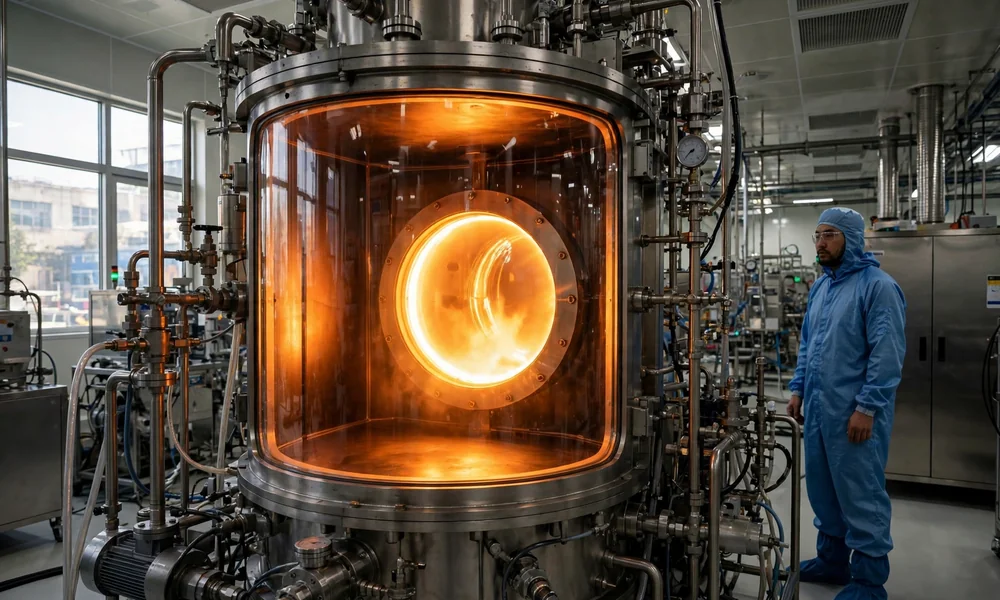
This is the step that gives OLED its name. Inside a vacuum chamber, organic materials are heated until they evaporate, and the vapour drifts down onto the glass through a fine metal mask, settling in layers only a few dozen atoms thick. Red, green, and blue materials are deposited in turn, each through its own precisely aligned mask, forming the pixels that will glow. The masks themselves are engineering marvels — thin metal sheets pierced with millions of tiny holes — and aligning them to the backplane is one of the hardest jobs in the factory. The challenge of stacking ultra-thin layers is shared across display technology, as shown in how a quantum dot display is made, where nanometre-scale layers decide the colour you see.
Step 4: Adding the electrodes and encapsulation
Once the glowing layers are down, transparent electrodes are deposited on top so current can flow through each pixel, and then comes the most critical protection step: encapsulation. The organic materials in an OLED panel are destroyed by oxygen and moisture, so the panel is sealed under thin layers of glass or protective film, sometimes with alternating organic and inorganic coatings that block water molecule by molecule. A panel that is not sealed properly will develop dark spots within weeks, so encapsulation is tested ruthlessly — panels are aged in hot, humid chambers to prove the seal will hold for years.
Step 5: Cutting the mother glass into panels
A single sheet of mother glass yields many panels, and now they must be separated. The glass is scored with a diamond wheel or laser along precise lines, then snapped apart cleanly. Each cut panel is edged, cleaned again, and fitted with its driver chip and flexible circuit board — the electronics that will feed it images. At this point the panel is a complete display for the first time, and it is switched on. The first glow of a new panel is the moment months of work either pays off or fails.
Step 6: Testing every pixel
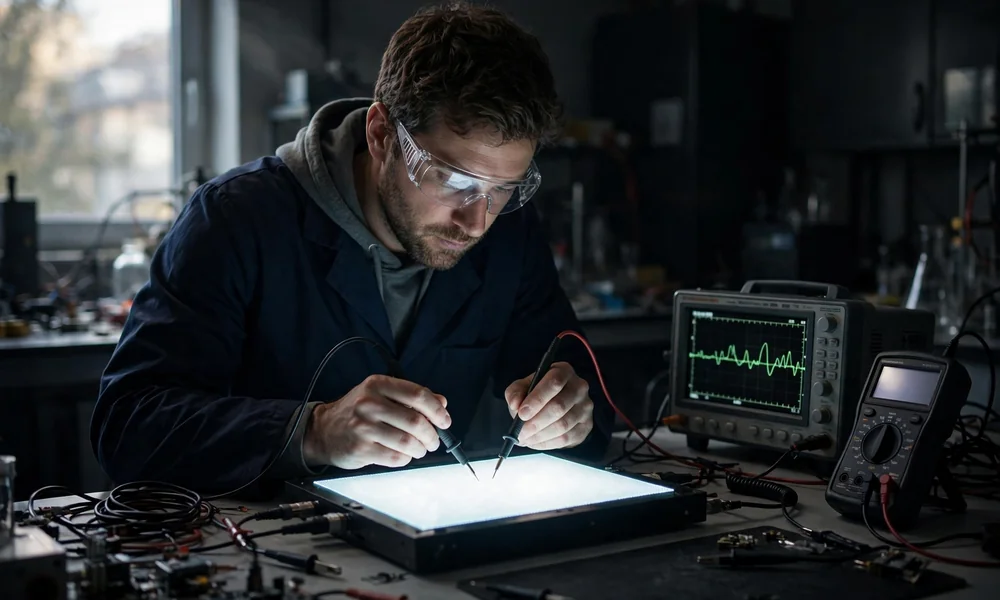
The final step is inspection, and it is total. Cameras photograph the lit panel and software checks every pixel for brightness, colour, and uniformity, hunting for dead spots, lines, or uneven patches. Panels are graded: the flawless ones go into flagship phones and televisions, while panels with minor imperfections may be sold for less demanding uses. A panel with a cluster of dead pixels is scrapped outright. The yield — the share of panels that pass — is the number every OLED factory lives and dies by, and it has taken years of refinement to push it from a minority to a large majority. The same unforgiving grading applies to the graphics hardware that drives these screens, as in how a gaming GPU is made, where a single flawed chip can mean a scrapped die.
Specs
| Specification | Typical value |
|---|---|
| Pixels per 4K panel | About 8.3 million |
| Organic layer thickness | A few dozen atoms per layer |
| Sub-pixel colours | Red, green, blue |
| Backplane | Thin-film transistors, one per sub-pixel |
| Black level | Effectively zero — pixels switch fully off |
| Typical panel thickness | A few millimetres including glass |
| Manufacturing environment | Clean room, vacuum chambers |
| Key enemy | Oxygen and moisture |
What Does It Cost?
An OLED panel is never sold on its own to consumers, so its price hides inside the device it lights up. A flagship smartphone with an OLED screen typically sells for around $800–$1,200, while a large OLED television can cost an estimated $1,500–$3,000, and those are approximate retail prices. The panel is usually the most expensive single component in the phone, and the factory behind it costs billions of dollars to build — the evaporation machines alone are among the most expensive tools in any industry. Prices fall as yields improve, which is why OLED screens that were once a luxury are now common. To judge what the numbers mean when you shop, the plain-English breakdown in OLED display panel specs explained is a useful companion to this factory tour.
A Rare Fact
Here is the detail most people miss: the organic layers inside an OLED panel are so thin that the entire glowing stack — all the layers that make the light — is roughly a thousand times thinner than a human hair. If you scaled a single pixel up to the size of a football pitch, its light-emitting layers would still be thinner than a sheet of paper. And yet that whisper of material produces the brightest, most colourful picture most people will ever own. The panel is, quite literally, mostly glass and air, with a breath of chemistry doing all the work.


