Three kilometres down, the ocean presses on every square centimetre with the weight of three hundred cars. The water is just above freezing. Yet inside a metal ball barely wider than a dining table, two scientists sit in shirtsleeves, watching fish drift past a small round window. The sphere around them is the only thing between them and instant destruction, and it was built to be the strongest shape in the sea.
A research submersible sphere looks simple: a hollow ball of metal with a hatch, a window and a few holes for wires. But building one is among the hardest jobs in marine engineering. The metal must be flawless, the shape must be perfect to within a fraction of a millimetre, and every weld must be tested as if lives depended on it — because they do. Here is how it is made.
How It’s Made
Step 1: Choosing the metal
Most deep-sea spheres are made from titanium, and for good reason. It is as strong as steel at half the weight, it never rusts in salt water, and it keeps its strength in the cold. The raw material arrives as thick plates or as a forged billet, and every batch is tested before it is touched: samples are pulled apart in a lab to prove the strength, and ultrasound scans look for hidden flaws inside the metal. A sphere that will dive to six thousand metres cannot contain a single weak spot, so any plate that fails a test is rejected outright. Older steel spheres were cheaper but heavier.
Step 2: Forming the hemispheres
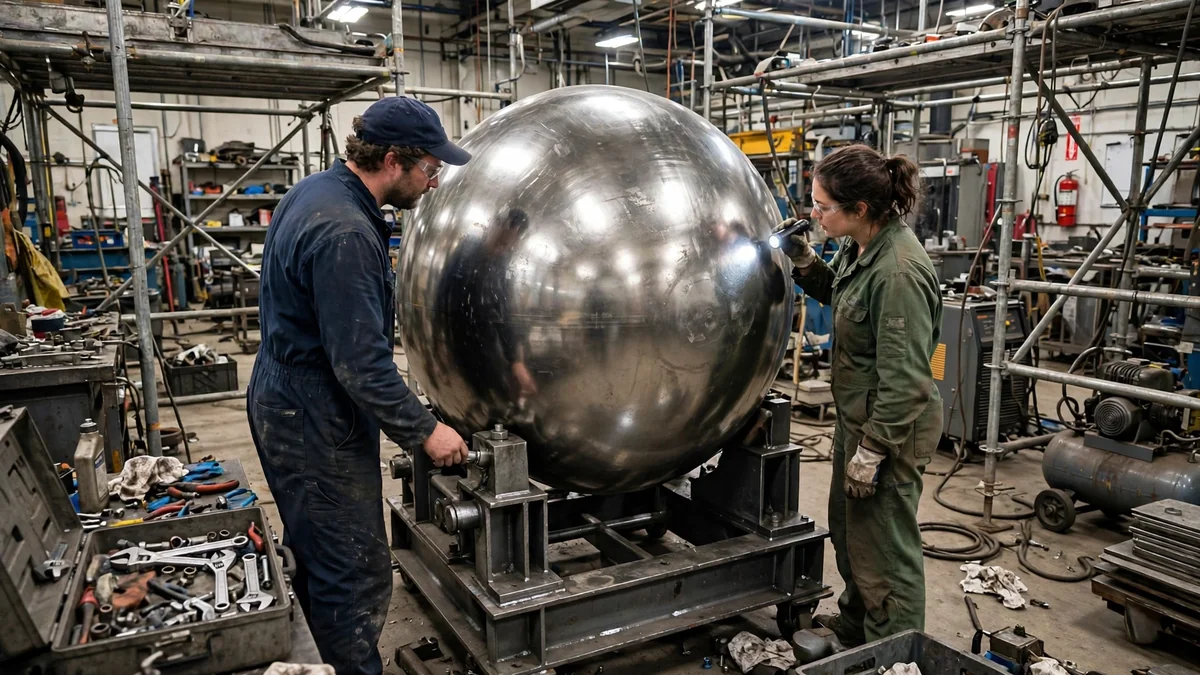
A sphere is built in two halves. Each half starts as a flat disc of titanium, heated until it glows and then pressed slowly into a bowl shape in a giant hydraulic press. The metal is worked in stages, reheated between presses, because titanium is stubborn and cracks if it is forced too fast. After forming, each hemisphere is machined on a huge lathe, cutting the rim to a perfect circle and thinning the wall to an even thickness all round. Even a small thin patch would be where it fails. The two halves are measured with laser scanners until their shapes match to within a fraction of a millimetre.

Step 3: Cutting the openings
Before the halves are joined, the openings are cut: a hatch big enough for a person to climb through, viewports for the windows, and smaller penetrations for power cables, lights and life-support lines. Each hole weakens the sphere, so each one is reinforced with a thick forged ring welded around it. The viewport rings are machined to hold cones of acrylic, a clear plastic that is thick enough to resist the pressure and flexible enough to compress slightly without cracking. Each ring is fitted by hand and checked twice. The hatch itself is a forged disc with a locking ring, and it is designed so that the ocean pressure pushes it tighter shut the deeper the sphere goes.
Step 4: Welding the two halves together
The two hemispheres are set rim to rim on a rotating fixture and welded around the equator. Titanium welding is done in a chamber flooded with argon gas, because hot titanium grabs oxygen from the air and turns brittle. The weld is made in several passes, each one melting a thin layer of metal into the joint, and the seam is ground smooth afterwards so the pressure flows evenly across it. The technique is the same family of precision work used in how a submarine pressure hull is made, where a flawless weld is the difference between a hull that dives and one that does not. Once welded, the whole sphere is X-rayed and ultrasound-scanned, and any defect, however small, is cut out and rewelded.
Step 5: Fitting the life support and controls
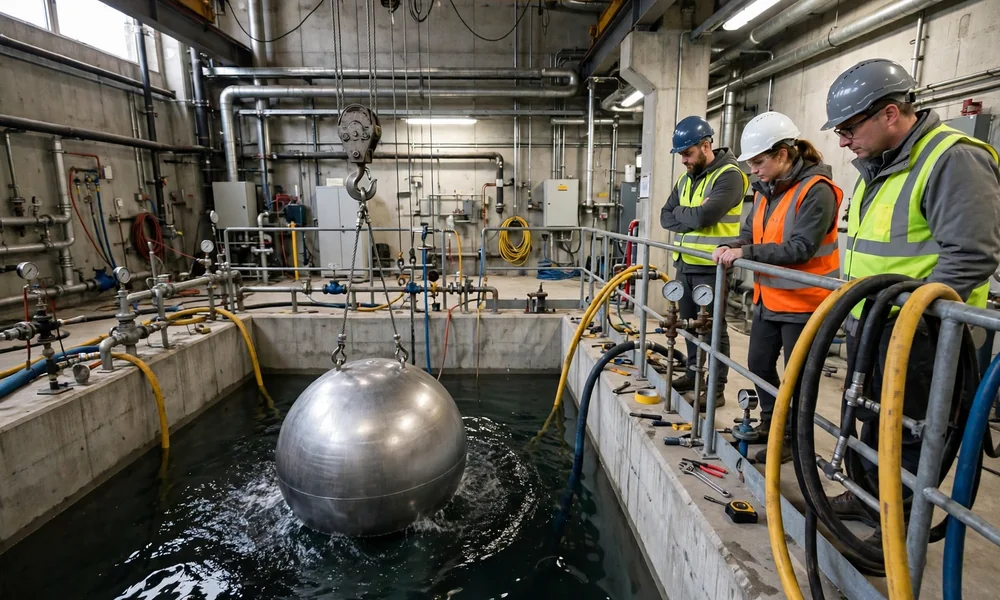
With the hull complete, the inside is fitted out. Oxygen tanks, carbon dioxide scrubbers, batteries, lights, cameras and a control panel are mounted on racks inside the sphere, and the wiring runs through sealed penetrators that keep the water out even under full pressure. The viewports are installed last, seated in their rings with gaskets that compress as the pressure rises. Every system is tested on the bench first. The sphere is then sealed and taken to a pressure tank, where it is lowered into water and squeezed to a pressure greater than any dive it will ever make, while sensors listen for the tiniest creak of metal giving way.
Step 6: Testing and first dive
The pressure test is the moment of truth. The sphere is held at full test pressure for hours, and if it survives without a measurable change in shape, it is certified for service. Only then is it mounted in its submersible frame, with thrusters, floats, manipulator arms and a battery pack fitted around it. The first dive is shallow and careful, with the crew watching every gauge. Each dive after that goes a little deeper, until the sphere is working at its full rated depth, carrying scientists to places no human has seen. The sphere itself never changes after that first dive, but it is inspected and pressure-tested again after every few years of service.
Specs
| Specification | Typical figure |
|---|---|
| Material | Titanium alloy, usually Ti-6Al-4V |
| Sphere diameter | About 2 metres inside |
| Wall thickness | 70–90 mm for 6,000 m depth |
| Rated depth | Up to 6,000–11,000 m |
| Pressure at 6,000 m | About 600 times sea level |
| Crew | Usually 2–3 people |
| Viewport material | Acrylic cones, up to 180 mm thick |
| Test pressure | Above the maximum dive pressure |
Price
A research submersible sphere is a one-off piece of engineering, and its price reflects that. As an estimate, a titanium sphere rated for 6,000 metres costs roughly $1 million to $3 million on its own, before the frame, thrusters, batteries and instruments are added — these are estimates, and the final figure depends on the size, the rated depth and the amount of testing required. A full deep-diving submersible built around the sphere can cost $10 million to $50 million. Only a handful of workshops in the world can forge and weld titanium at this scale, which is why so few of these spheres exist.
A Rare Fact
The sphere is the only shape that spreads deep-ocean pressure perfectly evenly, which is why nature uses it too: a fish egg and a deep-sea bubble both take the same form. The first crewed dive to the bottom of the Mariana Trench in 1960 used a sphere made of steel, and it was so heavy that the submersible needed enormous floats just to carry it. The principle has not changed in sixty years: a perfect ball of metal, with nothing inside but air and people.
The sphere is only one part of a working submersible. The craft around it carries the ears of the operation, and the submarine sonar array specs explain how underwater craft listen in the dark. For the numbers behind the ball itself, the research submersible sphere specs lay out the depth ratings and dimensions in detail. A sphere that can survive the deepest ocean is a quiet masterpiece — no engine, no moving parts, just metal, maths and a perfect shape.


