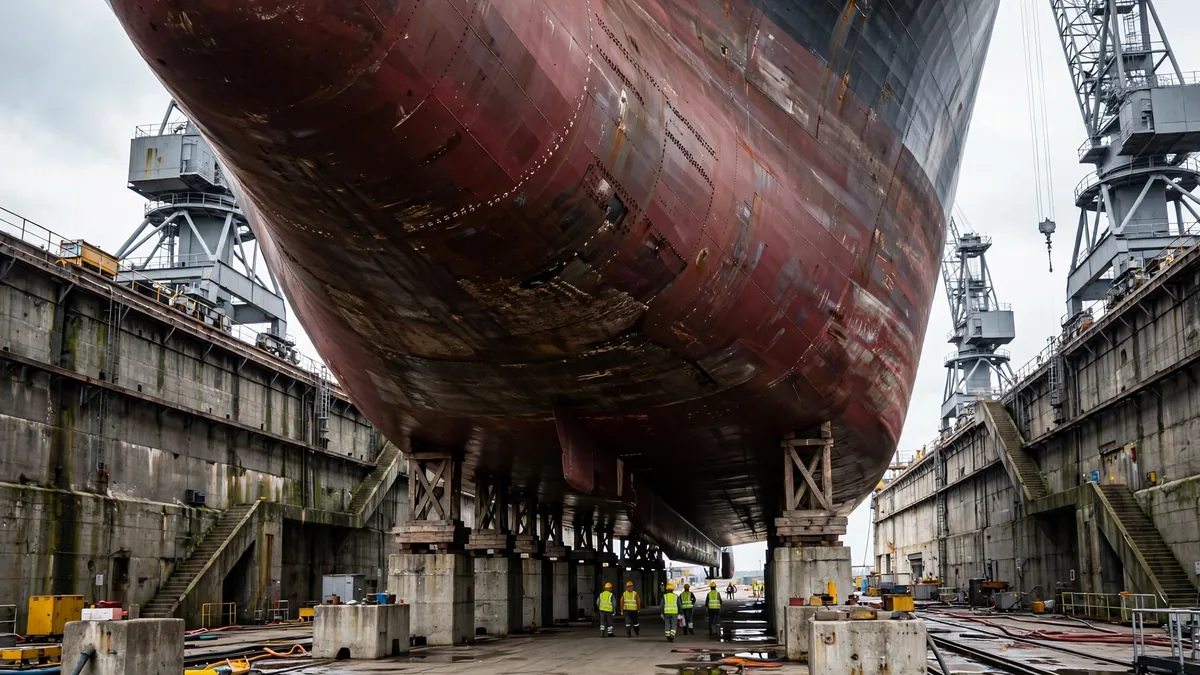
There is a moment in every big ship’s life when the sea is taken away from it. The gates close, the pumps start, and thousands of tonnes of water drain out of a concrete basin until the ship is standing on rows of blocks, with the whole of its hull exposed to the sky for the first time since it was built.
That concrete basin is a ship dry dock, and building one is among the most expensive civil engineering projects in the maritime world. A large dry dock can cost hundreds of millions to build, and hiring one for a single visit can run into the millions. The price is for what the hole must survive: the weight of the ship, the sea pressing to get back in, and decades of hard use.
Why a Ship Dry Dock Costs So Much
A dry dock is a giant bathtub with a door that can hold back the sea. The dock must hold back the ocean on one side and carry the weight of a fully loaded ship on the other, while its floor stays flat under the ship’s weight. It must do this for fifty years or more, in salt water. If you want the background on how a ship dry dock works, the principle is simple — pump the water out, let the ship settle on blocks — but the structure behind it is anything but.
Materials: concrete and steel on a heroic scale
The biggest cost of a dry dock is the dock itself. The walls and floor are made from tens of thousands of cubic metres of reinforced concrete, poured in sections and cured under strict control. The concrete must resist salt water for decades, so it is mixed with specialist cements and additives, with its steel reinforcement protected against corrosion. Above the concrete sit the dock gates, among the largest moving steel structures ever built. A single gate can weigh hundreds of tonnes and must seal perfectly against the full pressure of the sea. Then there are the gantry cranes, and the miles of pipework, pumps and valves that empty the dock in hours.
Labour: years of building, in the wet
A large dry dock takes years to build, and much of the work happens below the waterline. Before the first concrete is poured, engineers must excavate a basin in ground that is often wet or reclaimed from the sea. Dewatering pumps run day and night to keep the excavation dry, and the site must be protected against flooding from a storm surge. The workforce is a small army of specialists: civil engineers, concrete technicians, steel fabricators, crane erectors, divers and pump engineers. The labour is slow because the tolerances are tight — a dock floor out of level by a few centimetres can leave a ship badly supported.

Rarity: few yards, few docks, no spare capacity
Few dry docks in the world can take the biggest ships. A dock long enough and deep enough for a large cruise ship or container vessel is a rare asset, and building a new one is a decision a port makes once in a generation. The demand is steady — every large ship needs to come out of the water every few years — but the supply is fixed by geography, by the cost of construction, and by the sheer amount of waterfront land a dock consumes. When a shipowner books a docking, they are booking a slot that may be reserved months ahead, with a workforce, cranes and services that exist nowhere else nearby.
Testing: proving a basin that must never leak
Before a new dry dock takes its first ship, it is tested in ways that take months. The basin is flooded and emptied in stages, and surveyors measure every wall and floor section for movement. The gates are opened and closed against full water pressure, again and again, while divers and engineers check the seals for the slightest leak. The pumps are run at full capacity to prove they can empty the dock within the time the design promises. The testing does not stop once the dock is open: every few years the dock itself is inspected, the gates are lifted out for maintenance, and the pumps are overhauled.
Low volumes: one dock, one lifetime of work
A dry dock is the ultimate one-off project. No two are alike, because no two sites are alike: the ground, the tides, the ships the dock must serve and the space available all shape the design. The gates are fabricated for a single entrance, and even the blocks the ships stand on are arranged differently for every vessel, positioned to match one hull’s exact shape. And because a dock is built to last half a century or more, its cost is spread across decades of dockings. It is the same logic that shapes the container ship hull that sits on those blocks, and the ferry hull beside it: big steel, built once, maintained for a lifetime.
Cost Breakdown: Where the Money Goes (Estimates)
The figures below are broad industry estimates. Building a large dry dock costs nine figures, while a single docking visit is priced in the millions. Real figures vary with location, dock size and the work needed.
| Part of the project or visit | Estimated share of cost | Estimated price range |
|---|---|---|
| Excavation, concrete and foundations | About 40–50% of build cost | $80–250 million |
| Dock gates | About 10–15% of build cost | $20–60 million |
| Pumps, cranes and services | About 15–20% of build cost | $30–80 million |
| Design, testing and commissioning | About 10% of build cost | $20–50 million |
| Dock hire per large-ship visit | Daily rate plus services | $50,000–150,000 per day |
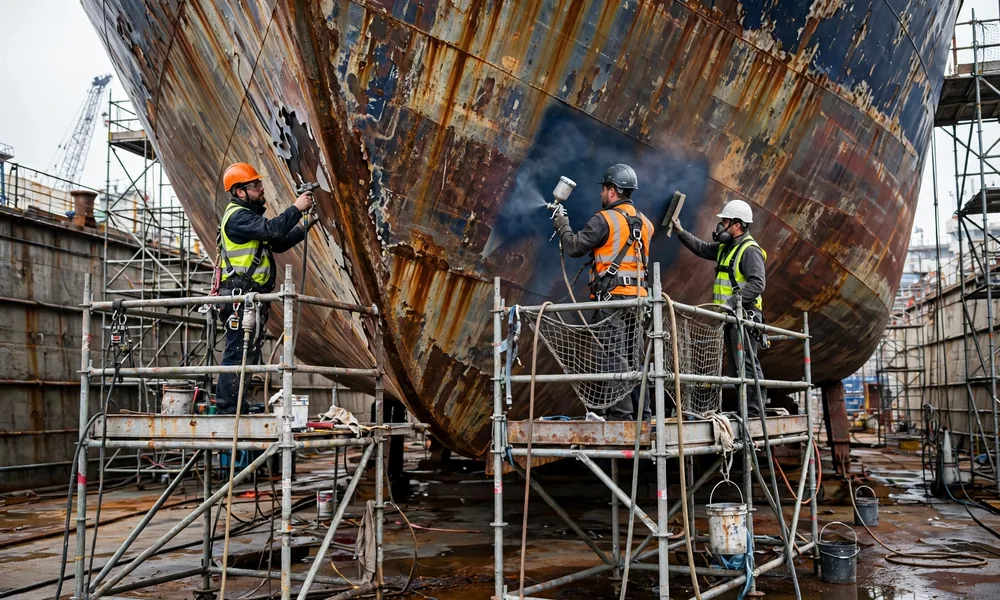
| Hull work, paint and labour per visit | Varies with scope | $500,000–3 million |
All told, a large dry dock is estimated to cost roughly $200–500 million to build, and a typical two-week docking runs roughly $1–4 million including the hire, the hull work and the paint. The dock is the most expensive piece of equipment a shipyard owns — and the one it cannot do without.
Ship Dry Dock at a Glance
| Detail | Typical figure |
|---|---|
| Length of a large dock | 300–400 metres |
| Width | 50–70 metres |
| Concrete used | Tens of thousands of cubic metres |
| Time to empty the basin | Several hours |
| Main materials | Reinforced marine concrete, structural steel, gate steel |
| Design life | 50 years or more |
A Rare Fact
Here is the detail that catches most visitors by surprise: a ship in dry dock is not sitting on the dock floor at all. It stands on rows of separate concrete and timber blocks, and the gaps between them are deliberate. The ship’s weight is carried only where the blocks are, and the spaces between them let workers reach the hull, let water drain away, and let the hull flex slightly without cracking. Getting the block layout right is a piece of engineering in its own right — put a block in the wrong place under a loaded ship and you can bend the hull.
That is why a dry dock costs what it does. It is not a hole in the ground. It is years of excavation and concrete, gates the size of buildings, pumps that can empty a small lake, and a workforce that knows how to hold a ship out of the water safely. Every vessel that sails the oceans will, sooner or later, stand on those blocks.


