The Rimac Nevera is the fastest accelerating production car ever built, reaching 100 kilometres per hour in under two seconds, and it does it without a drop of petrol. The secret is not just its four electric motors. It is the battery beneath the floor, a 120-kilowatt-hour pack that can deliver nearly 2,000 horsepower in a burst, yet is shaped like the spine of the car itself.
The Nevera’s battery is a liquid-cooled pack of 6,960 lithium-ion cells, arranged in modules and housed in a carbon-fibre case that forms the central spine of the car’s monocoque. It powers four motors, one at each wheel, and it must deliver enormous current without overheating, survive crashes, and last for years of fast charging. Every cell is monitored, every module is cooled, and every connection is made by hand. This is how the Rimac Nevera battery is made.

How It’s Made
Step 1: Testing every single cell
The build starts with the cells, cylindrical lithium-ion cells similar in shape to a large torch battery. Rimac buys the cells from a supplier, but it does not trust them on arrival. Every cell is tested for capacity, internal resistance and voltage, and any cell that falls outside a narrow band is rejected. The accepted cells are sorted into groups of closely matched performance, so that each module is built from cells that behave identically. This sorting is slow and expensive, and it is one of the reasons the Nevera’s battery performs so consistently.
Step 2: Building the modules
The matched cells are assembled into modules, groups of cells wired together with busbars and fitted with sensors. Each cell is connected by laser welding or wire bonding, techniques that join the metal without heating the cell enough to damage it. A module also carries its own temperature sensors and a circuit board that reports the voltage of every cell group to the battery management system. The modules are built in a clean, dry environment, because moisture is the enemy of lithium-ion cells, and the air in the assembly area is controlled to keep humidity far below normal room levels.
Step 3: Making the carbon-fibre case
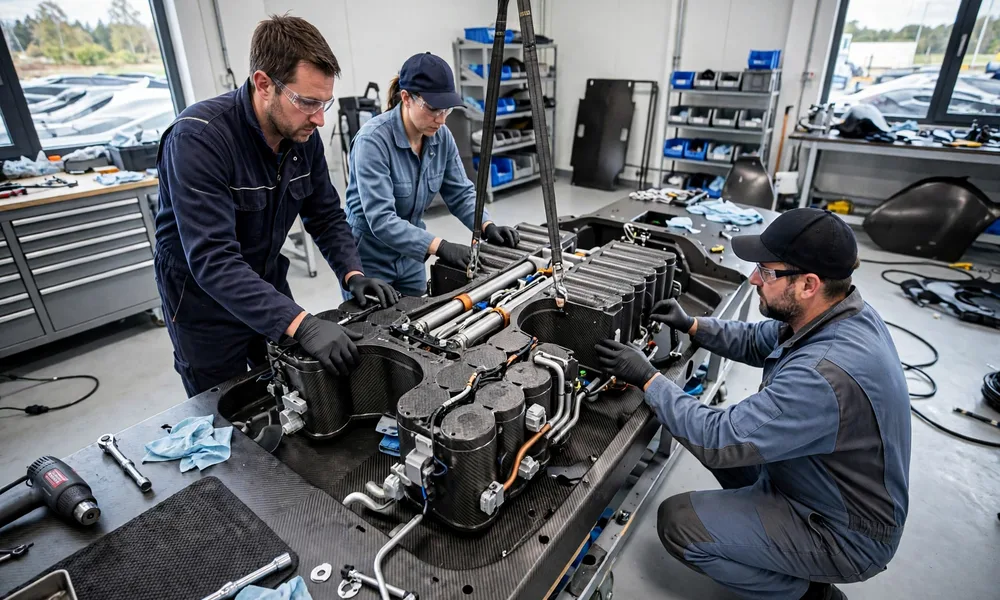
Unlike most electric cars, whose batteries sit in a metal box, the Nevera’s battery lives in a carbon-fibre case that is part of the car’s structure. The case is laid up from carbon fibre in moulds, cured in an autoclave, and bonded into the car’s monocoque, so the battery housing carries crash loads and stiffens the chassis. Building the case takes the same hand lay-up and curing skills used for the car’s bodywork, and it must be perfect, because a crack in the case could let water in or let the battery’s heat out in the wrong place. The materials behind the pack are covered in Rimac Nevera battery materials engineering, which lists the cells, cooling and structural materials used.
Step 4: Installing the cooling system
A battery that delivers nearly 2,000 horsepower generates a great deal of heat, and heat is what ages lithium-ion cells and limits their power. The Nevera’s pack is cooled by a liquid system that runs coolant through channels between the modules, carrying heat away to radiators at the front of the car. The cooling plates and pipes are fitted into the case before the modules go in, and every joint is pressure-tested for leaks. The cooling design is also what lets the Nevera charge quickly and repeat its acceleration runs without the battery overheating, a feat that sets it apart from most electric cars.
Step 5: Wiring the battery management system
The battery management system is the pack’s brain, and it watches every cell group, every temperature sensor and every current reading, thousands of times a second. It decides how much power the motors may draw, when to limit charging to protect the cells, and when to balance the cells so they all age evenly. The software is then loaded and the system is tested by simulating faults: a sensor is disconnected, a cell is forced out of balance, and the system must detect the problem and respond safely. A battery this powerful is only safe because its management system never stops watching it.

Step 6: Assembling and sealing the pack
With the cooling in place and the wiring done, the modules are lowered into the carbon-fibre case and connected to each other and to the battery management system. The pack is then sealed with a lid that is bolted and gasketed, and the whole assembly is pressure-tested to prove it is watertight. The finished pack is weighed, measured and electrically tested, and its serial number is recorded against the car it will power, so its entire history can be traced. The cost of building a pack like this, and why it is so expensive, is explained in why the Rimac Nevera battery is so expensive, which breaks down the materials and labour behind it.
Step 7: Testing the pack and fitting it to the car
Before the pack meets the car, it is tested on a bench that charges and discharges it at full power, checking that it delivers its rated energy, that no cell overheats, and that the cooling system keeps up. The pack is then fitted into the monocoque, where it becomes part of the car’s structure, and the four motors are connected to it. The finished car is tested on a rolling road and then on the track, where the battery must deliver repeated full-power launches without fading. The battery pack in a more ordinary electric car is built on the same principles at a very different scale, as how an EV battery pack is made shows, but the Nevera’s pack is the extreme version of the idea: a battery that is also a chassis.
Specs
| Specification | Typical figure |
|---|---|
| Capacity | 120 kilowatt-hours |
| Cells | 6,960 cylindrical lithium-ion cells |
| Peak power output | Nearly 2,000 horsepower in bursts |
| Case | Carbon-fibre structural case, part of the monocoque |
| Cooling | Liquid cooling through channels between modules |
| Motors powered | Four, one at each wheel |
| Voltage | Around 700 volts nominal |
| Charging | Fast DC charging, liquid-cooled during charging |
| Production | 150 cars planned, each battery built by hand |
Price
The Nevera’s battery is a component inside the car, not a product sold on its own, so there is no retail price for one. As an estimate, a replacement battery pack of this kind would generally cost in the region of $100,000 to $200,000, including the carbon-fibre case, cells, cooling and management system — these are estimates, and the true figures are commercial secrets. The Rimac Nevera itself sells for roughly $2.2 million, also an estimate.
A Rare Fact
Mate Rimac started building electric cars in his garage in Croatia, converting a 1984 BMW 3 Series into an electric car after its petrol engine blew up during a race. Less than two decades later, his company was building the Nevera, the fastest accelerating production car in the world.
From individually tested cells to a carbon-fibre spine that is also a chassis, the Rimac Nevera battery is made by treating a battery as a structural part of the car, not an accessory bolted underneath it.


