There is a number that tells you almost everything about the Rimac Nevera: 1,914 horsepower. It is the most powerful production car ever built, and it does it without a drop of petrol. But the number that makes the car possible is quieter and heavier — a battery pack that holds 120 kilowatt-hours of energy, weighs more than a small car, and forms the very spine of the chassis.
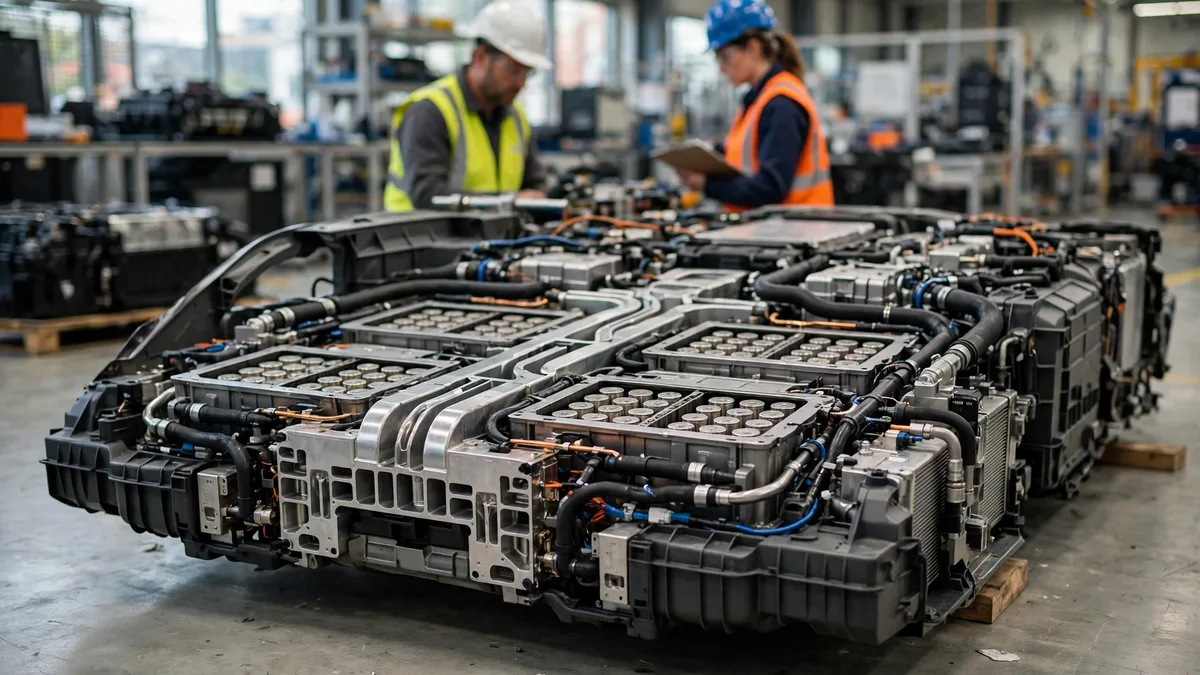
The Nevera’s battery is not a box of cells dropped into a frame. It is an H-shaped pack of nearly seven thousand cylindrical cells, cooled by liquid, watched over by a computer that measures every group of cells many times a second, and armoured against the worst day a car can have — a crash. Building it meant solving problems that have nothing to do with horsepower: how to keep thousands of cells at the same temperature, how to stop one hot cell from setting off its neighbours, and how to make a two-tonne slab of energy safe enough to sell to the public.
The Materials Behind the Rimac Nevera Battery
The Nevera’s pack is built around 6,960 cylindrical lithium-ion cells in the 2170 format — each about 21 millimetres across and 70 long — grouped into modules and wired together with copper and aluminium busbars. The cells use a nickel-manganese-cobalt chemistry, chosen for energy density, and they sit in an aluminium housing that is also the car’s floor and crash structure. Liquid coolant runs through channels between the modules, a battery management system watches voltage and temperature constantly, and the whole pack is sealed against water and dust. It is a battery, a chassis and a cooling system in one object, and every material in it earns its place twice.
Step 1: The cells — 6,960 small cylinders, one big battery
The choice of cylindrical cells is deliberate. A 2170 cell is a proven, mass-produced format — the same size used in many electric cars — which means its quality is consistent and its behaviour under stress is well understood. The cells are nickel-manganese-cobalt, or NMC, a chemistry that packs more energy per kilogram than the iron-based cells used in cheaper cars, at the cost of needing more careful thermal management. The same cell-level thinking shapes the electric car battery pack in everyday cars, just with fewer cells and gentler demands.
Step 2: Modules, busbars and the H shape
The cells are grouped into modules, and the modules are arranged in an H shape: two long banks running down the sides of the car, joined by a crossbar behind the seats. Copper busbars — thick, flat strips of copper — connect the modules, carrying up to 1,914 horsepower worth of current without melting, and aluminium links tie the modules to the housing.
Step 3: The housing — a battery that is also the chassis
The pack’s housing is not a container; it is the car’s backbone. Made from aluminium extrusions and castings, it is bonded and bolted to the carbon fibre monocoque, and the front and rear subframes attach directly to it. This structural role saves weight overall — the car does not need a separate heavy frame around the battery — but it means the housing must survive crash loads as well as protect the cells.
Step 4: Liquid cooling — keeping 6,960 cells at one temperature
Heat is the enemy of a performance battery. The Nevera’s pack is liquid-cooled, with coolant channels running between the modules and cold plates under the cells, carrying heat away to radiators at the front of the car. The cooling plates are aluminium, the hoses are heat-resistant rubber and plastic, and the coolant itself is a water-glycol mix, like a normal car’s, but pumped through a far more intricate network. The chemistry of the cells themselves is explained in the electric car battery cell guide, where the same heat problem appears at a smaller scale.
Step 5: The battery management system — a computer that never blinks
Watching over the pack is the battery management system, a network of sensors and controllers that measures the voltage and temperature of cell groups many times a second. If a group drifts out of line, the system can isolate it, limit the power, or warn the driver long before anything dangerous happens. The same watchful electronics appear in the electric bike battery, where a tiny management board does the same job for a few dozen cells instead of a few thousand.
Step 6: Crash protection and fire containment
A battery this large must be designed for the worst day. The pack is armoured underneath against debris and speed bumps, its sides are built to absorb a side impact without intruding into the cells, and inside, fire-resistant barriers sit between modules so that if one module ever overheats, the heat cannot easily spread to the next. These are not optional extras: regulators demand them, and Rimac tests beyond the minimum, because a hypercar battery fire is the one headline no maker can afford.
Step 7: Assembly, testing and what happens when it fails
Assembling the pack is a clean-room job. Cells are tested and sorted before they are grouped, so that every module holds cells of closely matched capacity, and the finished pack is charged, discharged and thermally cycled on a test rig before it goes into a car. Any module that underperforms is pulled and rebuilt. In service, the most common failure is not dramatic at all: a slow loss of capacity as the cells age, measured in a few per cent over years.

Rimac Nevera Battery at a Glance
| Specification | Detail |
|---|---|
| Capacity | 120 kWh usable |
| Cell count and format | 6,960 cylindrical 2170 cells |
| Cell chemistry | Nickel-manganese-cobalt (NMC) lithium-ion |
| Pack layout | H-shaped, structural, forming part of the chassis |
| Cooling | Liquid cooling with cold plates and front radiators |
| System power | 1,914 horsepower from four electric motors |
| Range | Around 340 miles (WLTP estimate) per charge |
What Does It Cost?
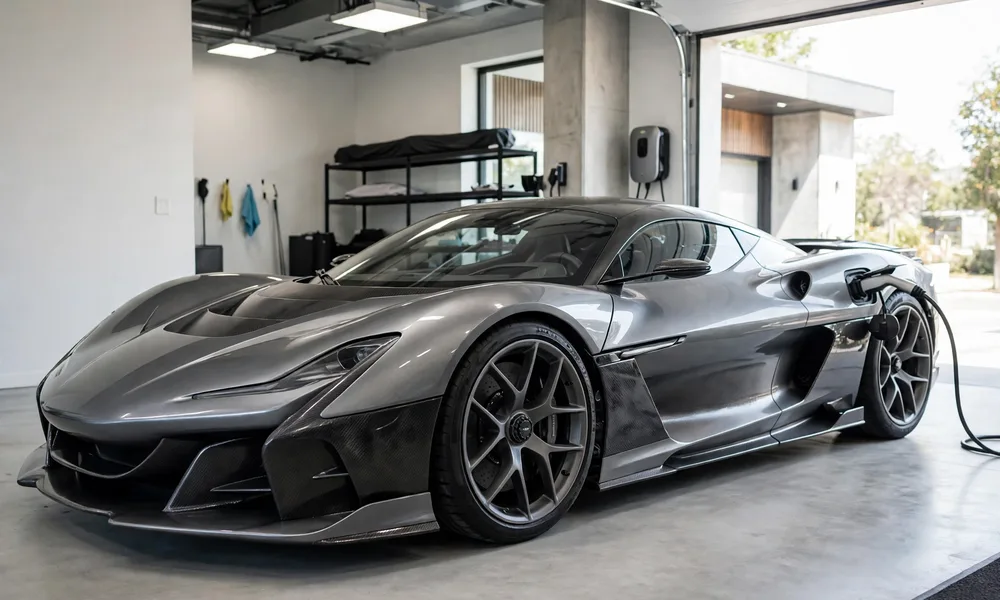
The Nevera itself sells for roughly $2.4 million (estimate), and the battery is one of the most expensive single parts of it — a replacement pack would cost well into six figures (estimate), though Rimac does not publish a price and packs are repaired at module level rather than replaced whole. The cost reflects the cells, the structural aluminium housing, the cooling system and the testing, but also the sheer scale: 6,960 cells, each tested and sorted, assembled by hand in a clean room.
A Rare Fact
The Nevera’s battery is so central to the car that the chassis is built around it, not the other way round — the pack is literally part of the structure, and removing it leaves a car with no spine. The most powerful production car in the world runs on thousands of cells the size of a torch battery, watched over by a computer that checks them many times a second. It is not one big battery. It is a small city of them, working in perfect unison.


