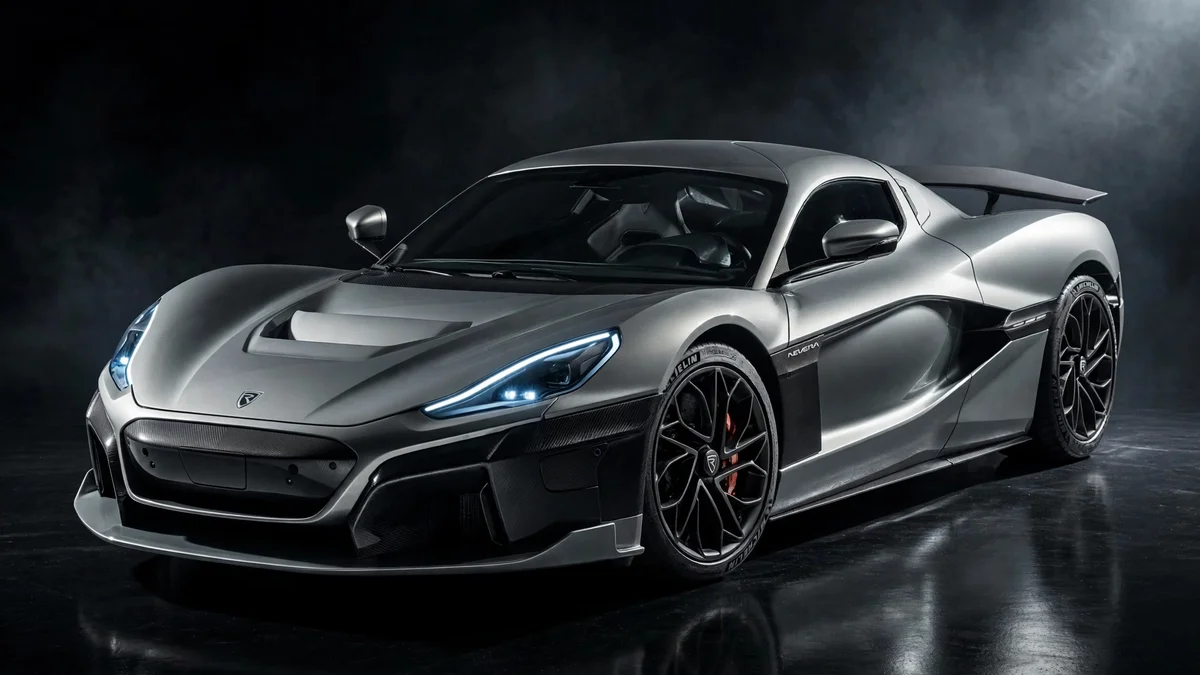
There is a moment, just before a Rimac Nevera launches, when the car seems to take a breath. Two thousand horsepower waits in silence, no engine note, no vibration, just the faint hum of cooling pumps. Then the driver presses the accelerator and the car is gone, covering the quarter mile faster than almost anything with wheels. What makes that possible is not visible at all. It is a battery pack, low in the floor, shaped like a giant letter H, and it is one of the most expensive single components ever fitted to a road car.
The Nevera costs about $2.4 million, and its battery is a large part of why. This is not a bigger version of the battery in a family electric car. It is a hand-built energy store designed to deliver nearly two megawatts of power, keep itself cool while doing it, and survive a crash at hypercar speeds without ever catching fire. Every cell inside it has been chosen, tested and placed by people who know that a single failure could end the car, and possibly the company.
Why It Costs So Much
A hypercar battery has to do three things at once that normally fight each other: hold enormous energy, release it in a violent burst, and stay safe while doing so. The Nevera’s pack manages all three, and each part of that trick adds cost that an ordinary electric car never faces.
Reason 1: Power density beyond any normal EV
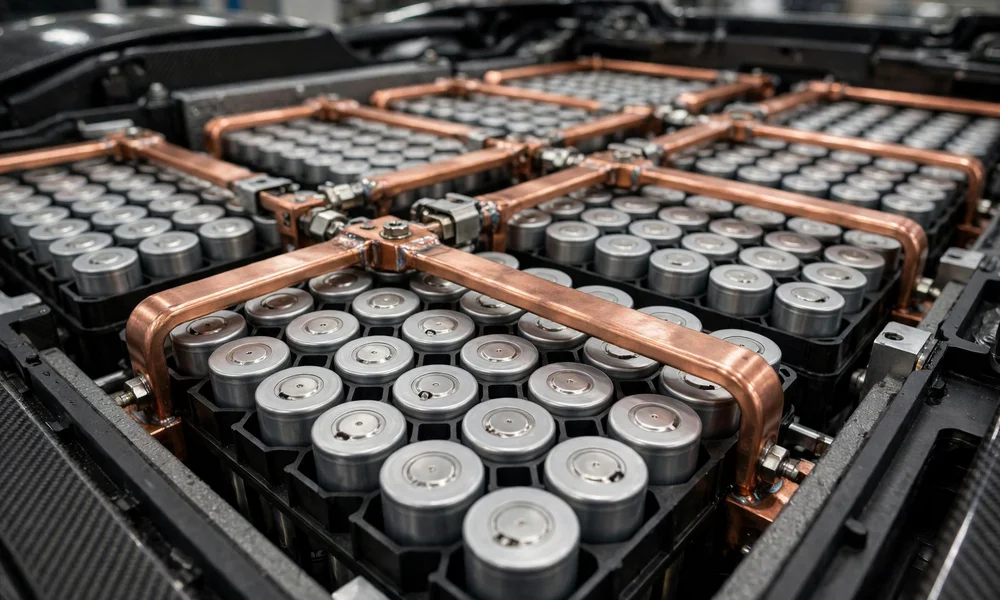
The Nevera’s battery holds 120 kilowatt-hours, but the headline number is power, not energy. The pack can discharge at a rate of about 1.4 megawatts, feeding four motors that together make 1,914 horsepower. Delivering that much current without the voltage collapsing means thick busbars, low-resistance connections and cells selected for power output rather than cheap energy storage. Every joint in the pack is engineered like a piece of electrical infrastructure, because at these currents it effectively is.
Reason 2: 6,960 cells, each one tested
Inside the pack sit 6,960 individual lithium-ion cells, arranged in modules and wired together with a precision that leaves no room for a weak link. Each cell is tested before assembly, and the pack’s management system watches every group of cells for voltage and temperature, ready to isolate a problem in milliseconds. The labour of assembling, testing and validating a pack of this size by hand, in small numbers, is closer to building a prototype than to running a production line, and the cost reflects that.
Reason 3: Cooling that never gets a rest
A battery making megawatts of power also makes enormous heat, and heat is what kills both performance and safety. The Nevera circulates liquid coolant through channels woven between the modules, with radiators and pumps sized for track driving rather than a gentle commute. The same lesson applies across electric cars: the pack is only as good as its thermal system, as shown by what really goes into an EV battery pack. Designing cooling that works at full power, lap after lap, without adding crippling weight, is one of the hardest problems in the car.
Reason 4: The battery is the chassis
Most electric cars bolt their battery into the floor. The Nevera goes further: the pack is a structural part of the carbon-fibre monocoque, carrying loads and adding stiffness to the whole car. That means the battery casing must be both a crash structure and a sealed, fireproof container, built from carbon fibre and aluminium to tolerances a normal battery tray never needs. A structural battery cannot be swapped like a part; it is the car, and building it demands the same craftsmanship as the body around it.
Reason 5: Crash safety at 250 miles per hour
A hypercar battery must survive impacts that would destroy an ordinary car, without a single cell being punctured. Rimac builds armoured casings, fire barriers between modules and a battery management system that can disconnect the pack in a crash. The car has been crash-tested far beyond what regulators demand, and every test destroys a pack worth a fortune. That testing is priced into every Nevera that reaches a customer, and it is the reason the car can be sold at all.
Reason 6: Tiny production numbers
Rimac planned to build only 150 Neveras. The tooling, the testing rigs, the crash programme and the factory all have to be paid for across those 150 cars, not across a million. A family electric car spreads its battery development over hundreds of thousands of units; the Nevera spreads it over a few hundred. That arithmetic alone multiplies the cost of every pack several times over, before a single cell is even bought. The engineering culture is the same one that builds hand-assembled engines, where the V12 engine is built by hand — except here the handwork is electrical, not mechanical.
Reason 7: Software that watches every cell
The battery management system is a computer in its own right, running models of each cell’s health, temperature and age, and deciding hundreds of times a second how much power is safe to deliver. It must never be wrong in either direction: too cautious and the car loses its performance, too generous and the pack is damaged. Developing and validating that software, then proving it across climates and driving styles, is a programme that costs millions before the first customer car is delivered.
Specifications
| Specification | Detail |
|---|---|
| Capacity | 120 kWh |
| Cells | 6,960 lithium-ion cells |
| Peak power output | About 1.4 MW discharge |
| System voltage | Approximately 730 V |
| Motors fed | Four, one per wheel |
| Combined output | 1,914 horsepower |
| Cooling | Liquid cooling, track-rated radiators and pumps |
| Structure | Structural part of the carbon-fibre monocoque |
Price
The Rimac Nevera is priced from about $2.4 million, and the battery pack is widely reported to be one of its most expensive components, with a replacement pack estimated to cost several hundred thousand dollars (estimate). Rimac has not published an official pack price, and with only 150 cars planned, there is no volume production to bring the cost down. The cell-level detail matters here too: the specs of an EV battery cell show how much performance is packed into each small cylinder, and the Nevera multiplies that by nearly seven thousand.

Rare Fact
The Nevera’s battery can deliver more power than a small power station’s turbine in short bursts, yet it also serves as a structural spine of the car — and Rimac developed the pack in-house in Croatia, a country with no previous car industry, rather than buying it from a major supplier. The company that built it started in a garage, and its battery now powers some of the fastest cars on earth.
That is why the Nevera’s battery costs so much: it is not a fuel tank, it is the car’s heart, spine and nervous system at once, built by hand in tiny numbers to do things no mass-market battery is ever asked to do. The silence before launch is the sound of 6,960 cells, cooled, watched and armoured, waiting to release their power all at once.


