The helicopter came in low over the bay, its rotor wash flattening the water into white streaks, and settled onto the bow of the yacht as gently as a bird landing on a branch. The guests on the sun deck barely looked up. That is the point of a superyacht helicopter deck: a piece of an airport, shrunk to the size of a tennis court and bolted to the front of a floating hotel, built so that arriving by air feels as ordinary as arriving by car.
Underneath, though, the engineering is serious. A helicopter deck has to carry several tonnes of aircraft that does not land so much as fall the last few centimetres, and it has to do it while the ship rolls, pitches and flexes in a swell. It must be strong, flat, fireproof and grippy, yet light enough not to ruin the yacht’s balance. It needs fuel handling, firefighting, lighting and drainage, all packed into a space that also has to look like a luxury sun deck when the helicopter is away. Building one is where shipbuilding meets aviation, and neither side is allowed to compromise.

How a Superyacht Helicopter Deck Is Made
Step 1: Designing for weight and balance
Everything starts on paper, with the naval architect and the aviation engineers arguing — politely — about weight. The deck must support the heaviest helicopter the owner plans to fly, plus a safety margin for a hard landing, and that load has to sit in the right place or the yacht will trim bow-down. The deck is usually placed forward, where the hull is widest and strongest, and its structure is drawn as part of the ship, not bolted on afterwards. Fire zones, fuel lines and escape routes are planned at the same time, because adding them later would mean cutting into finished steel.
Step 2: Building the steel structure
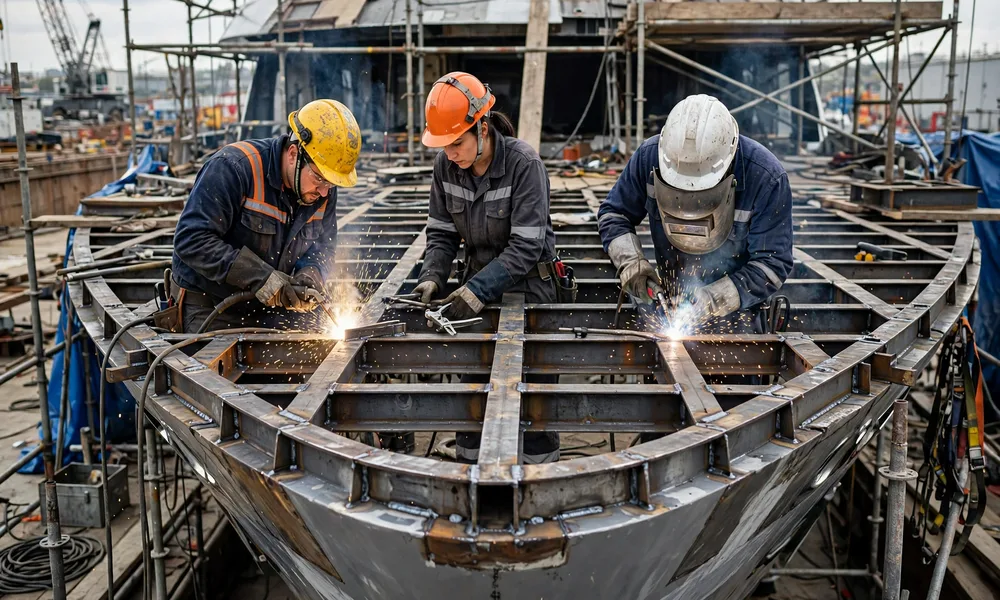
The deck’s skeleton is welded from marine-grade steel plate over a grid of stiffeners, much like the rest of the hull — a process with the same heavy discipline as building a superyacht steel hull. The panels are welded in a dry dock or a covered hall, checked for flatness with straight edges and lasers, because a deck that is out of level by even a few millimetres will pool fuel and water. The structure is then primed and painted with anti-corrosion coatings, and every weld is inspected: a crack in a helicopter deck is not a cosmetic problem.
Step 3: Fitting the landing surface
On top of the steel goes the landing surface itself — usually a lightweight aluminium or composite panel system, finished with a non-slip coating that grips helicopter skids and wheels even when wet. The surface must be hard enough to resist the scrape of a dragging skid, yet slightly flexible, so it does not crack as the hull works in a seaway. Drainage channels are built into the edges to carry fuel spills and rainwater overboard, away from the accommodation below.
Step 4: Markings, lighting and safety nets
Next come the markings that make the deck readable from the air: the painted touchdown circle, the big H, and the perimeter lines, all laid out to aviation standards and checked by measurement, not by eye. Recessed lights are set flush into the surface so nothing sticks up to snag a skid, and they are wired to a control panel on the bridge that can switch the deck from daylight to night operations. Safety nets are fitted around the edges — strong enough to catch a person, designed to fold away when the deck is used as a sunbathing area.
Step 5: Fuel, firefighting and drainage
A helicopter deck is also a fuel station. A refuelling point is fitted with bonded hoses, filters and a spill containment system, and the fuel is stored in a dedicated tank deep inside the hull, far from the cabins. Firefighting comes next: foam monitors that can cover the whole deck in seconds, plus extinguishers and a water deluge system, all tested by actually flooding the deck with foam. The drainage system is sized so that a full foam discharge, plus a tropical downpour, can run off without pooling.

Step 6: Testing, certification and the first landing
Before any helicopter is allowed near it, the deck is load-tested with weights equal to the heaviest aircraft it will ever carry, and the structure is checked for deflection. The firefighting system is fired for real, the lights are tested at night, and the drainage is flooded. Then an aviation surveyor inspects the whole installation against the rules for helicopter landing areas and signs it off. The first real landing is done in calm weather, with the crew standing by and the fire team ready. Only when that goes perfectly is the deck handed over — and the owner can finally fly in for dinner.
Superyacht Helicopter Deck at a Glance
| Specification | Detail |
|---|---|
| Typical size | About 12–15 m across, sized for the chosen helicopter |
| Structure | Marine steel stiffened panels, aluminium or composite surface |
| Load rating | Several tonnes, plus a margin for hard landings |
| Surface finish | Non-slip coating, pale grey, with drainage channels |
| Markings | Touchdown circle and H, painted to aviation standards |
| Lighting | Flush recessed perimeter and flood lights, bridge-controlled |
| Firefighting | Foam monitors, extinguishers, water deluge system |
| Main weakness | Weight high up and forward — it affects the yacht’s balance |
What Does It Cost?
There is no catalogue price for a helicopter deck, because each one is built into a single yacht. As a rough estimate, the deck structure, surface, markings, lighting and firefighting systems typically add around $1 million to $3 million to a new superyacht build, with the helicopter itself costing several million more. The figure climbs with size, certification level and whether the deck is rated for refuelling. Those figures are estimates, not quotes. The same craftsmanship that finishes a helicopter deck — flush fittings, perfect paint, nothing out of place — also finishes a yacht teak deck, where every plank is laid by hand.
A Rare Fact
The first helicopter decks at sea were not on yachts at all — they were painted circles on the decks of warships and oil platforms, and early pilots landed on little more than a flat patch of steel with a windsock. Yacht designers borrowed the idea in the 1970s, and the first superyacht helicopter decks were so basic that the helicopter often had to be tied down with ropes and covered with a tarpaulin at night. Today’s decks are certified landing areas with their own fire crews.
A helicopter deck is a strange piece of engineering: an airport that has to be beautiful, a fire station that has to be a sun deck, and a structure that has to be both feather-light and strong enough to catch a falling aircraft. When it works, nobody notices it — the helicopter simply arrives, the guests step off, and the deck goes back to being a quiet patch of grey paint at the front of the boat. That silence is the whole achievement. A yacht can have many luxuries, but few are as quietly difficult as the flat place to land, and even the pool below deck owes its existence to the same thinking — a superyacht swimming pool is, after all, a bathtub that has to survive a storm.


