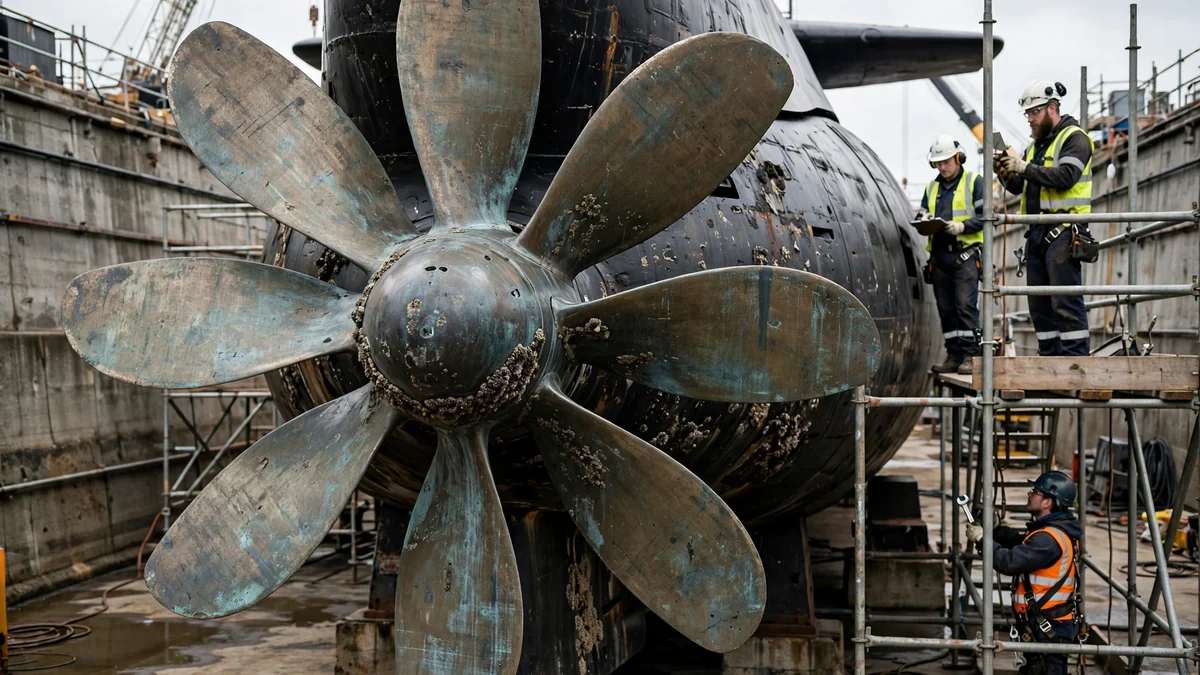
In the dry dock at dawn, the submarine looks less like a warship and more like a beached whale, its black hull resting on blocks while the harbour water laps at the concrete far below. Workers in hard hats walk the length of it with torches, checking welds and valves. But the crowd that gathers at the stern is not looking at the hull at all. They are looking at the propeller: a great bronze flower of seven curved blades, each one taller than a man, bolted to the end of a shaft thick as a tree trunk.
A submarine propeller is the quietest working part of the quietest machine ever put to sea. It must turn the power of a reactor or a bank of batteries into forward motion without shaking the boat, without making bubbles, and without giving the submarine away to anyone listening.
How It Is Made
Making a submarine propeller is slow, secretive work. A single propeller can take a year from first sketch to final polish, and much of that time is spent on steps that look, to an outsider, like doing almost nothing at all: measuring, waiting, measuring again. The reason is simple. At the speeds and pressures a submarine works at, a flaw the width of a hair can grow into a crack, and a crack can end a patrol. Every step below exists to make sure that never happens.
Step 1: Designing the blades in silence
Long before any metal is cut, naval architects design the propeller on computers, modelling how water will flow over each blade at every speed the submarine will travel. The blades are broad and swept back, spreading the load across a large area of water so the propeller can push gently rather than thrash. The twist of each blade changes from hub to tip, steep near the centre where the blade moves slowly, shallow at the tip where it moves fastest, so every part of the blade meets the water at the right angle. What a submarine propeller shares with the vessel around it is a demand for total silence, and the pressure hull that keeps a submarine alive is built to the same unforgiving standard.
Step 2: Casting the bronze
Submarine propellers are cast from nickel aluminium bronze, an alloy chosen because it resists seawater corrosion, stays strong under load, and can be repaired by welding if it is damaged. The metal is melted in a furnace at more than 1,000 degrees Celsius and poured into a mould built from sand and resin around a wooden pattern of the propeller.
Step 3: Rough machining
When the casting has cooled, the mould is broken away and the rough propeller is lifted onto one of the largest machine tools in the shipyard. Five-axis milling machines, some as big as a small house, cut away the excess metal to bring the blades close to their final shape. This is slow work: a single blade can take weeks of machining, with the cutter removing metal in passes a fraction of a millimetre deep.

Step 4: Hand finishing the blade surfaces
Here is where the machine gives way to the human hand. Skilled finishers work each blade with hand tools, grinding and polishing the bronze until its surface is smooth to a tolerance measured in hundredths of a millimetre. They check their work with templates cut to the exact curve of the design, holding them against the blade and looking for the thinnest sliver of light. A rough patch on a blade creates turbulence, turbulence creates noise, and noise is the one thing a submarine cannot afford.
Step 5: Balancing the propeller
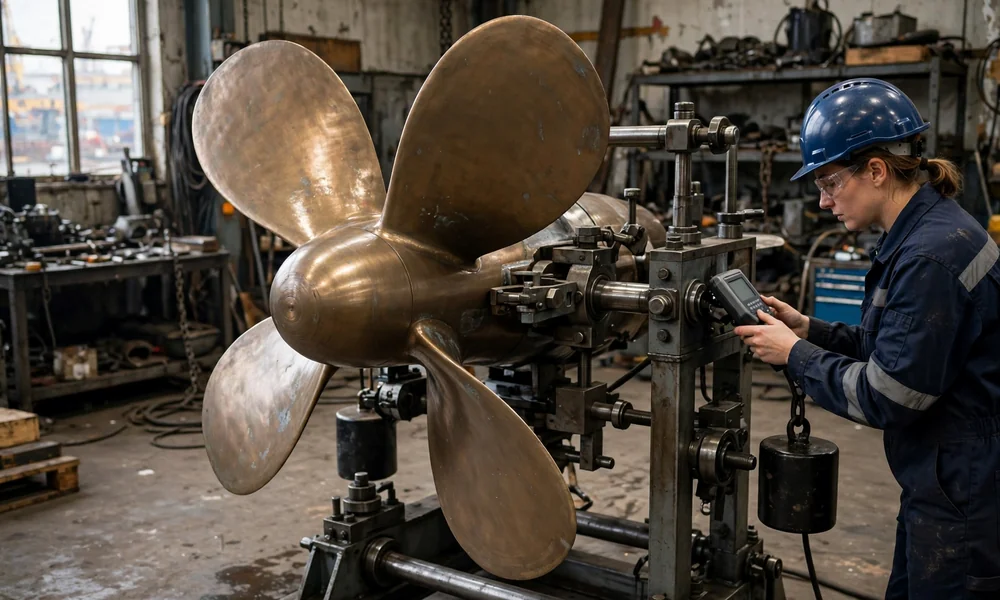
A finished propeller is mounted on a balancing machine and spun slowly while sensors measure vibration. Any imbalance, even a few grams on a twenty-tonne casting, would shake the boat at speed and wear out the shaft bearings. Small amounts of metal are ground away from the heavy side until the propeller spins true. The test is repeated at several speeds, and the results are recorded blade by blade. The care taken here echoes the precision found in the silent propeller beneath a submarine, where the same geometry decides how quietly the boat can move.
Step 6: Fitting, testing and sea trials
Finally the propeller is bolted to the submarine’s shaft, sealed against seawater, and the boat is launched. In early sea trials the crew runs the boat through its full range of speeds while engineers listen from inside and from chase boats, measuring noise and vibration at every setting. Only when the boat is quiet across its whole envelope is the propeller accepted. From first pour to final trial, a submarine propeller can take a year or more to build, and the result is a part that may serve for the life of the boat, twenty-five years or longer, with only routine polishing and inspection.
Specifications
| Specification | Typical value |
|---|---|
| Material | Nickel aluminium bronze |
| Number of blades | 5 to 7 |
| Diameter | 5 to 7 metres |
| Weight | 10 to 30 tonnes |
| Build time | 12 months or more |
| Service life | 25 years or longer |
What It Costs
Nobody publishes a price list for submarine propellers, and for good reason: each one is a bespoke part built for a single class of boat, and the cost is buried inside a submarine programme worth billions. Industry estimates put a large modern submarine propeller at roughly $1 million to $3 million for the casting and machining alone, before hand finishing, balancing and trials, and a full replacement programme for a fleet can run far higher. Against the price of the boat itself, which can exceed $3 billion, the propeller is a small fraction, yet it is the part the whole boat depends on to move and to hide.
A Rare Fact
During the Cold War, the Soviet Union secretly bought advanced propeller milling machines from Japan and Norway, and the leap in quietness that followed alarmed Western navies so much that it led to arrests, export controls and a diplomatic row that lasted years. The machines let Soviet engineers shape propeller blades with a precision they had never achieved before, and suddenly their submarines were far harder to hear. Modern boats face the same physics, and the same secrecy, which is why the deepest-diving machines in the fleet, from research craft to the deep-sea submersibles built to survive crushing pressure, are all designed around the same quiet-first rule.
Stand at the stern of a submarine in dry dock and the propeller looks almost decorative, a bronze sculpture bolted to a warship.


