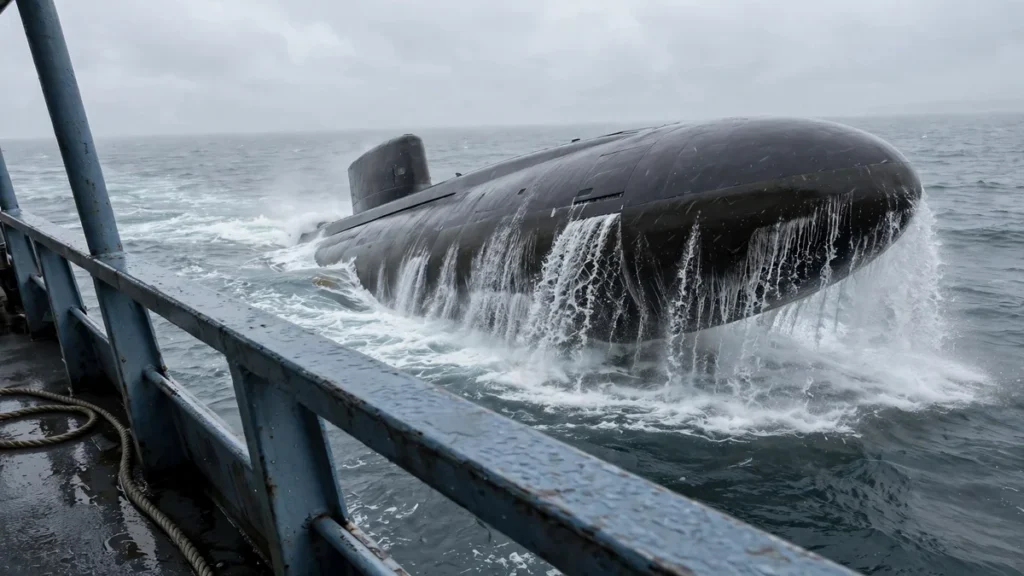
A submarine running underwater cannot burn fuel the way a surface ship does. There is no air down there, and no chimney to carry the smoke away. So when a conventional submarine dives, it runs on something far older and far quieter: a battery. Not a battery like the one in a car or a phone, but a battery the size of a house, made of hundreds of huge cells, each one weighing as much as a small car, all wired together to drive a silent electric motor. It is the largest battery most people will ever stand next to, and it is the reason a submarine can slip through the sea without a sound.
The submarine battery is a masterpiece of brute simplicity. It stores energy as chemistry, releases it as electricity, and asks for nothing but careful handling in return. But the scale makes everything hard: the cells must be identical, the connections must carry enormous currents without heating up, and the whole battery must survive decades of charging and discharging. This is how that battery is made.

How It’s Made
Step 1: Making the plates
Every cell in a submarine battery starts as a set of plates. For the traditional lead-acid battery, the plates are grids of lead alloy, pasted with a active material — lead dioxide on the positive plate, spongy lead on the negative — and then cured in ovens until the paste hardens into a porous, reactive sponge. A single submarine battery can hold thousands of plates, and a bad plate can spoil a whole cell, so the quality control is relentless. Newer boats use lithium-ion cells, where the plates are thin foils coated with metal oxides, but the principle is the same: make the plates perfect, or the battery will never be right.
Step 2: Building the cells
The plates are stacked into cells, separated by thin insulating sheets that keep the positive and negative plates apart while letting the electrolyte pass between them. Each cell is a tall, narrow container — often made from tough, acid-proof plastic or hard rubber — holding a stack of plates swimming in sulphuric acid, or in the electrolyte of a lithium cell. A finished cell can weigh several hundred kilograms, and a boat carries hundreds of them, arranged in long rows in a battery compartment deep inside the hull. The compartment is part of the boat’s structure, built to the same uncompromising standard as the rest of the pressure vessel, as in submarine pressure hull construction.

Step 3: Connecting the cells into a battery
A single cell makes only about two volts, so the cells are connected in series, positive to negative, in long strings that add up to several hundred volts. The connections are made with thick copper bars, bolted and soldered, because the battery must deliver thousands of amps to the propulsion motor without the connections heating up or dropping voltage. The wiring is heavy, short and neat, and every connection is checked with a meter before the battery is allowed to be charged. The same care runs through the boat’s propulsion system, which turns the battery’s power into silent thrust, as in the submarine propeller and the motor that drives it.
Step 4: Installing the battery in the boat
Installing a submarine battery is one of the heaviest jobs in the whole build. The cells are lowered through the hatches one by one, on cranes and trolleys, and set into their racks in the battery compartment, which sits low in the hull where its enormous weight helps keep the boat stable.
Step 5: Charging, discharging and testing
A new battery is not trusted until it has been cycled: charged fully, discharged under load, and charged again, many times over. The first charge is slow and gentle, taking days, while technicians watch the voltage of every cell and top up the electrolyte. The testing goes on for weeks, in the same spirit as deep-sea submersible testing, which proves a craft before it ever dives.

Step 6: Living with the battery at sea
Once the boat is at sea, the battery settles into a rhythm that will last for years. On the surface or at snorkel depth, the diesel engines run and charge the battery; submerged, the battery alone drives the boat, silently, until it needs charging again. The crew checks the cells every day, measuring voltages, topping up water, and watching for any cell that runs hot or low. A well-kept battery can last a decade or more, but it is a living thing: it ages with every charge, and its capacity fades a little with each year.
Step 7: Replacement and recycling
Eventually, every submarine battery reaches the end of its life. Replacing one is a major refit: the boat is docked, the old cells are lifted out one by one, and new cells are installed in their place, a job that can take months. The old battery is not thrown away: its lead is melted down and reused, its acid is neutralised, and its plastic cases are recycled, because a submarine battery holds tonnes of lead, far too valuable — and far too toxic — to waste. The new battery is cycled and tested just like the first one, and when it passes, the boat goes back to sea with a fresh heart, ready for another decade of silent running.
Specs
| Specification | Typical figure |
|---|---|
| Battery type | Lead-acid (traditional) or lithium-ion (newer boats) |
| Cells per boat | Several hundred, in long rows |
| Cell weight | Several hundred kilograms each |
| Cell voltage | About 2 volts per lead-acid cell |
| Battery voltage | Several hundred volts in total |
| Total weight | Often 200 to 500 tonnes for a conventional boat |
| Endurance submerged | Days at slow speed on battery alone |
| Design life | About 8 to 12 years per battery, with regular care |
Price
A submarine battery is never sold on its own, and navies do not publish a price for one. As an estimate, a complete battery for a conventional submarine typically costs roughly $10 million to $30 million, depending on the type of cells and the size of the boat — these are estimates, and the final figure depends on the chemistry, the number of cells and the supplier. It is one of the most expensive single items on a conventional submarine, and it is replaced more than once in the boat’s life.
A Rare Fact
The first submarines to use batteries, more than a century ago, had a terrifying problem: charging the battery made hydrogen gas, and hydrogen in a sealed steel tube is a recipe for disaster. Early crews learned to ventilate the battery compartment with hand fans, and a careless spark could — and sometimes did — blow the boat apart. Modern boats have automatic ventilation, gas detectors and flame-proof fittings, but the old rule still stands: no naked flames anywhere near the battery compartment.
From plates pasted like pastry to a silent river of power beneath the sea, the submarine battery is the quiet heart of the boat. It makes no noise and no smoke, and it asks only to be looked after — and in return it carries a submarine further, and more silently, than any engine ever could.