Three hundred metres below the surface, a submarine is alone. It cannot see the sky, it cannot hear a radio broadcast, and it cannot phone home, because seawater swallows radio waves almost as soon as they leave an antenna. The boat is silent, hidden, and cut off — until the captain decides it is time to listen. Then a hatch opens on the top of the sail, a slim mast rises out of the water like a snorkel, and for a few careful minutes the submarine rejoins the world.
The communications mast is the submarine’s link to everyone else: its base, other ships, and the satellites above. It is a retractable tower packed with antennas, raised only when needed and lowered the moment the message is done, because every second it spends above the surface is a second the submarine can be seen. It is one of the most carefully guarded pieces of equipment on the boat, and also one of the simplest in idea: a mast that carries antennas to where the air is.

How It Works
Step 1: Why radio cannot reach a submerged submarine
Radio waves and seawater do not mix. Ordinary radio signals fade within a few metres of the surface, and only extremely low-frequency waves penetrate deep, far too slowly to carry a useful message. That is why a submarine must come shallow to communicate: the mast has to break the surface so its antennas are in the air. The boat rises to periscope depth, usually around 15 to 20 metres down, and raises the mast just enough for the antenna head to clear the waves. Everything about the system is built around this one fact of physics.
Step 2: Raising the mast from the sail
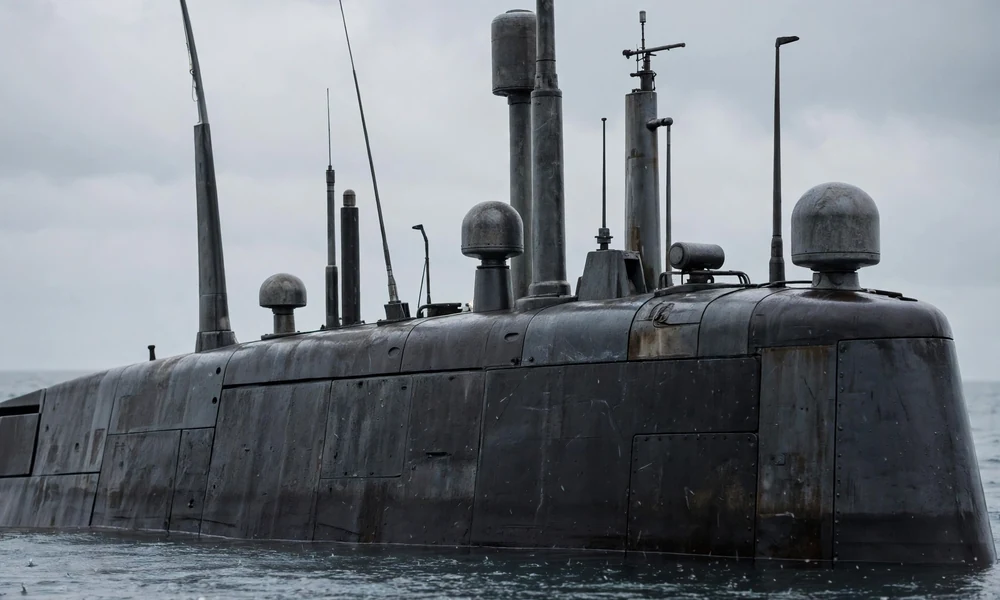
The mast lives inside the submarine’s sail, the tower on top of the hull, housed in a watertight trunk with hydraulic rams that drive it up and down. When the order comes, the rams push the mast through its seals until the antenna head is above the water, and locks hold it steady against the drag of the sea. The mast is slim and shaped to cut through waves with as little spray and wake as possible, because a white plume of spray is visible from far away. Lowering it is just as quick: the rams pull it down, the seals close, and the boat is invisible again.
Step 3: Antennas for different kinds of message
A single mast carries several antennas, each for a different job. There are antennas for very-high-frequency voice radio to talk to nearby ships, for satellite links that carry data and messages around the world, and for navigation signals that tell the boat exactly where it is. The satellite antenna is often housed in a small dome on the masthead, protected from spray, and it must point at the sky while the boat rolls in the swell. Switching between antennas is done from inside the control room, without anyone going near the mast itself.
Step 4: Sending and receiving in short bursts
Time on the surface is risk, so the crew works fast. Messages are prepared below, encrypted, and compressed before the mast ever goes up, then sent in a short burst the moment the antenna clears the water. Incoming traffic is downloaded in the same window, and the mast comes down as soon as the exchange is done. A typical window lasts minutes, not hours, and the whole evolution is rehearsed until it is routine: raise, transmit, receive, lower, dive. The boat’s radio operators train for speed, because every extra minute is exposure.
Step 5: Staying hidden while talking
Raising a mast makes a submarine detectable, so everything about the operation is designed to minimise the signature. The mast is raised only as high as needed, its shape is kept small and smooth to reduce its radar reflection, and the boat keeps moving slowly so its wake stays low. The crew watches the sea and sky before raising it, and the boat is ready to dive at a moment’s notice. Modern masts also use low-probability-of-intercept techniques, spreading a signal thinly so it is hard for anyone else to notice, let alone read.
Step 6: Maintenance in a hostile environment
A communications mast lives a punishing life: slammed by waves, soaked in salt, pressurised at depth, and expected to work perfectly after months underwater. Its seals are inspected and replaced on a strict schedule, its hydraulics are tested before every patrol, and its antennas are checked for corrosion that salt water causes relentlessly. Much of the maintenance happens in dry dock, where the mast can be removed, stripped, and rebuilt. At sea, the crew can do little more than keep it clean and trust the engineering, which is why the mast is built with redundancy: if one antenna fails, another can carry the message.

Specs
| Specification | Typical figure |
|---|---|
| Operating depth | Raised from periscope depth, about 15–20 metres |
| Mast drive | Hydraulic rams with mechanical locks |
| Antenna types | Voice radio, satellite link, navigation |
| Typical exposure window | Minutes per transmission |
| Mast material | High-strength steel or composite |
| Sealing | Multiple pressure seals in the sail trunk |
| Message handling | Encrypted, compressed burst transmission |
| Service interval | Inspected before patrol; rebuilt in dry dock |
Price
No one publishes a price list for submarine communications masts, because they are built for navies, not for sale, and each one is custom to its boat. As an estimate, a complete retractable mast system with its antennas, hydraulics, and control electronics can cost several million dollars as part of a submarine’s fit-out, with the antennas and electronics accounting for a large share — these are estimates, and the real cost is wrapped into the price of the submarine itself, which runs into billions. The mast is a small line in a very large budget, but the boat cannot do its job without it.
A Rare Fact
The communications mast has a quiet cousin that never breaks the surface at all. Submarines can trail a long wire antenna behind them, floating just below the surface, which lets them receive simple messages while staying deep. The floating wire cannot send a reply, so it is a one-way letterbox, but it means the boat can be told to come shallow without ever showing itself. The mast is for conversations; the wire is for a tap on the shoulder, telling the submarine it is time to talk.
From a silent boat deep below to a masthead briefly touching the sky, the communications mast is how a submarine stays part of the world it hides from. It rises from the same hull as how a submarine pressure hull is made, it shares the sail with the submarine periscope, and it answers to the same physics as the submarine propeller turning silently below. A few minutes above the water, then gone.