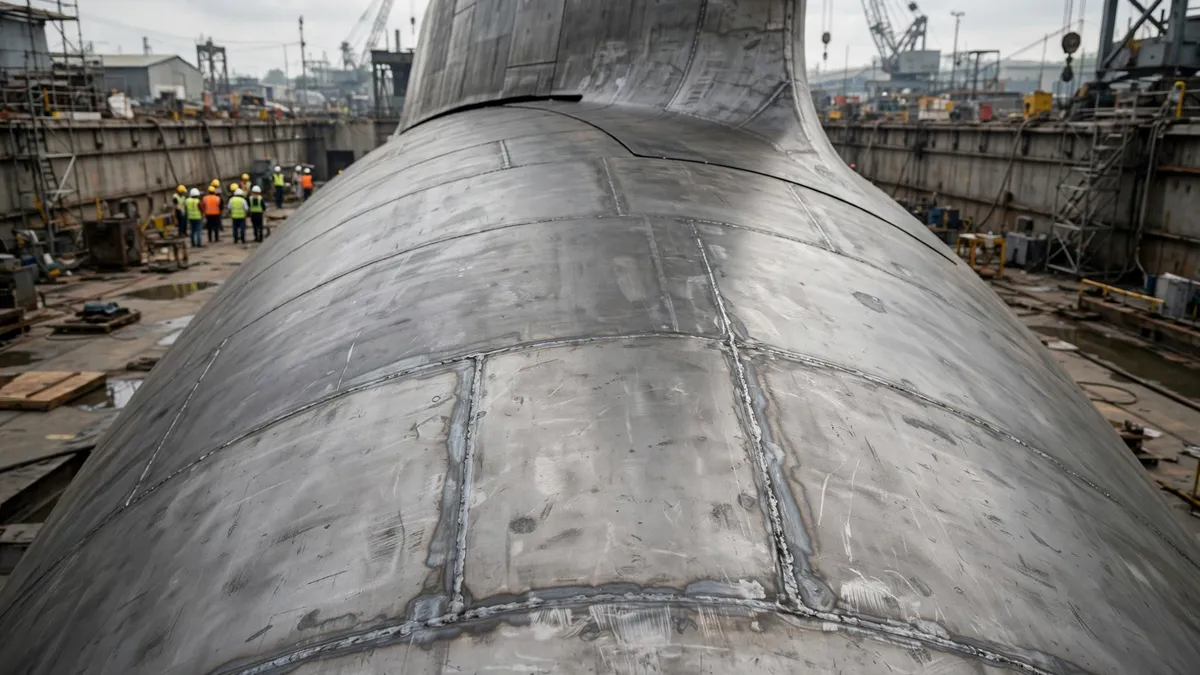
Stand at the edge of a dry dock and look up at a submarine hull, and the first thing that strikes you is how plain it looks. There is no gleam, no polish, no hint of the extraordinary metal beneath the dull grey skin. Yet that skin is titanium, one of the most stubborn metals ever put into a ship, and it is there to let the boat dive deeper than steel could. A titanium hull is not a luxury. It is a trade of money and difficulty for depth.
How a Submarine Titanium Hull Works
A submarine titanium hull works by turning the metal’s unusual mix of strength and lightness into depth. Titanium is roughly as strong as many steels but about forty per cent lighter, and it does not rust in seawater the way steel does. The hull is a pressure vessel: a long cylinder, capped at each end, built from curved plates welded together so the water pressing in from every side is carried as even compression. The hull’s job is to carry that load without buckling or leaking.
Step 1: The plates are cut and rolled to the curve
Everything starts as flat plates of titanium alloy, most often a grade mixed with small amounts of aluminium and vanadium for extra strength. The plates arrive thick — far thicker than the steel on a surface ship — and each one is cut to shape and rolled into a curve that matches the hull’s diameter. Rolling titanium is slow work, because the metal springs back after every pass and fights the rollers. The crew checks the curve against a template, because a plate even slightly out of round will not fit its neighbours.
Step 2: The rings are welded in an inert gas shield
Once the plates are curved, they are welded into rings, and the rings are welded into the long tube of the hull. Titanium welding is one of the hardest jobs in shipbuilding, because hot titanium grabs oxygen and nitrogen from the air and turns brittle. Every weld is therefore made inside a shield of argon gas, with welders working in sealed tents or behind trailing gas shields that keep air away until the metal has cooled. The pressure hull of a submarine carries the full weight of the sea, so every weld is inspected with ultrasound and X-rays.

Step 3: Frames and bulkheads stiffen the tube
A plain tube would buckle under deep pressure, so the inside of the hull is fitted with ring frames — heavy ribs that circle the hull at regular intervals — and flat bulkheads that divide the boat into compartments. The frames are welded to the inner skin and act like the hoops on a barrel, stopping the shell from collapsing inward between supports. The bulkheads do double duty: they add stiffness and they divide the boat so a leak or fire in one compartment can be sealed off from the rest.
Step 4: The hull is machined true and tested empty
After welding, the hull is machined and measured. Circularity matters more than almost anything else: a hull that is out of round will bend unevenly under pressure, and uneven bending is what starts cracks. Then the empty hull is pressure-tested, often by filling it with water and raising the pressure in stages while sensors listen for leaks or movement. The engineering of titanium in a submarine hull is a long argument between strength and weight, and the test settles it: the hull must hold its shape at pressures well beyond the depth it will ever reach.
Step 5: Openings are cut and reinforced
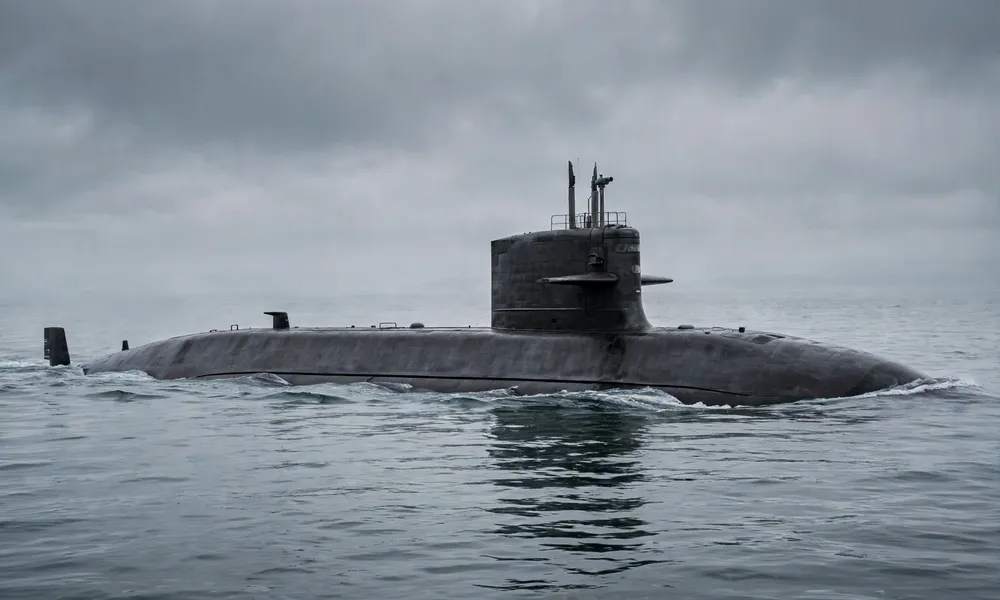
A hull is useless without holes in it — hatches, a sail, torpedo tube doors, and the many small penetrations for cables, pipes and sensors. Every opening weakens the shell, so each one is ringed with a thick reinforcing collar that spreads the load around the hole. The sail, the tall fin on top of the boat, is welded on as a separate structure and faired into the hull so water flows smoothly past it.
Step 6: The hull is coated and fitted out
Before the boat goes to sea, the outside of the hull is coated with layers of paint and rubbery tiles that absorb sound and keep the steel smooth. Titanium itself resists corrosion well, but the coating still matters: it keeps marine growth off the hull, which would slow the boat and make noise, and it hides the seams and welds from the water flow. The cost of a titanium submarine hull is dominated by the metal and the welding, but a boat that is quiet and smooth is hard to find, and that is the whole point.
Step 7: The boat dives, and the hull earns its keep
At sea, the hull’s work is invisible. As the boat dives, water pressure grows by roughly one atmosphere for every ten metres of depth, and the hull carries it all as steady compression, flexing by millimetres and no more. Titanium’s lightness means the boat can carry a thicker, stronger hull for the same weight as steel, and that is what buys extra depth. When the boat returns to the surface, the hull relaxes back to its original shape, ready to do it all again.
| Specification | Typical value |
|---|---|
| Hull material | Titanium alloy, usually with aluminium and vanadium |
| Density | About 4.5 grams per cubic centimetre |
| Strength | Roughly comparable to high-strength steel |
| Weight saving vs steel | About 40 per cent lighter for the same strength |
| Corrosion | Highly resistant to seawater |
| Welding | Argon gas shield, no air contact while hot |
| Key advantage | Greater diving depth for the same hull weight |
A titanium submarine hull is never sold on its own, so there is no list price to quote. Estimates put the hull structure of a large titanium-hulled submarine at roughly 200 to 500 million US dollars, with the metal alone accounting for a large share and the specialist welding adding much of the rest. Those are estimates, not list prices, and they explain why very few navies have built titanium-hulled boats: the depth is real, but so is the bill.
A rare fact: titanium is so reactive when hot that welders sometimes work with the whole joint enclosed in a plastic tent flooded with argon, and they must wait for the metal to cool completely before the tent comes off. A single breath of air on a hot weld can ruin it. The metal is also famously hard to machine — it dulls cutting tools quickly and holds heat at the cutting edge — so even drilling a hole in a titanium hull is a slow, careful job.
The submarine titanium hull works because it treats depth as a materials problem and answers it with a metal that is strong, light and unbothered by salt water. It is expensive to buy, difficult to weld and awkward to repair, and none of that matters when the boat is deep, quiet and still holding its shape. The dull grey skin in the dry dock is the most honest part of the submarine: it promises nothing, and it delivers depth.


