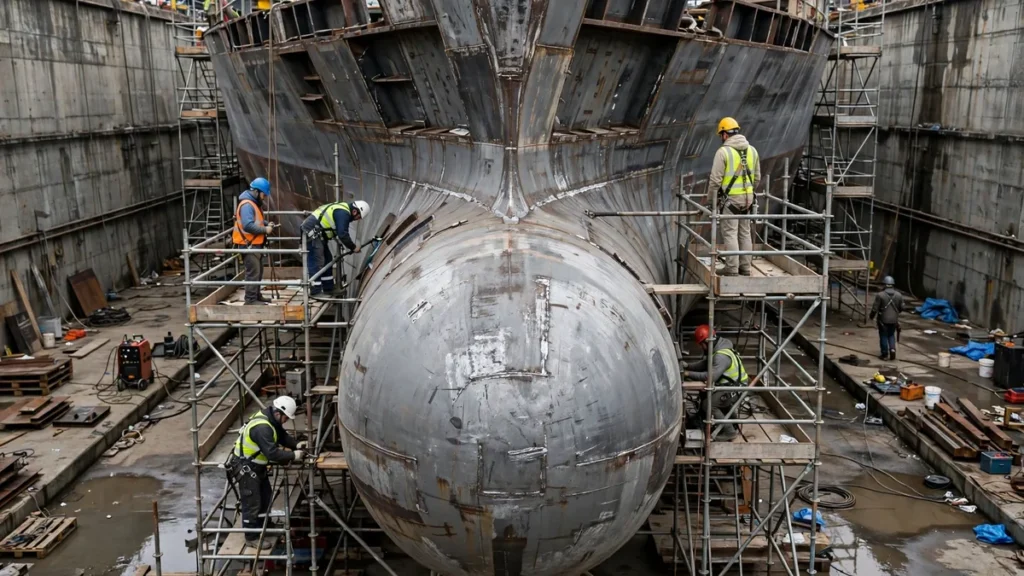
Deep below the surface, the pressure on a submarine’s hull is crushing. At a few hundred metres down, every square centimetre of steel carries the weight of a small car, and the hull must hold its shape without buckling, leaking or groaning. Most submarines are built from high-strength steel, but a few are built from titanium, a metal as strong as steel at half the weight and almost immune to seawater corrosion.
Titanium hulls are rare, expensive and difficult to build, which is exactly why they are fascinating. The metal is hard to forge, hard to weld and hard to machine, and every step of building a titanium pressure hull is a lesson in materials science.
The Materials Behind the Submarine Titanium Hull
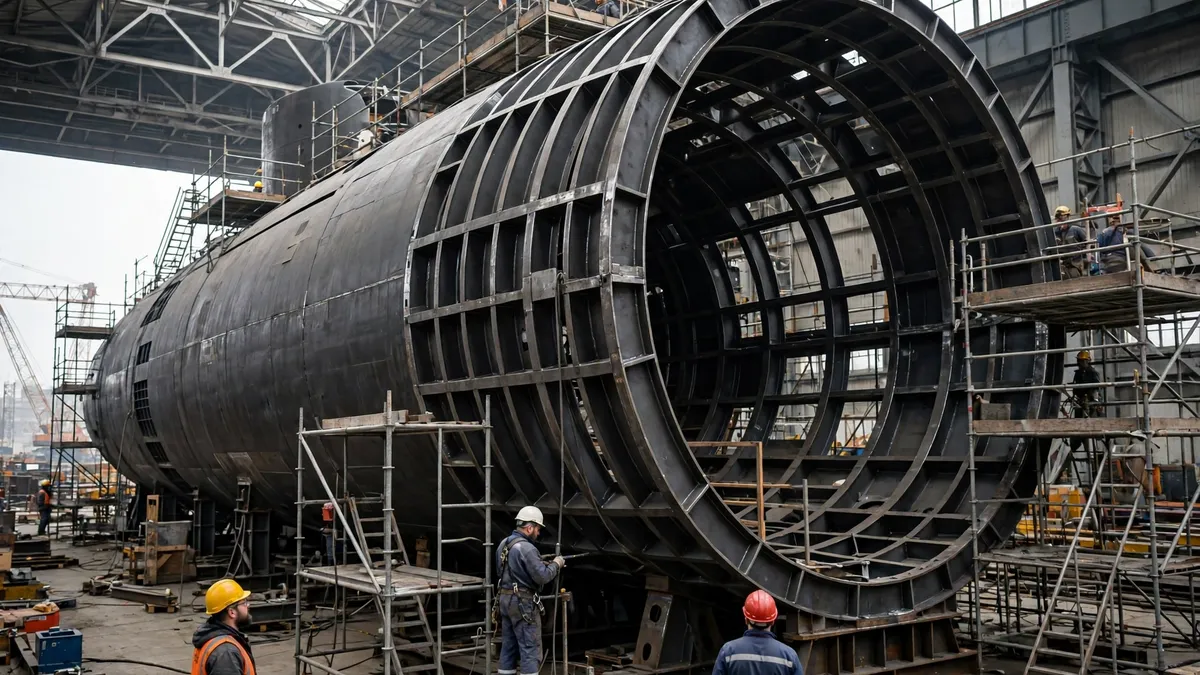
A submarine’s pressure hull is a cylinder, and the cylinder is the strongest shape for resisting pressure from outside. The hull plating is thick, the frames inside are heavy rings spaced closely together, and the whole structure is designed to resist buckling — the sudden collapse that happens when a thin cylinder is squeezed too hard. Every kilogram saved in the hull can be spent on equipment, crew space, or batteries, which is why the weight saving matters as much as the strength. Because titanium is lighter than steel for the same strength, a titanium hull can be built thicker without adding weight, and thicker walls resist buckling far better.
Step 1: Why titanium, and which titanium
The titanium used in hulls is not pure titanium but an alloy, most commonly Ti-6Al-4V, which is titanium with about six percent aluminium and four percent vanadium. The aluminium strengthens it, the vanadium makes it more workable, and the result is an alloy with a yield strength around 880 megapascals, comparable to the best hull steels, at roughly half the density. Titanium also forms a thin oxide film that protects it from seawater corrosion almost completely, so a titanium hull does not need the thick coatings and anodes a steel hull depends on.
Step 2: Forging rings and plates at high heat
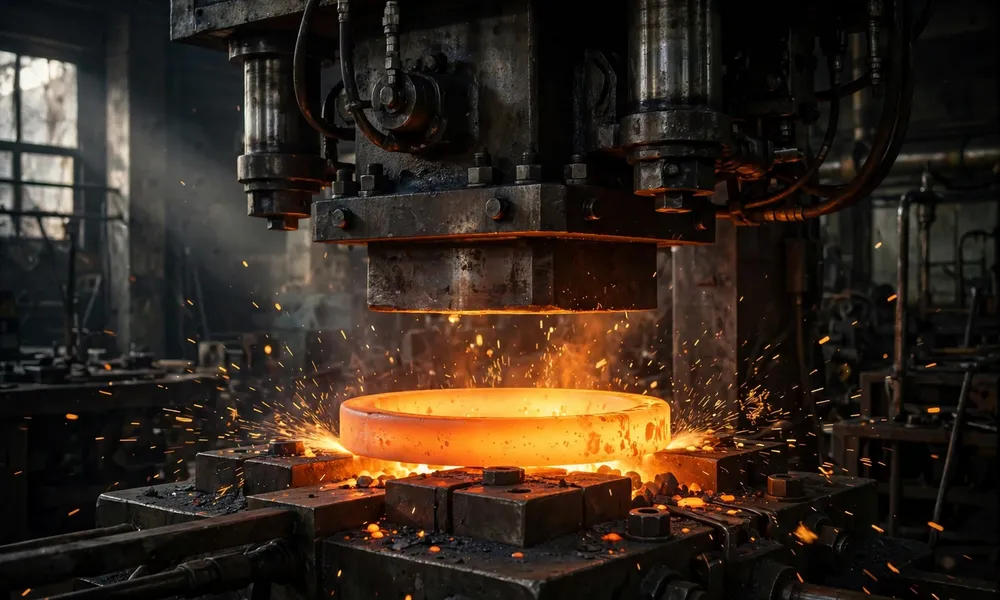
Titanium is forged, not cast, for hull work. Large ingots are heated to around 900 to 950 degrees Celsius and pressed into rings, plates and forgings under enormous hydraulic presses. The forging must be done in a narrow temperature window: too cold and the metal cracks, too hot and its grain structure coarsens and weakens. Each forging is checked by ultrasound for internal flaws.
Step 3: Rolling and forming the hull plates
Hull plates are rolled from titanium slabs in rolling mills, then formed into curved sections that match the hull’s diameter. Rolling titanium is harder than rolling steel: the metal is springy, it work-hardens quickly, and it must be rolled hot, with frequent reheating between passes. The fit-up is exacting, because a hull that is even slightly out of round will buckle at a lower pressure.
Step 4: Welding in an inert gas shield
Welding titanium is the hardest part of the whole job. Hot titanium reacts eagerly with oxygen and nitrogen in the air, and even a small amount of contamination makes the weld brittle. So titanium welds are made inside a shield of argon gas, with the weld zone, the cooling metal behind the torch, and often the whole joint enclosed in a trailing shield or a purge chamber. The weld metal is a matching titanium filler wire. The titanium forging process sets up the material, but it is the welding that decides whether the hull holds together, and every hull weld is inspected by X-ray and ultrasound before it is accepted.
Step 5: Ring frames, bulkheads and the structure inside
Inside the pressure hull, heavy ring frames are welded to the plating at regular intervals, turning the long cylinder into a series of short, stiff sections that resist buckling far better than a plain tube. The frames are spaced closely, often less than a metre apart, because each short section of hull between two frames can carry far more pressure than a long, unsupported tube. Bulkheads divide the hull into compartments, and their circular or domed shapes spread the pressure evenly. The frames and bulkheads are made from the same titanium alloy as the plating, so the whole structure expands and contracts together with temperature and pressure. Steel fittings are avoided wherever possible, because joining titanium to steel invites galvanic corrosion.
Step 6: Machining, tolerances and the smooth hull
After welding, the hull is machined and ground where it matters. The outside is finished smooth, because a rough hull is noisier and slower in the water, and the mating surfaces for hatches and fittings are machined to tight tolerances so their seals hold under pressure. Machining titanium is slow work: the metal is tough and dulls cutting tools quickly. The submarine propeller is machined to the same philosophy, with smooth, precise surfaces, because on a submarine, every roughness is a source of noise and drag.
Step 7: Pressure testing the finished hull
Before a hull ever goes to sea, it is tested. The completed pressure hull is sealed and filled with water, then pressurised hydraulically to a test pressure above its designed operating depth, a process that proves the welds, the forgings and the frames all work together. Only when the hull passes the test is it fitted out with everything inside. The deep-sea submersible is tested the same way, in a pressure chamber, because the only thing worse than a hull failing in a test is a hull failing at depth, and the test is where that failure is meant to happen, if it ever will.

Submarine Titanium Hull at a Glance
| Specification | Detail |
|---|---|
| Main alloy | Ti-6Al-4V, titanium with 6% aluminium and 4% vanadium |
| Yield strength | About 880 megapascals |
| Density | About 4.4 g/cm³, roughly half that of steel |
| Forging temperature | About 900–950°C |
| Welding | Argon-shielded, with trailing gas shields |
| Structure | Cylindrical hull with forged ring frames |
| Corrosion | Protected by a natural titanium oxide film |
| Testing | Hydraulic pressure test above operating depth |
What Does It Cost?
Titanium is expensive, and a titanium hull is more expensive still. Titanium plate costs roughly $25 to $50 per kilogram (estimate), several times the price of hull steel, and the forging, welding and inspection add far more (estimate). A titanium-hulled submarine costs substantially more than a steel-hulled boat of the same size (estimate), which is why so few have ever been built. The cost is not just the metal: it is the argon-shielded welding, the slow machining and the ultrasound inspection of every forging.
A Rare Fact
Titanium was once so difficult to weld that early titanium hulls were assembled in vast argon-filled chambers, with the welders working inside the gas-filled room in breathing apparatus, because the whole joint had to be kept away from air until it cooled. Modern trailing shields and purge chambers have made the work more practical, but the principle has not changed: hot titanium and air do not mix. A metal that is almost indestructible in seawater is ruined by a breath of ordinary air while it is being welded, and the most advanced hull material in the sea is also one of the most demanding to build with.