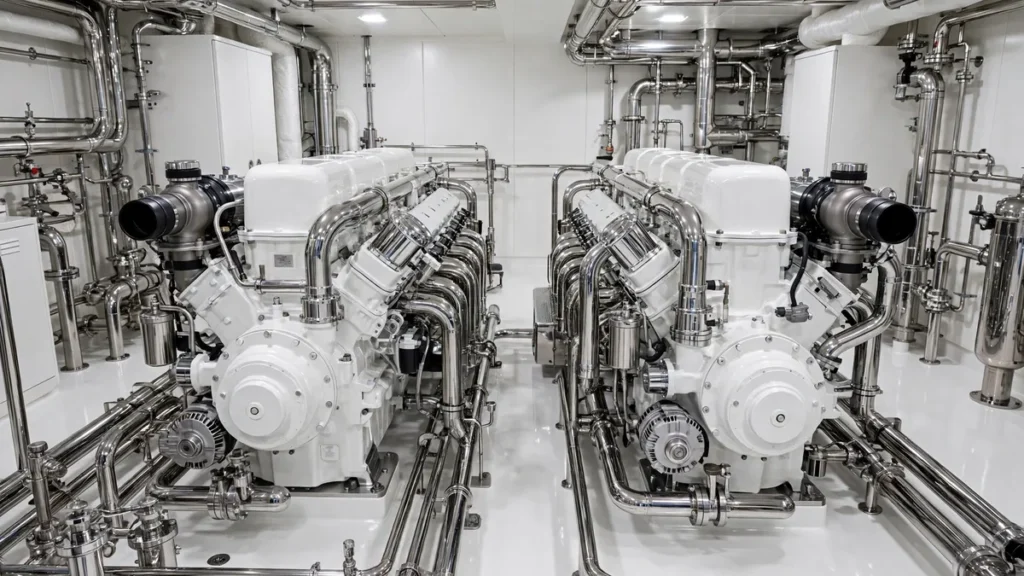
Step into the engine room of a superyacht and the first thing that hits you is the quiet. A space filled with two diesel engines the size of vans, generators, pumps, pipes and tanks — and you can hold a normal conversation in it while everything is running. That silence is not luck. It is materials engineering, layer upon layer of it, wrapped around machines that would otherwise shake the whole yacht apart and deafen everyone on board.
A superyacht engine room is one of the most hostile rooms on the water. It is hot, wet, salty and vibrating, and it has to keep running for weeks at a time, thousands of miles from the nearest mechanic. The materials inside it must resist salt-water corrosion, survive wide temperature swings, stop a fire from spreading, and hold tonnes of machinery still. Every pipe, panel and mount in the room is a small argument between weight, strength, silence and safety.
The Materials Behind the Engine Room
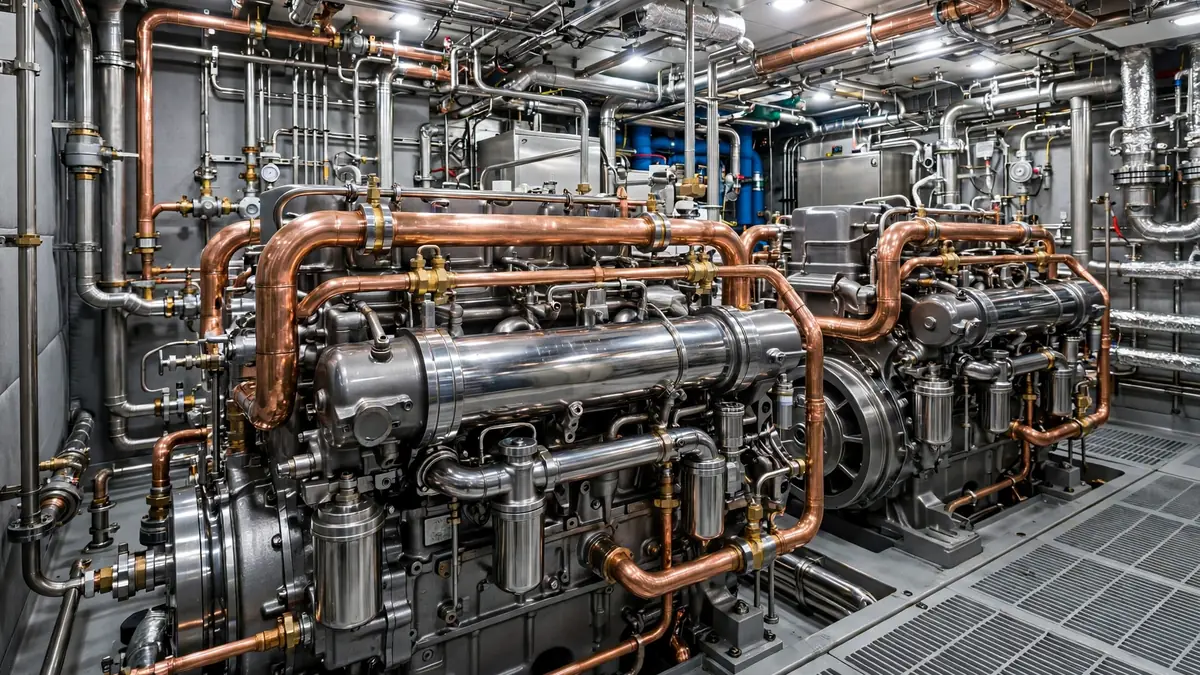
The engines themselves are built from cast iron and steel, but the room around them is where the materials story really lives. The bulkheads — the walls that divide the engine room from the guest cabins — are steel, lined with mineral wool insulation and covered in perforated aluminium panels that absorb sound. The deck under the engines is steel plate, thick enough to carry their weight, with resilient mounts of rubber and steel that let the engines vibrate without passing that vibration into the hull. And the pipework is a map of materials: copper-nickel for seawater, stainless steel for fuel, aluminium for ventilation ducts.
Ordinary steel pipe in seawater corrodes in months; copper-nickel alloy, usually 90 parts copper to 10 parts nickel, forms a protective film that resists both corrosion and marine growth. It is the reason a superyacht can pump seawater through its cooling system for years without the pipes rotting from the inside. Stainless steel handles the fuel system, where a leak would be catastrophic, and fire-resistant mineral wool wraps the exhausts, which run hot enough to glow.
Step 1: Building the steel structure
The engine room starts as part of the yacht’s steel hull, its bulkheads and decks welded from marine-grade steel plate, primed and painted with epoxy coatings that resist salt water and heat. Every weld is inspected, because a cracked weld can let water or exhaust gas into spaces where people sleep. Its walls are rated to contain a fire for at least sixty minutes.
Step 2: Mounting the engines on resilient mounts
The main engines — usually two large diesels — are lowered into the room by crane before the deck above is fitted, because they will never fit through a door again. Each engine sits on resilient mounts: steel housings filled with natural rubber that absorb vibration. Alignment matters enormously; the engine’s output shaft must line up with the propeller shaft to within a fraction of a millimetre, or the bearings will wear out in weeks. Technicians check it with laser tools, hot and cold, because the engine grows by millimetres as it warms up.
Step 3: Installing copper-nickel seawater pipework
Seawater cools the engines, generators and air conditioning, so copper-nickel tubes run through the room to sea chests in the hull. The alloy is cut, bent and brazed into place, and every joint is pressure-tested. Copper-nickel costs several times the price of steel pipe, but a yacht that loses its cooling water in the middle of the ocean loses everything, so no builder gambles on cheaper materials here. Strainers catch seaweed and debris before they reach the pumps.
Step 4: Fitting stainless steel fuel and exhaust systems
Fuel lines are stainless steel, double-walled in accommodation spaces, with shut-off valves the crew can close from outside. The exhaust system is the hottest part of the room: gas leaves the engines at around 500 degrees Celsius, so the exhaust pipes are made from heat-resistant stainless steel and wrapped in mineral wool insulation and aluminium cladding. The insulation keeps the room cool enough for the crew to work in, and stops the exhaust from setting fire to anything it touches.
Step 5: Soundproofing the whole room
Silence is a luxury material in a superyacht, and it is built in layers. The bulkheads are lined with mineral wool, then a heavy barrier layer of mass-loaded vinyl, then perforated aluminium panels that trap sound waves. The deck above gets the same treatment, plus a floating floor — a layer of insulation with a separate floor on top, so vibration cannot travel through the structure. The result is an engine room of around 70 decibels inside, while the guest cabins above hear almost nothing at all.
Step 6: Adding fire protection and final checks
Finally the room is fitted with its safety systems: sealed bulkhead penetrations, a fixed fire-extinguishing system, and A-60 insulation that holds back fire for an hour. Every cable runs in fire-resistant trunking, every tank is bunded so a leak cannot spread, and the whole room is tested — engines run at full power, temperatures and noise measured — before the yacht is handed to its owner.

Why These Materials Win
Each material in the engine room solves a problem that would otherwise sink the yacht, literally or figuratively. Steel gives the structure its strength. Copper-nickel survives seawater that eats everything else. Stainless steel keeps fuel contained and exhausts intact. Mineral wool and mass-loaded vinyl turn a roaring diesel into a murmur. Rubber mounts stop vibration from shaking the yacht apart, while gyroscopic stabilizers steady it against rolling. Together they are the difference between a yacht that glides silently across an ocean and one that rattles, rusts and breaks down.
The superyacht steel hull keeps the sea out, but the engine room keeps the yacht alive.
Specifications
| Specification | Detail |
|---|---|
| Structure | Marine-grade steel bulkheads and decks, epoxy coated |
| Seawater pipework | Copper-nickel alloy (90/10 CuNi) |
| Fuel lines | Stainless steel, double-walled in accommodation areas |
| Exhaust insulation | Mineral wool with aluminium cladding |
| Sound insulation | Mineral wool, mass-loaded vinyl, perforated aluminium panels |
| Fire rating | A-60 bulkheads, 60 minutes of fire containment |
| Engine mounts | Steel and natural rubber resilient mounts |
| Noise level inside | Around 70 decibels at full power |
| Exhaust gas temperature | Approximately 500 degrees Celsius |
Price
An engine room is one of the most expensive spaces on a superyacht. A pair of main engines for a 50-metre yacht can cost $2 million to $4 million (estimate), and the systems around them can add as much again. A complete 50-metre superyacht typically costs $30 million to $50 million (estimate), and a substantial share of that figure sits below the waterline. The materials are a small part of the cost; the hand-fitting labour is the rest.
Rare Fact
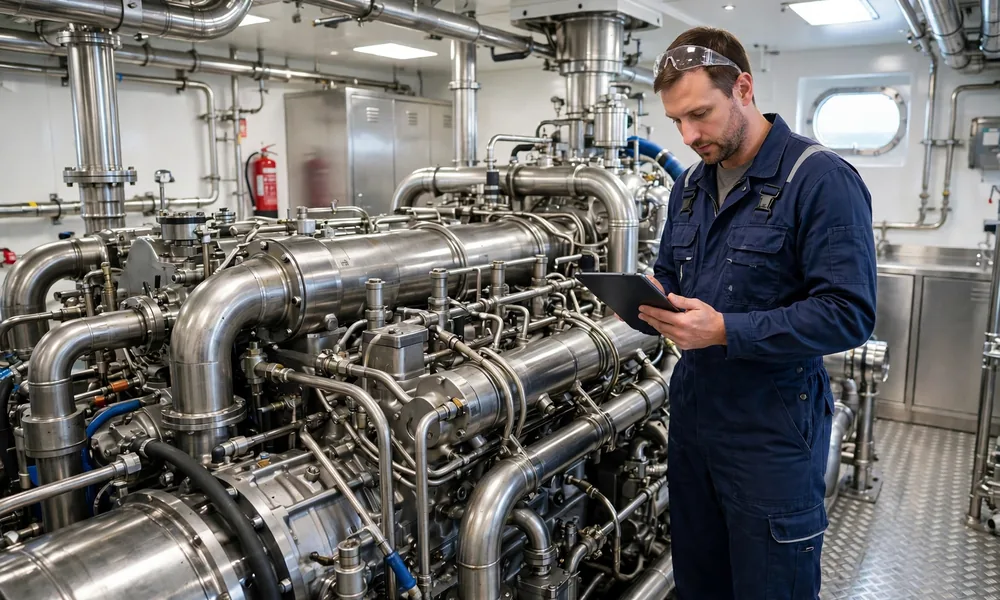
Superyacht engine rooms are soundproofed so thoroughly that the guest cabins directly above the engines are often quieter than a normal bedroom at night — even while the yacht is cruising at full speed. Rubber mounts, layered insulation and a floating floor can cut engine noise by more than 40 decibels.
The engine room is the superyacht’s hidden heart: hot, loud and hard-working on the inside, silent and invisible on the outside. Steel, copper-nickel, stainless steel, mineral wool and rubber keep thousands of horsepower running smoothly beneath a deck where guests hear nothing at all. That silence is the most expensive material in the room, and the one its owners value most.