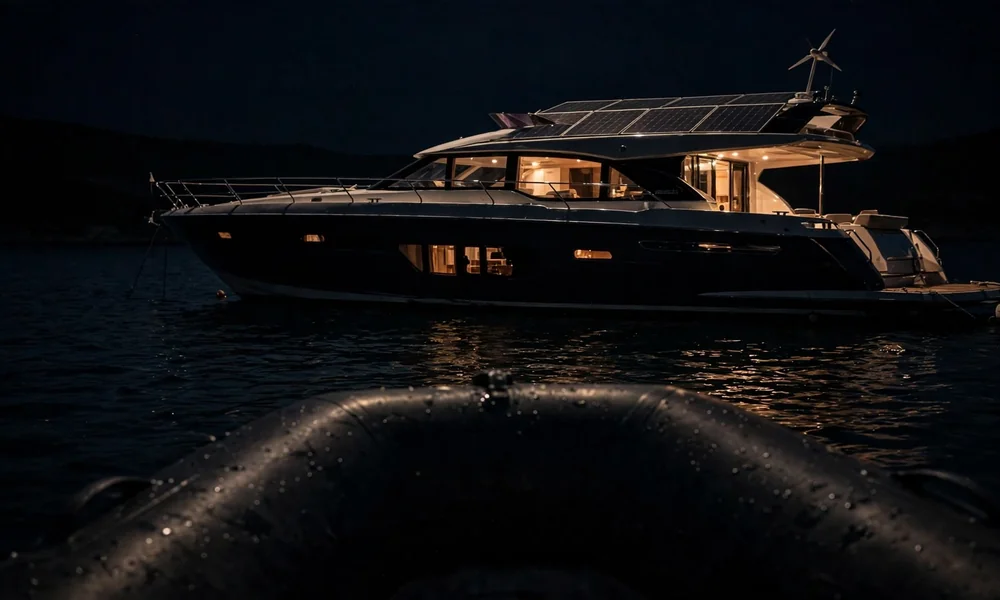
It is late evening in a quiet bay, and a large yacht is coming in to anchor. The strange thing is the silence. There is no rumble of diesel engines, no vibration through the hull, no smell of exhaust drifting across the water. The yacht glides in, drops its anchor, and sits still, lights glowing in the windows, while the only sound is the water against the hull. Then, when the crew are ready, the engines start again, so quietly that you barely notice. That is the promise of a hybrid yacht.
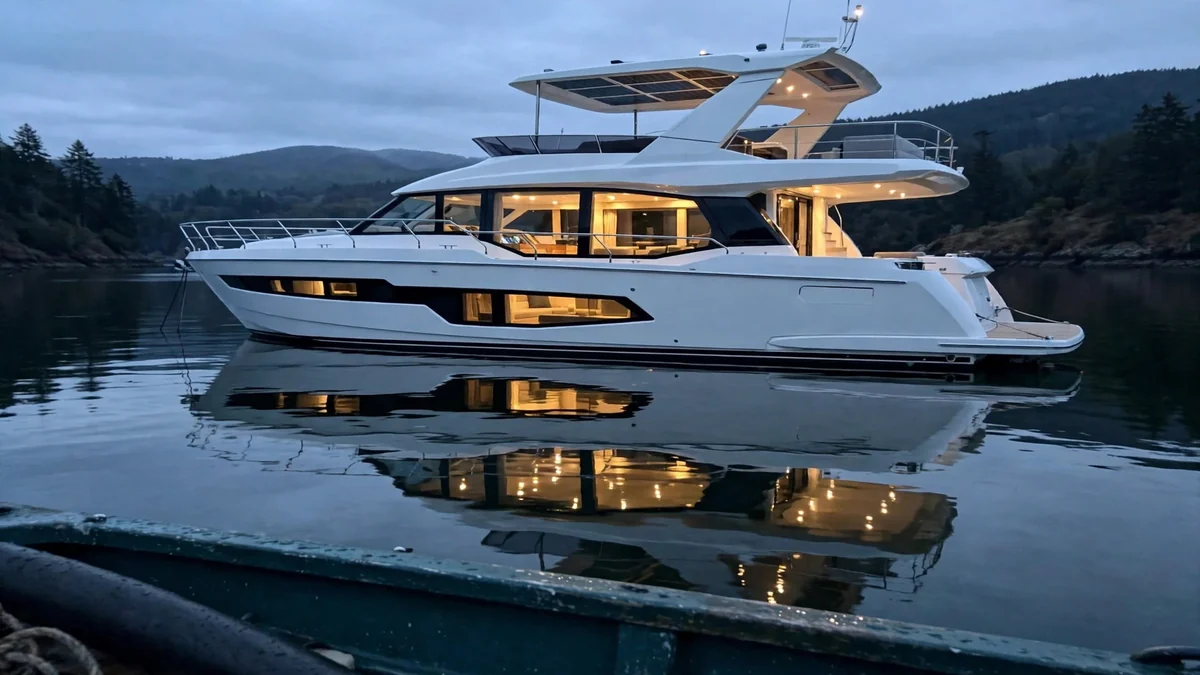
A hybrid yacht is a yacht that carries two kinds of power: diesel engines, like a conventional yacht, and electric motors fed by a bank of batteries. The two work together, and the captain or the computer chooses which one does the work at any moment. At low speed, the boat runs on electricity alone, silently. At cruising speed, the diesels take over, and while they run they charge the batteries. At anchor, the batteries run the lights, the air conditioning and the galley, so the generators can stay off for hours.
How a Hybrid Yacht Works, Step by Step
Step 1: The diesel engines and the generators
At the heart of a hybrid yacht are its diesel engines, but they work differently from the engines on a conventional yacht. On some hybrids the diesels still drive the propellers directly, with electric motors fitted to the same shafts to help or to take over. On others, the diesels do not drive the propellers at all: they spin generators, and the electricity they produce drives electric motors that turn the propellers. This second layout, called diesel-electric, is common on larger yachts, because it lets the engines run at their most efficient speed whatever the boat is doing.
Step 2: The battery bank
Batteries are managed by a battery management system, a computer that watches the charge, temperature and health of every module. It keeps the batteries in a safe range, stops them overheating, and balances the charge between modules so they age evenly. The bank is charged by the diesel generators while the yacht cruises, by shore power in a marina, and sometimes by solar panels on the roof of the superstructure. The charging and storage principles are close to those used in electric cars, as explained in a guide to how an EV battery pack works.
Step 3: The electric motors and the propellers
Because an electric motor makes its full torque from a standstill, a hybrid yacht is remarkably good at slow-speed manoeuvring. The captain can nudge the boat sideways into a berth with tiny, precise bursts of power, and the boat responds instantly, with no lag while an engine spools up. The motors are controlled by inverters, boxes of electronics that turn the batteries’ direct current into the alternating current the motors need, and that control the speed precisely. The inverter is a key part of the system, and the guide to how an EV inverter works explains the same device in a car.
Step 4: The power management system
The cleverest part of a hybrid yacht is the power management system, the computer that decides, moment by moment, where the power should come from and where it should go. When the yacht is leaving harbour at low speed, it chooses electric power, because it is silent and clean. When the yacht is cruising, it starts the diesels, because they are efficient at that load, and uses the spare power to charge the batteries. When the yacht is at anchor, it runs everything from the batteries and keeps the generators off until the charge runs low.

Step 5: Silent running and hotel loads
Silent running is the feature owners talk about most. In electric mode, a hybrid yacht makes almost no noise and no vibration, which changes life aboard completely. Conversations are easier, sleep is better, and the boat feels calm in a way a diesel yacht never does. The silence is also kind to the sea: with no engine noise underwater, the yacht disturbs marine life far less, which matters in the protected bays and anchorages where yachts spend most of their time.
Step 6: Regeneration and shore charging
A hybrid yacht recovers energy in two ways. The first is regeneration under way: when the yacht is moving and the propellers are turning, the electric motors can be switched into generator mode, using the flow of water past the propellers to charge the batteries. This works best when the yacht is being pushed by the diesels or sailing with the wind, and it turns energy that would otherwise be wasted into stored power.
Step 7: Maintenance and the life of the system
Maintaining a hybrid yacht is different from maintaining a conventional one. The diesel engines run fewer hours, because the electric motors do much of the low-speed work, so they last longer between services. The electric motors themselves need very little maintenance: no oil changes, no fuel filters, just a check of the bearings and the cooling. The batteries are the part that wears out, and most are guaranteed for eight to ten years, after which their capacity slowly falls.
Specifications at a Glance
| Feature | Typical Large Hybrid Yacht |
|---|---|
| Length | 25 to 40 metres |
| Diesel power | 1,000 to 2,500 horsepower |
| Electric power | 100 to 400 kilowatts |
| Battery capacity | 200 to 600 kilowatt-hours |
| Silent range | 2 to 6 hours at low speed |
| Top speed | 15 to 20 knots |
| Fuel saving | 20 to 30 percent versus diesel-only |
| Propulsion | Diesel-electric or parallel hybrid |
What a Hybrid Yacht Costs
A hybrid yacht costs more to buy than a conventional yacht of the same size, and the premium is mostly in the batteries, the motors and the electronics. As an estimate, a hybrid yacht of around 30 metres might cost roughly $12 million to $20 million, compared with perhaps $8 million to $14 million for a similar diesel-only yacht. The difference is the hybrid system itself, which can add an estimated $1 million to $3 million to the build cost.
Those are estimates, and the running costs tell a different story. A hybrid yacht can use 20 to 30 percent less fuel, and its engines need servicing less often, so the extra purchase price can be recovered over years of use. There is also the question of value: a quiet, modern hybrid holds its appeal with buyers who care about comfort and the environment, which helps the boat keep its price when it is sold on. The structure that carries all of this is a modern aluminium design, and the guide to how a superyacht aluminium superstructure works shows how that upper structure is built.
A Rare Fact
The first hybrid yachts were not built for luxury at all. They were built for research ships and naval vessels, where silent running was a matter of listening to the sea rather than enjoying it. The technology moved from warships and survey ships into yachts, and the same silence that once helped a ship hear a whale or a submarine now helps an owner sleep through the night at anchor.
A hybrid yacht is a boat that thinks about power. It does not waste energy making noise in harbour, and it does not burn fuel to run a fridge at anchor. It uses the right power at the right time, and the result is a yacht that is quieter, cleaner and calmer than the boats that came before it.