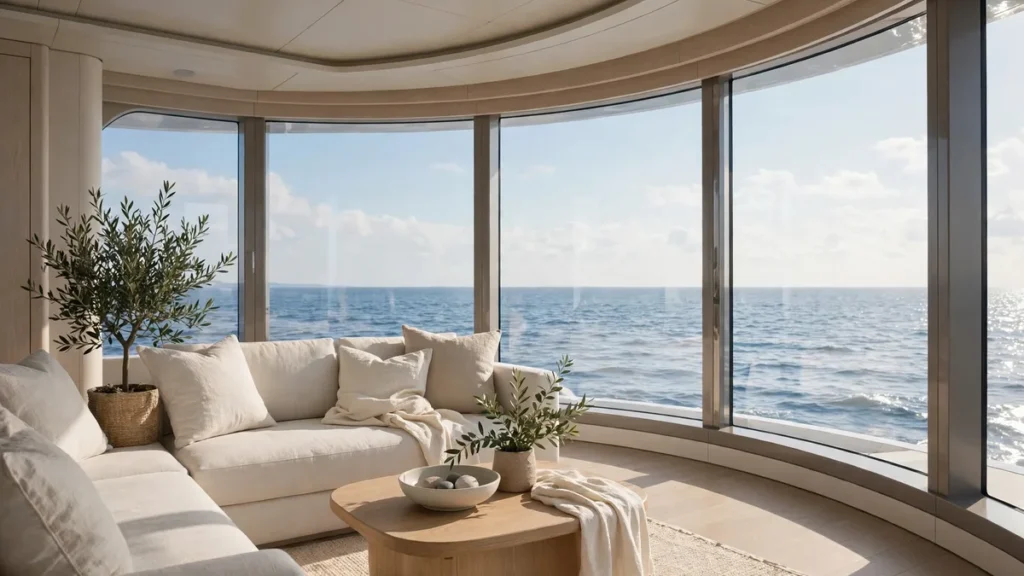
Stand on the deck of a superyacht at sunset and look at the windows. They are enormous — floor-to-ceiling sheets of glass that wrap around the salon like the walls barely exist — yet the sea stays outside, the wind stays outside, and the whole structure feels as solid as a building. When a wave slams into the bow at twenty knots, those windows take the hit and do not even shiver. That is not ordinary glass doing an ordinary job.
Superyacht glass is a feat of engineering disguised as a luxury. Each panel can be several metres across, curved in two directions, and heavy enough to need a crane to lift, yet it must stay perfectly clear, survive storms and the occasional green wave over the bow, and keep the interior cool under a tropical sun.
Behind that calm transparency sits a sandwich of specialist glass, plastic, and chemistry, held in frames that are engineered as carefully as the hull itself. This is how superyacht glass works, from the wave hitting the outside to the cool, quiet salon within.

How It Works
Step 1: A wave hits glass built like armour
The first job of superyacht glass is simply to survive. A wave striking the front windows of a yacht at speed can deliver tonnes of force in a fraction of a second, and a single pane of ordinary glass would shatter instantly. Superyacht windows are therefore made from laminated glass: two or more sheets of toughened glass bonded together with a layer of clear plastic, usually PVB or a specialist resin. The glass itself is chemically strengthened or heat toughened, making it several times stronger than ordinary glass of the same thickness.
Step 2: The curve spreads the load
Look closely at a superyacht window and you will see it is rarely flat. Most large panels are curved, sometimes in two directions at once, and that curve is doing real structural work. Just as an arch is stronger than a flat beam, a curved sheet of glass spreads the force of a wave across its whole surface and into the frame, instead of letting it concentrate in the middle. Making such a panel is a slow, precise process: flat glass is heated until it softens, bent over a mould, cooled under control, and then laminated. The panels that result are measured in millimetres, as how superyacht glass is made shows.
Step 3: The frame lets the glass flex
Glass and steel do not behave the same way at sea. A yacht hull flexes as it rides over waves, expands in tropical heat, and contracts in cold water, and its glass must be allowed to move with it. So superyacht windows sit in frames with flexible seals and structural adhesive, a rubbery bond that holds the glass firmly while letting it shift by a few millimetres. The adhesive also spreads loads evenly around the edge of the panel, so there is no single hard point where a crack could start. A window that is clamped rigid is a window waiting to break.

Step 4: Coatings tame the sun
The same huge windows that give a superyacht its view also invite the sun inside, and in the tropics that would turn the salon into a greenhouse. So superyacht glass carries invisible coatings that reflect infrared heat while letting visible light through. Low-emissivity coatings bounce heat back outside, and some panels include a tinted or solar-control interlayer that cuts glare without dimming the view. The result is a salon that stays cool and bright at the same time, with far less work demanded from the air conditioning. The yards that fit these panels plan the whole glazing job as one system, as the look inside superyacht glass production makes clear.
Step 5: The glass seals the yacht against the sea
A window is also a hole in the hull, and every hole is a place where water wants to get in. Superyacht glass is therefore sealed with a belt-and-braces approach: the structural adhesive bonds the panel to the frame, rubber gaskets compress around the edges, and drainage channels carry away any water that finds its way past the first seal. The seals are chosen to resist salt, sunlight, and years of flexing without hardening or shrinking. A superyacht window is not a pane of glass; it is a watertight system with glass at its centre.
Step 6: It stays clear with simple care
Once installed, superyacht glass asks for surprisingly little. The crew washes it with fresh water to remove salt, which would otherwise etch the surface over time, and cleans it with soft cloths and specialist products that will not scratch the coatings. Small chips in the outer layer can sometimes be repaired, but a cracked panel is replaced whole — there is no patching a structural window. The steel structure around it matters just as much, as how a superyacht steel hull works explains, since the glass and the hull share every wave the yacht meets.
| Main material | Laminated toughened glass with a PVB or resin interlayer |
| Typical panel size | Up to several metres across; the largest are crane-lifted |
| Glass thickness | Commonly 12 to 30 millimetres, depending on position and size |
| Strength | Several times stronger than ordinary glass of the same thickness |
| Coatings | Low-emissivity and solar-control layers that block heat, not light |
| Mounting | Structural adhesive and flexible seals in steel or aluminium frames |
| Safety behaviour | Cracked glass stays bonded to the interlayer, like a car windscreen |
| Extras | Heated bridge windows and drainage channels behind the seals |
What Does Superyacht Glass Cost?
Superyacht glass is priced like the bespoke engineering it is. A single large curved laminated panel is estimated at roughly $15,000 to $60,000, depending on size, curvature, thickness, and coatings, and a full glazing package for a large yacht can run into hundreds of thousands of dollars. Those are estimates only, and they exclude the frames, the installation, and the yard time. The cost is driven by the small numbers involved — every panel is made to order for one yacht — and by the testing each one must pass before it is allowed to go to sea.
A Rare Fact
Some of the largest superyacht windows are so big that they cannot be made in one piece by any normal glass factory. They are produced in specialist furnaces, bent on moulds the size of a small room, and shipped to the yard in custom crates with their own suspension, because a single jolt in transit could ruin a panel worth more than a family car. Once fitted, the glass also does a job most guests never notice: on many yachts the windows are structural, helping carry the loads of the superstructure itself.
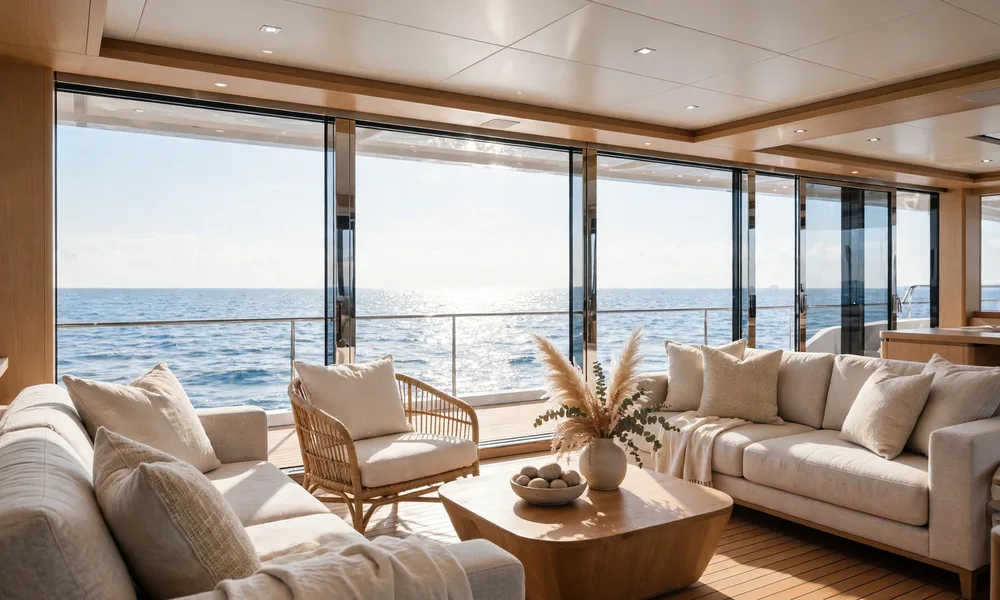
Superyacht glass succeeds by disappearing. When it works, nobody thinks about it at all — they look straight through it at the horizon, the sunset, or the harbour lights, and forget that a few centimetres of engineered glass and glue are all that stands between them and the ocean. It is one of the hardest materials on the yacht to make, fitted so well that it looks like it was never there.