Stand on a modern superyacht’s main deck and the first thing you notice is what is not there. There are no small windows, no portholes, no thick frames breaking up the view — just one sweep of glass, curved like a wave, running the length of the saloon and opening the whole room to the sea. From outside the yacht seems to wear sunglasses; from inside the wall seems to have disappeared. That glass is the largest single piece of engineering on the boat, and making it is closer to building an aircraft windscreen than fitting a window.
Superyacht glass is not the glass in your house. A single panel can be five metres long, weigh half a tonne and curve in two directions at once, yet it must survive a wave strike at speed, a fender bump in a marina, and years of salt, sun and flexing as the hull works in a seaway. It is layers of toughened glass bonded with plastic interlayers, bent in giant ovens and polished until optically perfect. The factory handles each panel like a work of art: if one breaks, there is no spare on a shelf anywhere in the world.

How Superyacht Glass Is Made
Step 1: Cutting the flat sheets
It starts with flat sheets of low-iron glass, chosen because ordinary glass has a green tint that would dull the view. Sheets are cut to shape on computer-controlled tables, diamond wheels scoring the glass and offcuts snapping away cleanly. Each panel is cut slightly oversize, since bending and laminating change its dimensions, and the edges are ground smooth so no chip can become a crack later. One yacht can need dozens of panels, each numbered and tracked from this first cut to its final fitting.
Step 2: Bending in the oven
The flat sheets are laid on a steel mould shaped to the exact curve of the yacht’s superstructure, then rolled into a giant oven and heated to around 600 degrees Celsius, where glass softens like toffee. Gravity does the work, letting the sheet sag gently onto the mould over several hours, with the temperature controlled to a degree so the bend is even. Panels curving in two directions need a mould machined to the yacht’s digital model and a bending cycle tuned over many trials. Cool the glass too fast and it shatters; cool it too slowly and the curve drifts. The mould must match the yacht’s structure perfectly, which is why the glassmaker works from the same digital model as the yard building the superyacht aluminium superstructure the glass will sit in.
Step 3: Toughening the glass
After bending, each sheet is toughened: heated again, then blasted with jets of cold air, cooling the outside fast while the inside stays hot. This locks the surface into compression, making the glass roughly five times stronger than ordinary annealed glass. Toughened glass also fails safely: if it breaks, it crumbles into small blunt pieces instead of lethal shards. The toughening must be even across a curved panel — uneven cooling leaves optical distortion, and a yacht owner will notice a wavy view immediately.
Step 4: Laminating the sandwich
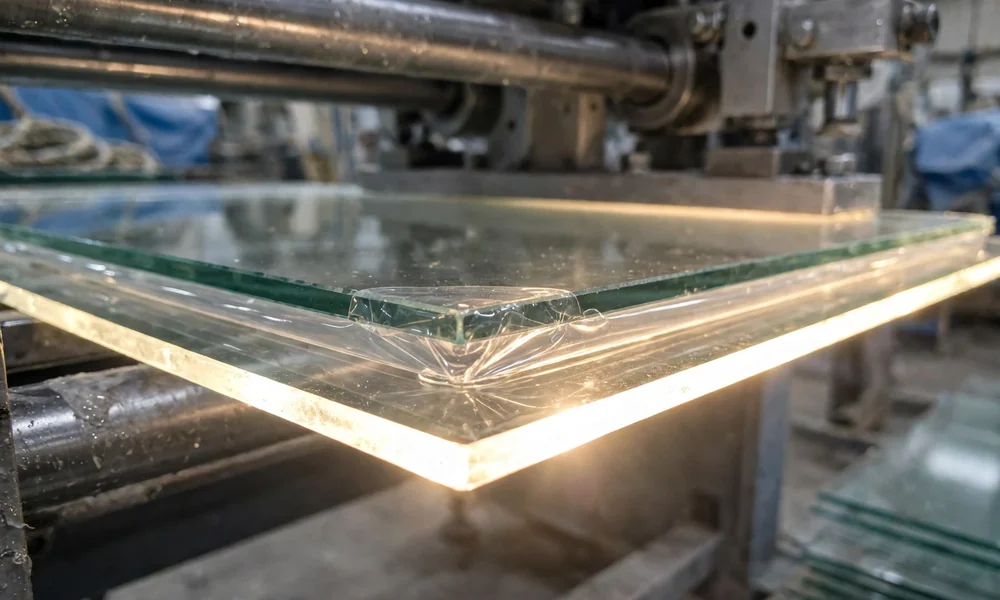
Superyacht glass is laminated: two or more toughened sheets are bonded together with interlayers of clear PVB or SentryGlas plastic, a tough film that holds the glass together even if it cracks. The layers are stacked in a clean room, since a single speck of dust trapped between them would be visible forever, then sealed in a vacuum bag and heated in an autoclave — a giant pressure oven — until the plastic melts and fuses the sandwich into one panel. The interlayer also blocks ultraviolet light and deadens sound, which is why a superyacht saloon stays quiet in a busy harbour. A three-layer panel can stop a flying fender; a sheet of house glass would not.
Step 5: Polishing and optical inspection
Every panel is inspected for optical quality, and this is where most fail. The glass is checked against a grid for distortion, examined for bubbles, seeds and inclusions, and measured for thickness throughout. Edges are polished to a furniture finish, because a rough edge is where a crack starts. Failed panels are rejected — there is no repairing a bent, laminated sheet — and the process starts again. The rejection rate is high, and it is the single biggest reason superyacht glass costs what it does. The same intolerance for flaws governs the superyacht swimming pool, where a leak in a glass wall would be catastrophic.
Step 6: Coatings and heating
Many panels get coatings before they leave the factory: a low-emissivity layer reflecting heat while letting light through, keeping the saloon cool in the tropics, and sometimes a nearly invisible heated coating clearing condensation and ice. The coatings are applied by sputtering metal oxides onto the glass in a vacuum chamber, a few atoms thick, and must survive the bending and laminating that follows. Some windscreens carry a heating element for the bridge, so the captain’s view stays clear in any weather — a detail the crew on the yacht navigation bridge depend on when the weather turns.
Step 7: Transport and installation
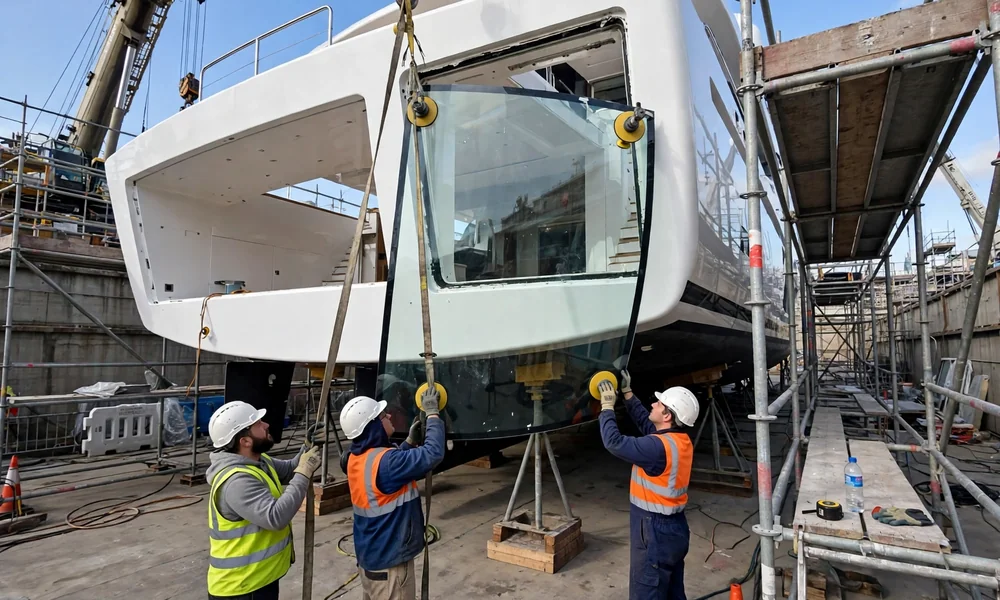
Moving a curved glass panel is a job in itself. Each one travels in a custom-built crate, on edge, cushioned and braced, sometimes by dedicated truck across a continent. At the yard, a crane with suction cups lifts it into place, and a team guides it into its frame with millimetres to spare. It is bedded on structural adhesive and rubber seals that let the glass flex with the hull without cracking, then left to cure for days before the yacht moves. The installation is photographed and recorded, so if that panel ever needs replacing, the factory can make an identical one from the same mould.
Superyacht Glass at a Glance
| Specification | Typical Value |
|---|---|
| Panel size | Up to about 5 m long, single curved panels |
| Glass type | Low-iron, toughened, laminated |
| Layers | Usually 2 to 3 glass layers plus interlayers |
| Bending temperature | Around 600 degrees Celsius |
| Strength | About 5 times stronger than ordinary glass |
| Panel weight | Up to about 500 kg for the largest panels |
| Key advantage | Panoramic view, wave-proof, fails safely |
What Does It Cost?
Superyacht glass is priced by the panel, and the numbers are startling. One large curved laminated panel typically costs $20,000–$80,000 (estimates), and a full set of glass for a large superyacht can pass $500,000 (estimates). The cost is driven by the custom moulds, the high rejection rate, the autoclave time and transport. A replacement panel, made to order years later from a stored mould, can cost even more. It is one of the most expensive materials on the boat by weight, and the one the owner looks through every single day.
A Rare Fact
The largest single piece of curved glass ever fitted to a yacht had to be bent in an oven built specially for the job, and the panel weighs more than a small car — yet it is only a few centimetres thick. Glassmakers say the hardest part is not the size but the optics: a curve perfect on paper can act like a funhouse mirror at sea, bending the horizon into a wave. The best panels are tested by looking through them at a distant grid, and one that distorts the view by even a fraction is rejected, no matter what it cost to make. On a superyacht, the glass must disappear — and disappearing is the hardest trick of all.


