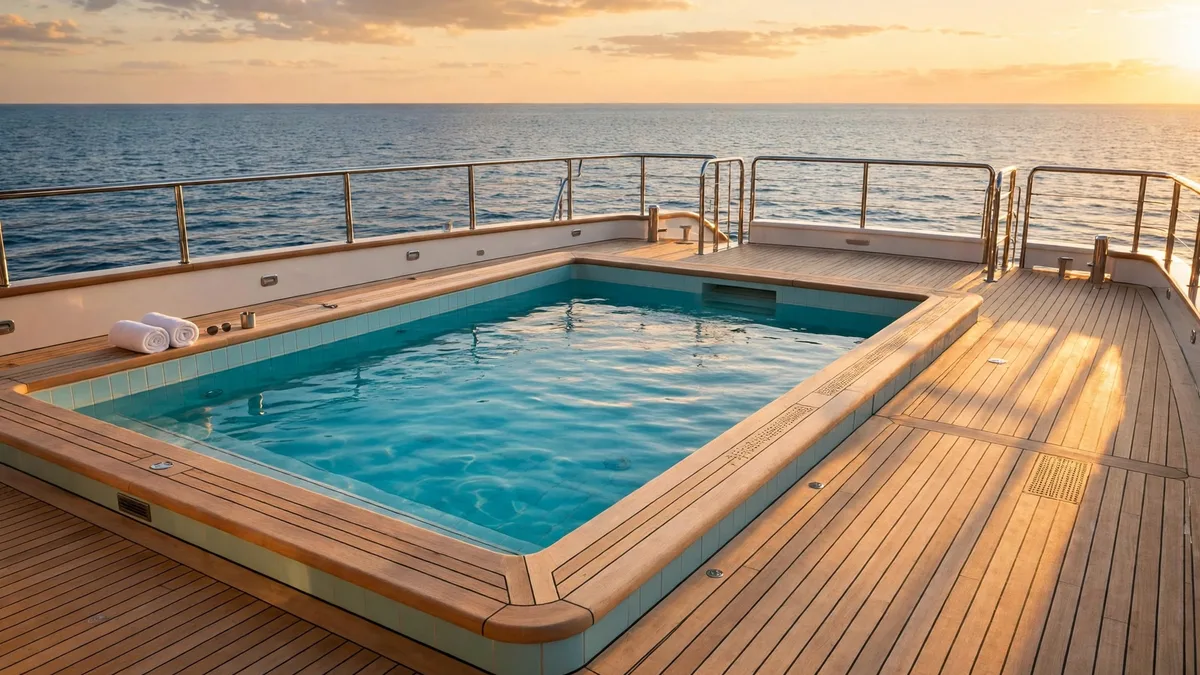
Picture a superyacht anchored off a quiet bay in the Mediterranean at dusk. The sun is low, the water is flat, and on the main deck aft, a rectangle of turquoise glows against the teak. It is a swimming pool, and it is sitting on a ship that is itself floating on the sea — a pool within an ocean, held in a steel and composite tub that must not leak a drop, must not slosh its water across the deck when the yacht rolls, and must somehow disappear entirely when the owner wants the deck back. Building one is a strange engineering job, because a pool is a hole full of water, and a ship survives by keeping water out.
Superyacht pools come in many forms: a plunge pool on the sun deck, a long lap pool along the centreline, a glass-bottomed pool that doubles as a skylight for the cabin below. Some have floors that rise to turn the pool into extra deck space. All share the same problem — tonnes of moving water on a moving vessel — and solving it takes naval architects, structural engineers, and pool specialists working together.
How It’s Made
Step 1: Designing the tub into the ship
The pool is designed before the yacht’s steel is even cut, because its weight and position shape the whole vessel. A modest plunge pool holds five to ten tonnes of water; a large one can hold thirty tonnes or more, and that weight sits high in the ship, where it affects stability more than the same weight low in the hull. Naval architects calculate the centre of gravity with the pool full, half-full, and empty, and plan for sloshing water with baffles or a modest surface area. The steel hull that carries it all is built to the same exacting standards as a superyacht steel hull, because the pool is only as good as the structure beneath it.
Step 2: Building the structural shell
The pool tub is usually fabricated as a watertight steel or aluminium shell, welded into the yacht’s structure during hull construction so that it becomes part of the ship rather than something bolted on later. The shell’s walls are stiffened with ribs and brackets, and every weld is tested — a leak can send tonnes of water into the machinery spaces below. Either way, the shell is built with a slight fall towards the drains, and with access hatches for the day — years later — when a pump or a seal needs replacing.
Step 3: Waterproofing and finishing
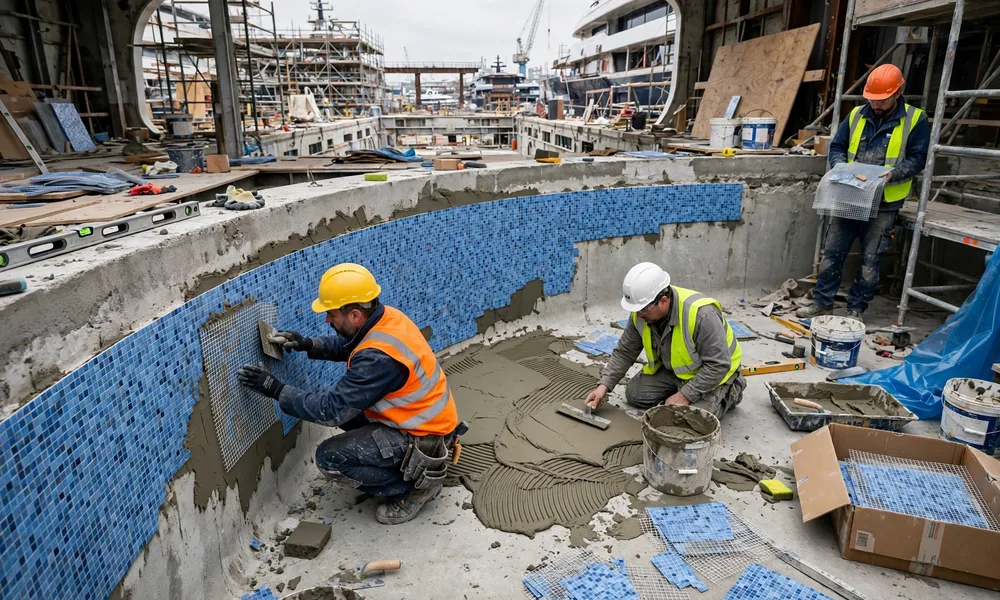
Inside the shell, the pool is waterproofed with a membrane and finished with materials that can live permanently underwater in salt air. Options include mosaic glass tiles, laid by hand one tiny square at a time; stainless steel, polished to a mirror that makes the water look deeper than it is; and specialist resin finishes. Each tile is a potential leak path, so the adhesive and grout are marine-grade and the surface is flood-tested before filling. The finish is where the pool stops being a tank and starts being a piece of the yacht’s design.
Step 4: Plumbing, filtration, and heating
Behind a discreet hatch near the pool sits the plant room: pumps, filters, heaters, and dosing equipment that keep the water clear and safe. The pool is filled with fresh water made aboard by the yacht’s watermakers, circulated through filters, heated by heat exchangers or electric heaters, and sanitised with chlorine or ultraviolet and ozone systems. The equipment must be quiet: nobody wants to hear a pump while swimming at sunset. The same care for hidden systems runs through the yacht’s other machinery spaces, as seen in the superyacht engine room, where every pipe and cable has its place.
Step 5: The moving floor
Many superyacht pools have a floor that rises. At the touch of a button, hydraulics lift the pool floor until it is flush with the deck, turning the pool into extra deck space for a party — and, just as importantly, closing the pool when the yacht is at sea. A pool that is open in rough weather is a hazard: the water sloshes, the surface breaks, and the yacht’s stability suffers. The moving floor is a precision mechanism, a watertight platform running on guides and driven by hydraulic rams, sealed so that it moves smoothly and locks positively at every height, including part-way up as a shallow children’s pool. The hydraulics have redundancy so the floor can always be raised before a storm.
Step 6: Glass walls and edge details
The most spectacular pools have glass walls — a transparent side that turns the pool into an aquarium the owner can swim in, or a glass edge where the water seems to vanish into the sea beyond, an infinity edge at sea. The glass is laminated and tempered, set in marine-grade frames with seals that must survive years of sun, salt, and flexing. The infinity edge needs a balance tank below deck to catch spill-over and pump it back. Details like these are what separate a superyacht pool from a very expensive hole in a deck, and they are also what make the vessel’s motion systems matter — a pool that sloshes needs a stable platform, which is why large yachts invest so heavily in gyroscopic stabilizers that keep the yacht level at anchor.
Step 7: Filling, testing, and handover
Before handover, the pool is filled and tested over days: leaks, water quality, heating, and the moving floor at every position. The yacht is taken to sea with the pool full, and the crew watch how the water behaves in a real seaway — whether it sloshes, whether the overflow tank copes, whether the floor stays locked. The crew are trained on its operation: how to balance the water, when to raise the floor, how to winterise the system. A superyacht pool is, in the end, a small piece of civil engineering floating on the ocean, and it is handed over with the same seriousness as the engines or the navigation systems.

Specifications
| Property | Typical Superyacht Pool |
|---|---|
| Length | 3–8 m (plunge) / up to 12 m (lap) |
| Water volume | 5–30 tonnes |
| Shell material | Steel / aluminium / stainless insert |
| Finish | Glass mosaic tile / stainless / resin |
| Moving floor | Hydraulic, full travel in ~1–2 min |
| Water treatment | Filtration + UV / ozone / chlorine |
| Heating | Heat exchanger / electric, to ~28°C |
| Glass floor/wall | Laminated tempered, load-bearing |
Price
A superyacht swimming pool is priced as part of the yacht, not as a standalone item, but industry figures put a typical installation at an estimated $500,000 to $2 million depending on size, with the largest and most complex — glass-bottomed, moving-floor, infinity-edge pools — costing an estimated $3 million or more. The shell and structure are only part of it: the tiling, the glass, the hydraulics, and the water-treatment plant each add hundreds of thousands, and the design and engineering time is billed on top. All prices here are estimates, not quotes.
Rare Fact
Some superyachts have pools with glass bottoms that form the ceiling of the owner’s cabin — the owner can lie in bed and watch the sunlight ripple through the water above, with the silhouettes of swimmers drifting across the ceiling. It is the most literal version of sleeping under the sea, and it only works because the glass floor is engineered to carry tonnes of water while staying perfectly clear.