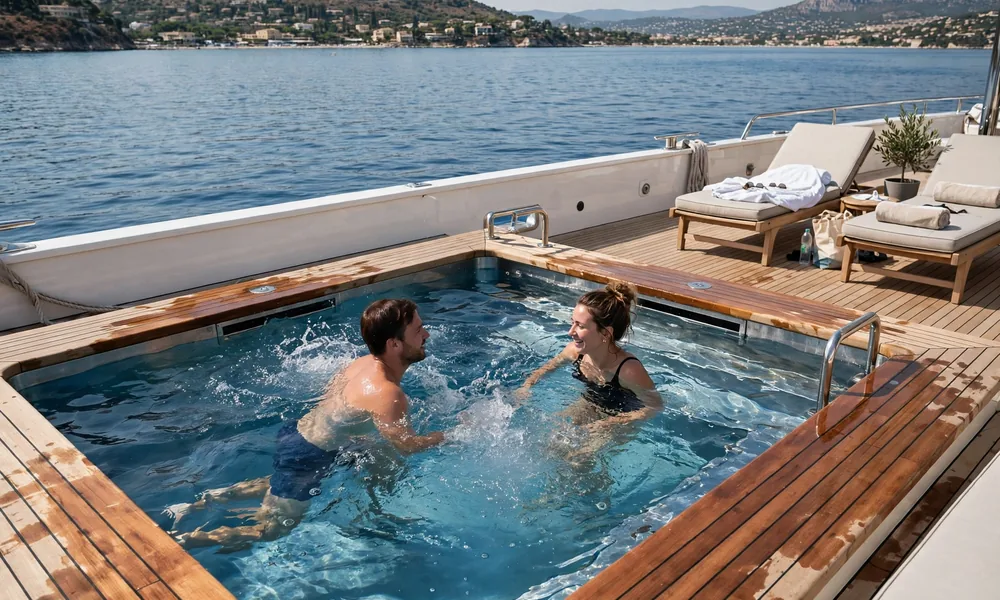
Picture the scene: a yacht the length of a football pitch is cutting through the Mediterranean at fifteen knots, the deck rolling gently with the swell — and on the aft deck, guests are swimming laps in a pool that is not spilling a drop. It looks impossible. A swimming pool is a box of still water, and a ship is a moving, rolling, pitching machine. Put them together and physics says the water should slosh over the edge with every wave.
Yet superyacht pools work, and they work beautifully, because the pool is not really a box of water sitting on a deck. It is a carefully engineered system of tanks, pumps, sensors, and moving floors, designed to keep the water where it belongs no matter what the sea is doing. This is how it works, step by step.
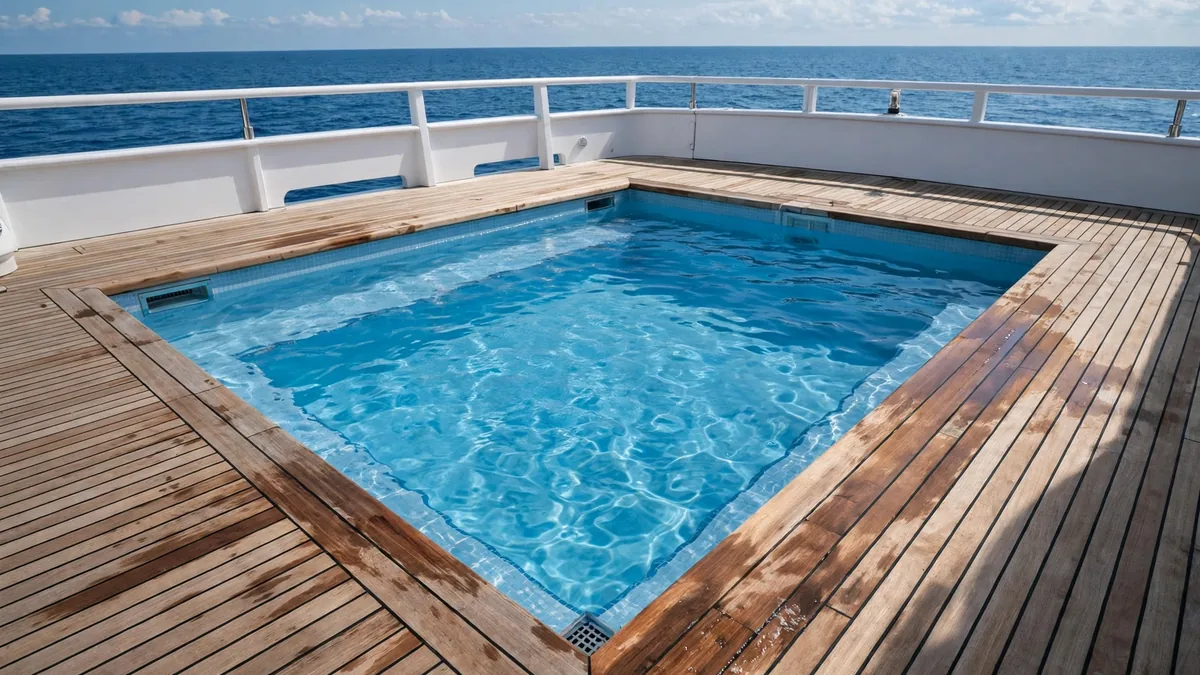
How a Superyacht Swimming Pool Works
Step 1: The pool shell is built into the yacht
Everything starts with the shell, which is not dropped onto the deck but built into the yacht’s structure itself. On most large yachts the pool is a stainless-steel or fibreglass tub welded or bonded into a recess in the deck, with its own framing tied into the hull so the weight of the water — several tonnes — is carried by the ship, not by the deck plating. The shell is lined with a waterproof membrane and finished with tiles or a smooth resin surface that can flex slightly as the hull works in a seaway. The construction of that shell, from the steel tub to the final tile, is covered in how a superyacht swimming pool is made, and the materials chosen for it are laid out in superyacht swimming pool materials engineering.
Step 2: A balance tank absorbs the sloshing
The cleverest part of the system sits below the deck, out of sight: the balance tank. The pool is connected to this tank by wide pipes, and together they hold more water than the pool alone. When the yacht rolls and a wave of water surges toward one side of the pool, the excess flows down into the balance tank instead of over the edge. When the yacht rolls back, the water flows up again. The tank acts as a buffer, swallowing the surge and returning it a moment later, so the visible water level barely moves. It is the same idea as a reservoir smoothing a river, and it is what lets guests swim while the yacht is under way.
Step 3: Pumps keep the water circulating
Still water goes stale, so the pool water is always moving. Powerful circulation pumps draw water from the pool through skimmers at the surface and drains at the bottom, push it through filters that trap hair, sunscreen, and dust, and return it through inlets set into the pool floor and walls. The full volume of the pool is turned over every few hours, day and night, whether anyone is swimming or not. The pumps are sized generously, because they also have to refill the pool quickly after the balance tank has absorbed a big surge, and they run on variable-speed drives so the crew can quiet them down when guests are on deck.
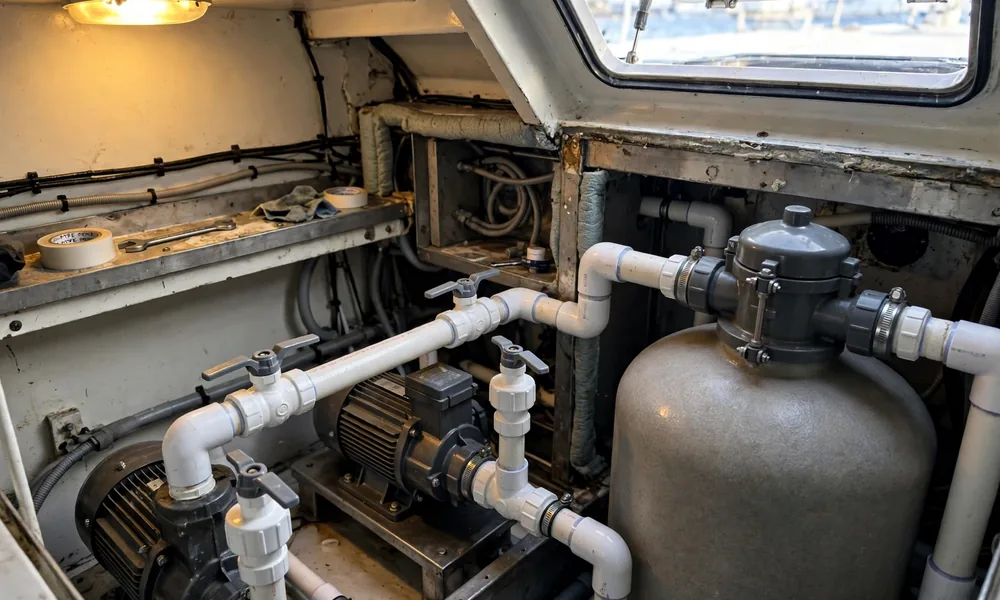
Step 4: Heating and chemistry keep it swimmable
Seawater is cold and salty, and nobody wants to swim in it, so the pool is filled with fresh water and kept at a comfortable temperature, usually around 26 to 28 degrees Celsius. Heat comes from the yacht’s engines or dedicated heaters, passed through a titanium heat exchanger so the warm engine coolant never touches the pool water. At the same time, a dosing system adds small, measured amounts of chlorine or bromine to kill bacteria, and sensors test the water several times an hour, adjusting the dose automatically. The result is water that stays clear and safe without the harsh chemical smell of a public pool.
Step 5: A moving floor changes the depth
Many superyacht pools have a trick that no land pool can match: a floor that moves. At the touch of a button, the floor rises until it is flush with the deck, turning the pool into a dance floor or extra deck space, or sinks to make the pool deeper for swimming. The floor is a watertight platform driven by hydraulic rams, guided on rails, and sealed so tightly that it can hold back the full weight of the water above it. When it is raised, the water it displaces flows down into the balance tank, and when it is lowered the water flows back up. It is a piece of theatre as much as engineering — a pool that disappears.
Step 6: The crew drains, cleans, and refills
Even with perfect filtration, a pool needs care. Every day the crew skims the surface, checks the chemistry, and brushes the walls. Every week or so, depending on use, the pool is drained into the balance tank or overboard where regulations allow, the shell is scrubbed, and the pool is refilled with fresh water made on board by the yacht’s watermakers. In rough weather or when the yacht is in port with strict discharge rules, the pool is simply kept covered and the water left to circulate. The pool depends on the yacht’s machinery spaces for power, heat, and water, and how a superyacht engine room works shows the plant that keeps all of it running.
Superyacht Swimming Pool Specifications
| Specification | Typical figure |
|---|---|
| Pool length | Roughly 5 to 10 metres |
| Water volume | About 10,000 to 40,000 litres |
| Water temperature | Around 26 to 28 degrees Celsius |
| Turnover time | Full volume every 4 to 6 hours |
| Shell material | Stainless steel or fibreglass |
| Moving floor | Hydraulic, variable depth to about 1.8 metres |
How Much Does a Superyacht Swimming Pool Cost?
There is no catalogue price for a superyacht pool, because each one is custom-built into its yacht. Industry estimates put a large yacht pool system at roughly $500,000 to $2 million, including the shell, balance tank, filtration, heating, and a moving floor — these are estimates, not list prices, and they vary with size and complexity. The pool is a small fraction of a yacht that may cost hundreds of millions, but it is one of the features guests remember most.
A Rare Fact About the Superyacht Swimming Pool
Here is something few people realise: the first superyacht pools were not for swimming at all. Early yacht owners installed them as ornamental ponds and plunge baths, and the idea of actually swimming laps at sea seemed absurd — the water would simply slosh out. The balance tank, the invention that made swimming pools at sea practical, was borrowed from the surge tanks of hydroelectric dams, where the same problem of a moving body of water had to be tamed. A dam’s engineering, shrunk into a hull, is what lets you swim on a moving ship.
So the next time you see a pool on a yacht, remember what is happening beneath the deck: a steel shell built into the hull, a balance tank swallowing every surge, pumps turning the water over hour after hour, heaters and dosing systems keeping it warm and clear, and a floor that can rise to turn the pool into a dance floor — all of it working so that a box of still water can ride the sea.


