Step through the watertight door at the bottom of a superyacht and the world changes. Above deck there is teak, sunlight and the smell of salt; below, in the engine room, there is a clean white space the size of a small house, humming with machinery, where two engines the size of wardrobes turn diesel into motion, electricity, hot water and air conditioning, all at once. It is the hardest-working room on the boat, and also the quietest triumph of engineering on board: everything the guests enjoy upstairs depends on what happens down here.
A superyacht engine room is far more than a place to keep the engines. It is a power station, a water plant and a workshop in one, and every system in it is built twice over, so that no single failure can strand the yacht. This is how it works, from the fuel tank to the propeller.

How It Works
The heart of the room is a pair of large marine diesel engines, each producing anywhere from 1,000 to 5,000 horsepower, mounted low in the hull on flexible mounts that soak up vibration. They drive the propellers through gearboxes and long shafts, and they also drive generators, pumps and compressors. Around them sits a ring of supporting systems, each with its own job, each monitored from a control panel that watches hundreds of readings at once.
Step 1: Fuel is cleaned before it is burned
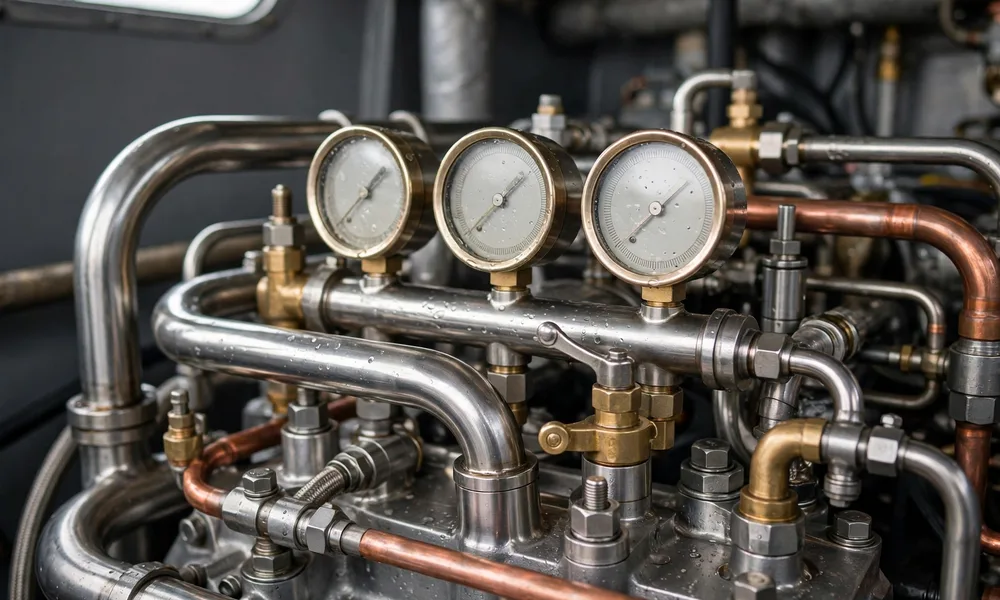
Fuel arrives in the yacht’s tanks as ordinary marine diesel, but it is never burned straight from the tank. First it passes through filters and a centrifugal separator, a spinning drum that flings water and dirt out of the fuel, because even a small amount of water in a marine diesel can destroy an injector. The clean fuel is held in a day tank, a smaller tank that holds roughly a day’s supply, and from there it is pumped to the engines at high pressure. The physical build of this space is described in the account of how a superyacht engine room is made.
Step 2: The main engines turn fuel into thrust
Inside each engine, diesel is injected into cylinders at enormous pressure and ignites from the heat of compression, with no spark plugs, driving pistons that turn a crankshaft. The crankshaft spins at around 1,500 to 2,300 revolutions per minute, and a reduction gearbox slows that down to a few hundred revs at the propeller shaft, because a propeller is most efficient turning slowly. The shaft runs through the stern of the hull in a sealed tube, and where it exits the hull, a seal keeps the sea out while the shaft spins.
Step 3: Generators make the yacht’s electricity
While the main engines push the yacht, separate smaller diesel generators make its electricity, usually two or three of them, each producing enough power for a small neighbourhood. They run the air conditioning, the galley, the navigation systems, the stabilisers and the lights, and they are sized so that one generator can be shut down for maintenance while the others carry the load.
Step 4: Seawater cools everything
A superyacht engine room runs hot, and seawater is the coolant. Pumps draw seawater in through intakes in the hull, pass it through heat exchangers that cool the engines’ freshwater circuits, the generators, the air conditioning and the gearbox oil, and then pump it back out. Strainers on the intakes catch weed and debris, and the crew checks them daily, because a blocked intake can overheat an engine in minutes. The same seawater, passed through a different plant, is also turned into drinking water by reverse osmosis.
Step 5: Stabilisers, air and water keep the yacht livable
The engine room also houses the systems that make life on board comfortable. Gyroscopic or fin stabilisers, driven by hydraulics from the engine room, counteract rolling in waves. Air conditioning plants chill water that is pumped up to fan units in every cabin. A watermaker forces seawater through membranes at high pressure to produce fresh drinking water, and a sewage treatment plant cleans wastewater before it is discharged. The production side of the room, how it is laid out and fitted, is covered in the look at inside superyacht engine room production.
Step 6: Alarms and fire systems stand guard
The engine room is the most closely watched space on the yacht. Temperature, pressure, oil level, exhaust temperature and vibration are all monitored continuously, and any reading outside its limits triggers an alarm on the bridge and in the crew quarters. The room is also a fire risk, with fuel, hot exhausts and electricity in one space, so it is protected by a fixed fire-extinguishing system that can flood the room with gas or fine water mist, sealing the ventilation first so the fire is starved of air. The crew drills for engine room fires regularly, because at sea there is no fire brigade to call, and the room’s design, with two exits and a fireproof door, reflects that.
Specifications
| Specification | Typical value |
|---|---|
| Main engines | Two marine diesels, 1,000 to 5,000 horsepower each |
| Generators | Two or three diesel generators |
| Electrical output | Enough for a small neighbourhood, 200 to 500 kW |
| Fuel capacity | 50,000 to 200,000 litres |
| Fresh water production | Up to 20,000 litres per day by reverse osmosis |
| Propulsion | Twin shafts with reduction gearboxes |
| Fire protection | Fixed gas or water-mist system, sealed ventilation |

What It Costs
The machinery in a superyacht engine room typically accounts for a large share of the yacht’s build cost, with the main engines alone costing roughly $500,000 to $2 million each depending on size, and the full engineering package, including generators, stabilisers, air conditioning and water systems, running into several million dollars on a large yacht. Running costs are just as striking: a large superyacht can burn 500 to 2,000 litres of diesel per hour at cruising speed, and annual engineering maintenance, including oil changes, filter replacements and overhauls, commonly runs into hundreds of thousands of dollars. It is the price of carrying a small power station and water plant everywhere you go, and of building it so that it never fails far from shore.
A Rare Fact
Superyacht engine rooms are painted white for a reason that has nothing to do with looks. A white room makes the smallest oil leak, the faintest drip of coolant or the first speck of soot instantly visible, so the crew can spot a problem before it becomes a breakdown. The floors are often painted in a light grey with a non-slip finish, and the pipes are colour-coded: red for fire mains, blue for seawater, yellow for fuel, green for freshwater. The whole room is designed so an engineer can walk in, glance around, and know in seconds whether everything is healthy. The same obsession with keeping machinery visible and clean extends to the rest of the yacht, including the tall structure above deck, whose engineering is explained in how a superyacht mast works.
Guests upstairs see teak decks and still water. Down below, two engines, three generators, a water plant and a fire system are working around the clock, and the white paint, the colour-coded pipes and the watchful gauges are what keep a floating hotel moving safely across an ocean.


