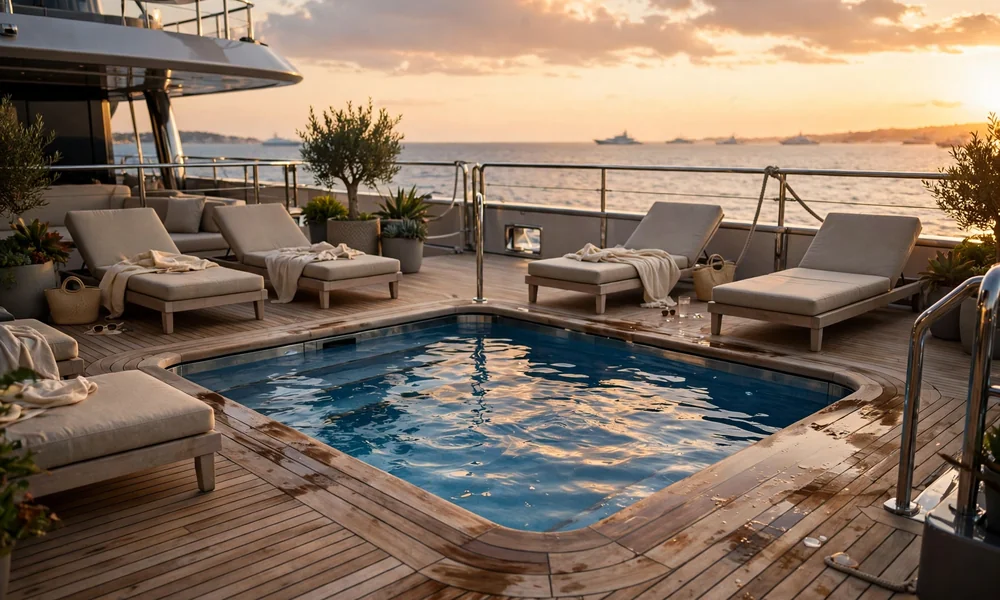
There is a particular kind of wealth that shows itself quietly, and one of its signatures is a swimming pool on a boat. Not a hot tub, but a real pool, long enough to swim in, full of fresh water, sitting on a hull that is itself floating on the sea. It is also one of the hardest engineering problems on a superyacht.
The problem is the weight, the movement and the salt. A pool holds tonnes of water that sloshes with every wave, pushing against walls never meant to carry a shifting load. The pool must not leak into the yacht below, must not corrode in salt air, and must survive a hull that flexes as it crosses an ocean. The materials are borrowed from swimming pools, ships and chemical plants, chosen for one quality above all: they must not fail, because a failure means tonnes of water inside a yacht.
Here is what a superyacht pool is made of, and why each material earned its place.

The Materials Behind It
1. Stainless steel shell, the tub that holds the water
Most superyacht pools are built as a stainless steel shell, usually grade 316L, welded into a watertight tub and set into the deck structure. Stainless is strong, welds into any shape, and resists chlorinated water and salt air. The shell is typically 3 to 5 millimetres thick, stiffened with ribs underneath. Every weld is tested, because a single pinhole leak will drip into the accommodation below for weeks before anyone notices.
2. GRP and composite liners, the lighter alternative
Some pools are built from glass-reinforced plastic, GRP, moulded as a single piece and dropped into the deck opening. GRP is lighter than steel, never rusts, and can be moulded with steps, seats and curves that would be expensive to weld. The trade-off is stiffness: a GRP shell needs a strong supporting frame, and it must be protected from ultraviolet light. The pool is finished with a gel coat, a smooth resin skin that gives the water its pale blue colour.
3. Glass mosaic tiles, the finish that survives salt and sun
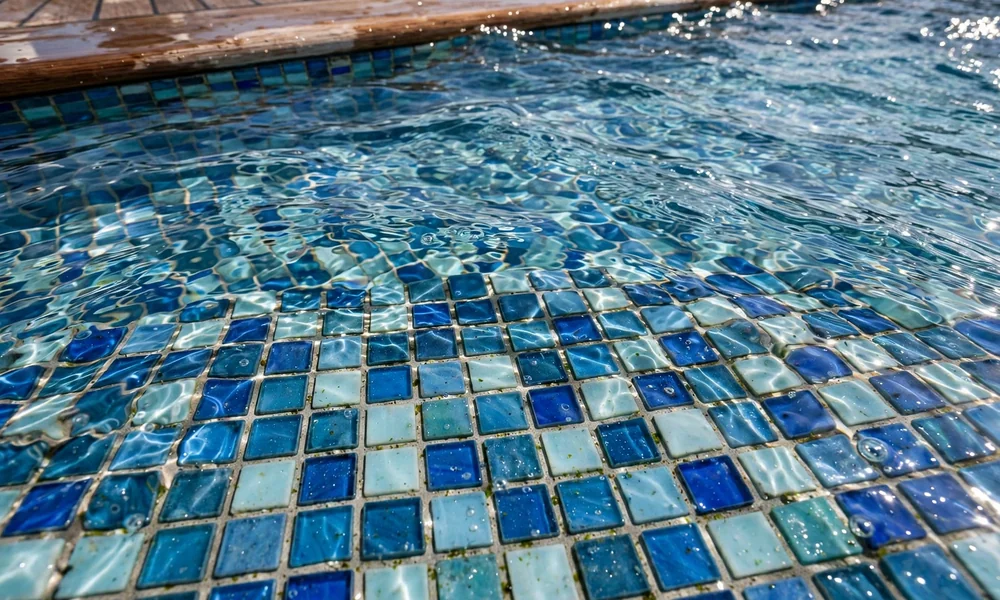
The visible finish of a luxury pool is usually glass mosaic tile, small squares of coloured glass set in epoxy grout. Glass tile does not fade, does not stain, and shrugs off chlorine and salt. The grout matters as much as the tile: ordinary cement grout would crack as the hull flexes, so pools use flexible epoxy grout, which moves with the structure and seals the joints. Laying the tile is slow, skilled work, and on a large pool it can take weeks.
4. Epoxy waterproofing, the layer that must never fail
Under the tile sits the waterproofing layer, usually a two-part epoxy membrane applied in several coats. This is the last line of defence: if the shell cracks or a tile joint opens, the membrane must still hold the water. Epoxy bonds to steel and GRP alike, stays flexible enough to follow the hull’s movement, and resists chlorine and seawater. The membrane is applied by specialists and tested by filling the pool and watching the level for days.
5. Titanium and bronze fittings, the parts the water touches
Every fitting that touches pool water, the jets, the lights, the drains and the handrails, is made from materials that will not corrode in chlorinated water. Titanium is used for the most exposed parts, such as heater elements, because it is effectively immune to chlorine. Bronze is used for drain covers and through-hull fittings, a traditional marine metal that lasts decades in seawater. Ordinary stainless steel is not enough here: in warm chlorinated water, lesser grades can suffer pitting corrosion. The deck around the pool gets the same care, and the guide to the yacht teak deck shows how the timber surround is built to survive the same wet, salty life.
6. Acrylic windows and the water itself, the moving load
Some pools have an acrylic window in one wall, so the pool can be seen from a cabin below, and the window is a thick cast acrylic panel, sometimes 100 millimetres or more, set in a steel frame with a flexible seal. The water itself is the real engineering problem: a pool of 10 cubic metres weighs 10 tonnes, and when the yacht rolls, that water sloshes against one wall and then the other. Designers fight this with baffles and covers that damp the movement. The hull below must carry all of it, and the yacht keel is part of the same balancing act, keeping the vessel upright under loads that change with every wave.
How a Superyacht Pool Is Built
- Design and weight budget. Naval architects place the pool, usually low and near the centreline, and budget its weight into the stability calculations.
- Shell fabrication. The stainless steel shell is welded and pressure-tested, or the GRP shell is moulded, before it is lifted into the deck opening.
- Waterproofing. The epoxy membrane is applied in coats, cured, and tested by filling the shell and watching the level.
- Tiling and finishing. Glass mosaic tiles are set in epoxy grout, and the coping stones and handrails are fitted around the edge.
- Plumbing and plant. Pumps, filters, heaters and the water treatment system are installed below deck, in the pool’s own plant room.
- Sea trials. The pool is filled and the yacht goes to sea, where the crew watch for leaks and any movement in the shell as the hull works in waves.
Superyacht Swimming Pool Materials
| Material | Where it is used | Why it is chosen |
|---|---|---|
| 316L stainless steel | Pool shell | Strong, weldable, resists salt and chlorine |
| GRP composite | Alternative shell | Light, never rusts, moulded to any shape |
| Glass mosaic tile | Visible finish | Does not fade or stain, survives chlorine |
| Epoxy membrane | Waterproofing layer | Seals the shell, flexes with the hull |
| Titanium fittings | Heaters, jets, rails | Immune to chlorine corrosion |
| Cast acrylic | Pool windows | Clear, strong, thick enough for water pressure |
What Does a Superyacht Swimming Pool Cost?
A superyacht swimming pool is estimated at roughly $200,000 to $500,000 to build, depending on size and finish. The water treatment and heating plant is estimated at roughly $50,000 to $100,000 on top of that, and annual running costs at roughly $10,000 to $30,000. The real cost is the weight: every tonne of pool is a tonne that cannot be used for fuel, guests or tenders. The same attention to weight and balance shapes the yacht’s underwater gear, as the yacht stabilizer fins show, keeping the vessel steady so the pool stays where it belongs.
A Rare Fact
Some of the largest superyacht pools are fitted with a floor that rises. At the touch of a button, the pool floor lifts to deck level, turning the pool into extra deck space for a party, then lowers again when guests want to swim. The mechanism is hydraulic, the floor is a watertight steel platform, and the seal has to hold back tonnes of water while the floor sits flush with the deck.
A superyacht swimming pool is a small piece of land engineering that has learned to live at sea. The steel holds the water, the epoxy keeps it in, the tile makes it beautiful, and the titanium fittings survive the chemistry. Above all, it is a reminder that on a yacht, nothing is simple: even a pool has to be designed like a ship, because it is one, floating on another ship, on an ocean that never stops moving.


