A superyacht anchored off a deserted island carries twenty guests and crew, and every one of them needs fresh water — for drinking, for showers, for the galley, for the laundry, for the pool. A large yacht can use tens of thousands of litres a day, and out here there is no tap to turn on and no tanker to call. The tanks would run dry within days, and carrying enough water for a long crossing would mean giving up space for fuel, food, or guests.
The answer is a machine that makes fresh water from the sea itself. A superyacht watermaker takes in seawater, forces it through membranes finer than any filter, and pours out drinking water so pure it has to be given minerals back before anyone drinks it. Building one is a job of stainless steel, precision pumps, and careful testing, and this is how it is done, step by step.
How a Superyacht Watermaker Is Made
Step 1: The frame and the seawater circuit come first
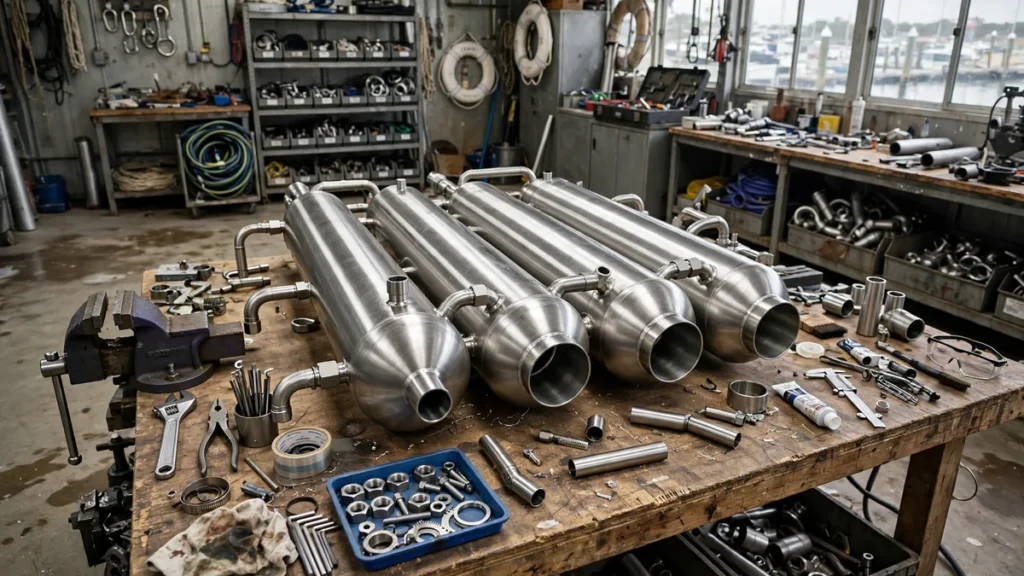
Every watermaker starts as a frame, usually welded from marine-grade stainless steel so it can live for years in a damp, salty machinery space without rusting through. The frame is built to fit a particular yacht, because no two engine rooms have the same spare corner, and every pipe run and service hatch has to be planned before a single component is bolted down. Onto the frame go the parts of the seawater circuit: a through-hull fitting below the waterline, a bronze sea strainer that catches seaweed and debris, and a low-pressure feed pump that pushes the water through pre-filters. The first filter catches sand and silt, and the second, a fine five-micron cartridge, traps anything larger than a speck of dust.
Step 2: The high-pressure pump is fitted and tested
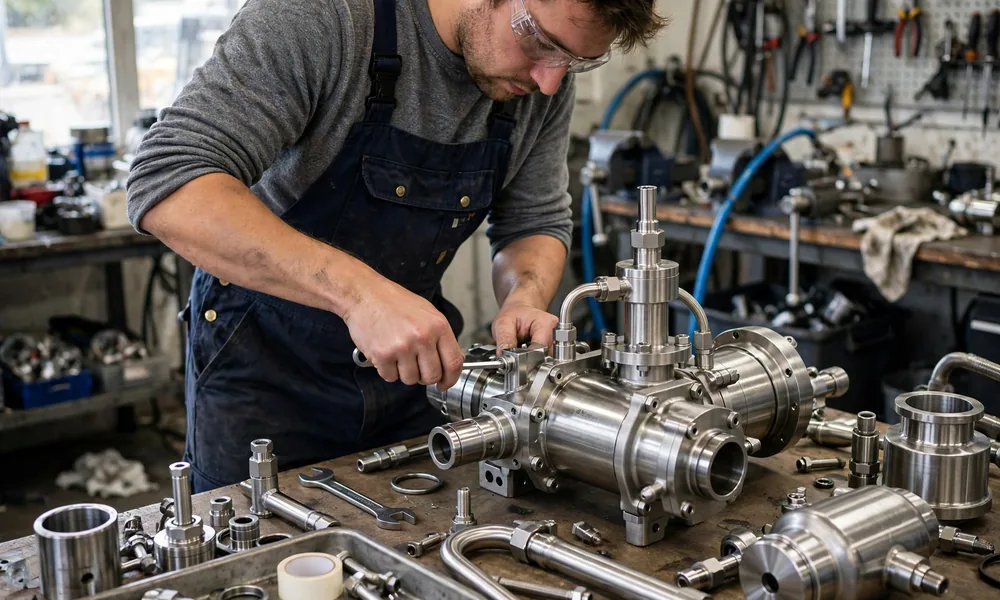
The heart of the machine is pressure. Seawater holds about 35,000 parts per million of dissolved salt, and the only way to separate that salt is to push the water against a membrane harder than the sea pushes back, a force called osmotic pressure that sits near 27 bar for seawater. The watermaker’s high-pressure pump, usually a heavy plunger pump driven by an electric motor, raises the water to between 55 and 70 bar, roughly sixty times the pressure in a car tyre. The pump is bolted to the frame on vibration mounts, connected with high-pressure stainless pipework, and run on a test bench before it ever meets a membrane, because a pump that pulses or leaks will tear a membrane apart in hours. The way the finished machine turns that pressure into drinking water is described in how a superyacht watermaker works.
Step 3: Membrane housings and elements are assembled
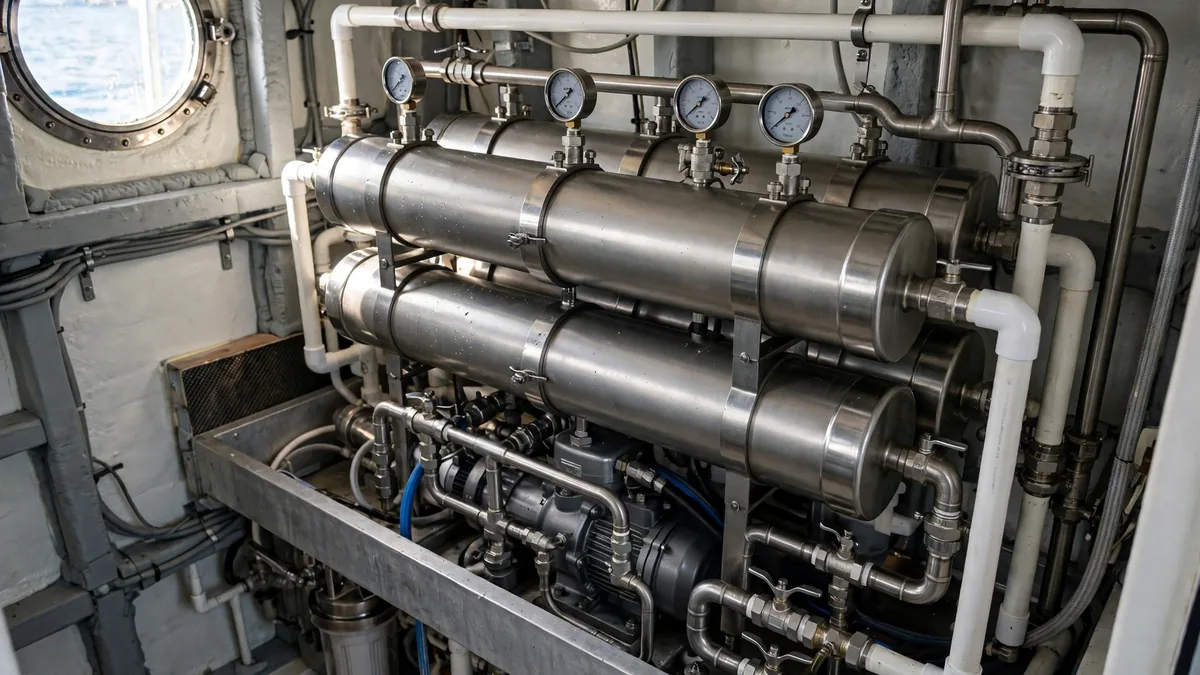
Next come the long cylindrical pressure vessels, the stainless or composite tubes that hold the membrane elements. Each element is a tight spiral of semi-permeable sheets wrapped around a central collection tube, and it slides into its housing with O-ring seals at each end that must sit perfectly, because a single damaged seal lets salty water slip past and ruins the product. Several housings are mounted in a row on the frame and plumbed together, so the water flows through them in series and the fresh water gathers in the central tubes. The exact sizes, flows, and capacities of a typical unit are set out in superyacht watermaker specs explained, and the housings are pressure-tested empty before any membrane goes in.
Step 4: Sensors, controls, and the polishing stage are wired in
Pure water is not quite the same as drinkable water, so the next stage is all about testing and finishing. A conductivity sensor measures every litre as it leaves the membranes, and if the salt level rises above a set limit a valve automatically diverts the water back to the sea rather than into the tanks. Good water then passes through a carbon filter that removes any taste or odour, and a remineralising cartridge adds back a little calcium and magnesium, because water with no minerals at all tastes flat and can leach minerals from the pipes. An ultraviolet lamp gives a final sterilising pass, and the whole system is wired to a control panel where the crew can watch pressure, flow, and water quality at a glance.
Step 5: The energy recovery device is installed
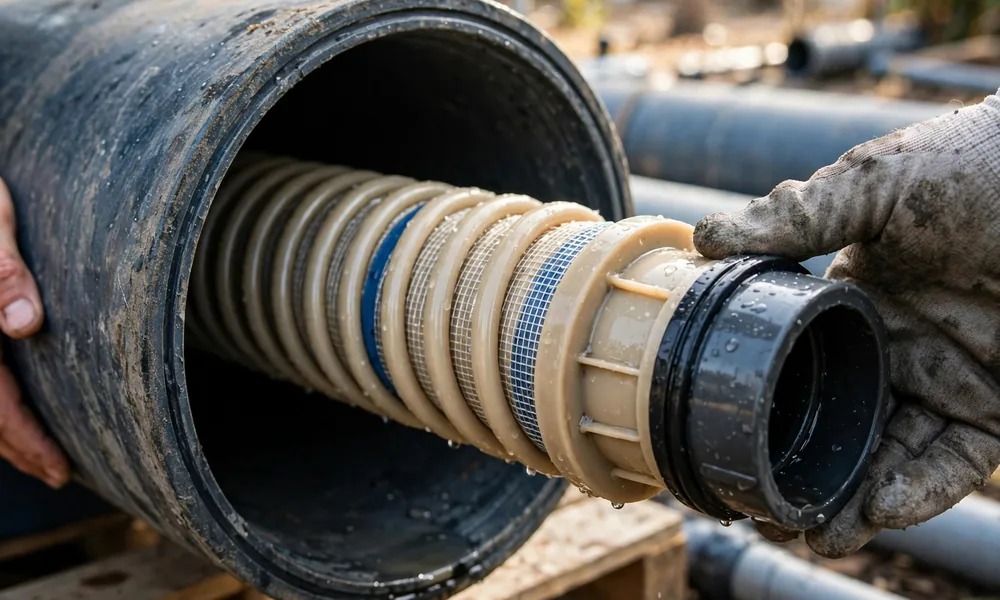
Forcing seawater to 60 bar takes a lot of energy, and the brine leaving the membranes still holds most of that pressure. Modern watermakers recover it with an energy recovery device, a spinning pressure exchanger that takes the high-pressure brine and uses it to pressurise the incoming seawater, so the electric pump only has to top up the pressure rather than create it from scratch. That one device can cut the machine’s electricity use by more than half, which matters on a yacht where every kilowatt comes from a generator burning fuel.
Step 6: The system is pressure-tested, flushed, and tuned
Before the watermaker is allowed near a yacht’s tanks, the whole assembly is tested as a system. It is filled with fresh water, brought slowly up to full pressure, and held there while every joint is checked for leaks. Then it is run on real seawater, and the crew tune the pressure, flow, and recovery rate until the product water sits comfortably under 200 parts per million of dissolved solids. The membranes are flushed with fresh water so salt cannot crystallise on them overnight, and the finished unit is crated for the yard. Once installed, it shares its space with the rest of the yacht’s machinery, as described in how a superyacht engine room is made.
Superyacht Watermaker Specifications
| Specification | Typical figure |
|---|---|
| Output | Roughly 5,000 to 20,000 litres per day |
| Operating pressure | About 55 to 70 bar |
| Recovery rate | Around 30 to 40 percent of intake |
| Product water quality | Under 200 ppm total dissolved solids |
| Membrane type | Spiral-wound reverse osmosis |
| Power draw | Roughly 5 to 15 kW depending on size |
How Much Does a Superyacht Watermaker Cost?
There is no shop price for a yacht watermaker, because each one is sized and fitted to its yacht. Industry estimates put a large yacht reverse-osmosis system at roughly $50,000 to $200,000 installed (estimate), including membranes, pumps, energy recovery, and controls, and the figure varies with output and complexity. Against that, a yacht that could not make its own water would have to cut cruises short or pay for water deliveries in port, so the machine pays for itself in freedom.
A Rare Fact About the Superyacht Watermaker
Here is something few people realise: the brine a watermaker discharges is about twice as salty as the sea it came from. The membranes take roughly a third of the water as fresh product, and all the salt from the full intake stays in the remaining two-thirds, so the waste stream leaves the yacht far saltier than the water around it. In a crowded anchorage, crews often run the watermaker while the yacht is under way, so the concentrated brine disperses in the wake instead of pooling around the hull.
So the next time you turn on a tap on a yacht miles from land, remember what is happening below deck: seawater strained and filtered, squeezed to sixty times the pressure of a car tyre, pushed through membranes that let only water through, and tested and polished and given its minerals back.